The short answer first
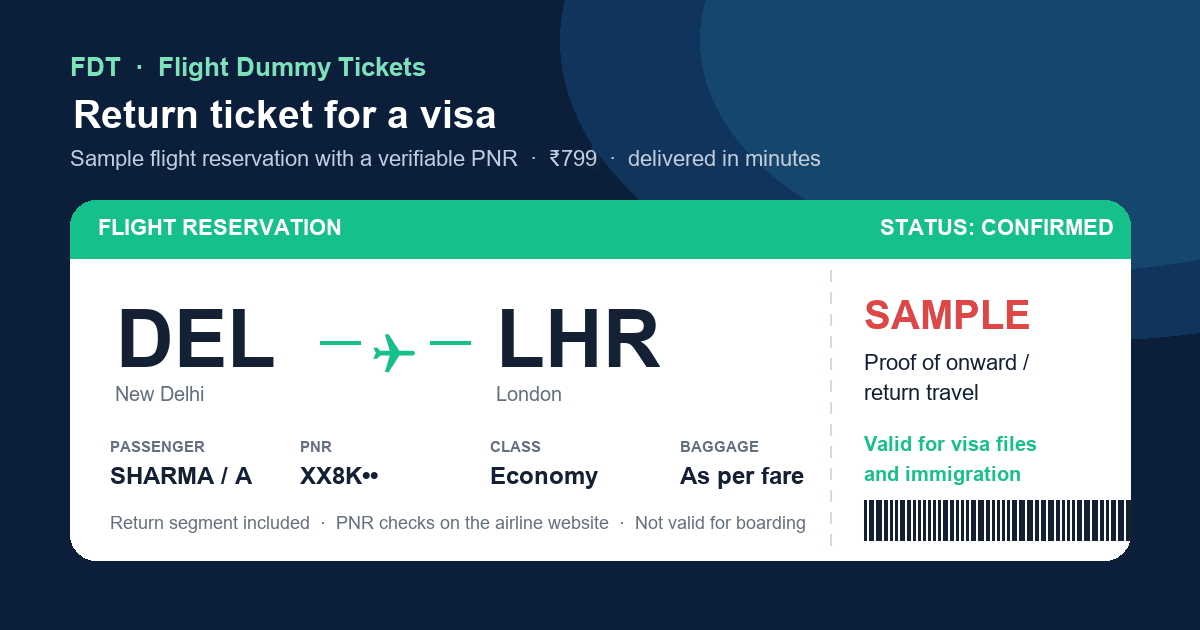
A return ticket for visa means a genuine flight reservation showing your entry into the destination country and your exit from it, usually back to your home country, within the period your visa allows. Embassies do not require a paid, confirmed ticket. They ask for a flight reservation. A return ticket for visa is that reservation, showing both the outward flight and the return flight, with your name, the dates, the route, and a PNR that can be checked. It demonstrates to the visa officer that you have a travel plan, that you intend to go, and that you intend to come back within a defined timeframe.
The phrase causes more unnecessary anxiety and unnecessary expense than almost any other item on a visa checklist, because most applicants read "return ticket" and immediately think of a fully paid, non-refundable airline booking. They assume they need to spend hundreds of dollars on an actual airfare before they even know whether their visa will be approved. That assumption is wrong, and embassies themselves say so explicitly. A dummy ticket is the document that satisfies this requirement without that expense. A dummy ticket is a temporary flight reservation, not a paid ticket, not for boarding, and it does not guarantee a visa. It is a reservation held for a short time, with a verifiable PNR, showing the outward and return flights you plan to take. This guide explains what a return ticket for visa must contain, how it differs from an onward ticket, how to time it, and how to get one without paying the full fare. Always check your own embassy or VFS checklist before you submit. For UK topics, remember: UK guidance generally says do not routinely submit flight bookings unless transiting, so a return booking should not be submitted for a standard UK visitor visa unless it is requested.
Flight Dummy Tickets, or FDT, provides return reservations at ₹799 / $10 flat per passenger, the same for One-Way, Return and Multi-City. Delivery is about 10 minutes, as a PDF by email and WhatsApp, with a verified PNR. Validity is up to 2 weeks, so always check your own reservation expiry. Payment is through Razorpay, UPI, cards and net banking, with 5% off every booking and 10% off for 3 or more passengers. Support is at support@flightdummytickets.com and on WhatsApp at +1 786 957 8117. FDT has delivered 20,000+ tickets. Those are the only commercial facts on this page.
Key facts at a glance
| Question | Short answer |
|---|---|
| What is a return ticket for visa? | A flight reservation showing entry into and exit from the destination country. |
| Do I need a paid ticket? | No. Embassies ask for a reservation, not a paid ticket. |
| What is a dummy ticket? | A temporary flight reservation for visa purposes, not a paid ticket and not for boarding. |
| Can I board with it? | No. Buy a real ticket after the visa is approved. |
| What must it show? | Outward and return flights, full passport name, dates, route, and PNR. |
| FDT price | ₹799 / $10 flat per passenger, One-Way, Return and Multi-City the same. |
| Delivery | About 10 minutes, PDF by email and WhatsApp, verified PNR. |
| Validity | Up to 2 weeks. Check your own reservation expiry. |
| Payment | Razorpay (UPI, cards, net banking). 5% off every booking, 10% off for 3+ passengers. |
| Support | support@flightdummytickets.com, WhatsApp +1 786 957 8117. |
| Does it guarantee a visa? | No. No ticket, real or dummy, guarantees a visa. |
Why embassies ask for a return, not just an arrival
An embassy is not only asking whether you can get to the destination. It is asking whether you plan to leave, when you plan to leave, and whether that plan is consistent with the rest of your file. A one-way flight into a country, with no plan to leave, raises a question that a return flight answers. The return flight shows that you have thought about the end of the trip, not only the beginning, and that you have a date by which you intend to be back in India, or onward to another destination.
That question matters because a visa is a permission to stay for a limited time, not a permission to stay indefinitely. For Schengen, that limit is up to 90 days in any 180-day period. For a UK visitor visa, it is usually up to six months. For a US B1/B2 visa, the stay is determined at the border, within the visa validity. In every case, the officer wants to see that the applicant understands the limit, and that the travel plan fits within it. A return flight dated within the permitted stay shows that understanding. A return flight dated after the permitted stay, or no return flight at all, shows the opposite, or at least creates a question that the applicant will need to answer.
The return flight also shows that the applicant has considered the cost and the logistics of the whole trip, not only the arrival. A traveller who has planned a return has usually planned the hotels for every night, the insurance for the whole period, and the funds for the whole stay. A traveller who has only planned an arrival may not have planned the rest. That is why officers read the return flight together with the hotel bookings and the insurance, not separately. The return date should match the hotel checkout date. The insurance should cover from the departure date to the return date. The bank statements should show sufficient funds for the duration between those two dates. When all of those documents agree, the file reads as a complete plan. When one of them disagrees, the officer has to stop and ask why.
There is a practical point too. A return flight is often cheaper than two one-way flights, and it is easier to manage than a one-way flight plus a separate onward booking made later. For a visa file, a return reservation on a single PNR, showing both sectors, is the clearest way to show the whole journey at a glance. The officer can see the entry and the exit on one page, with one booking reference, and can check that reference in seconds. That clarity is valuable in a process where the officer sees hundreds of files a day and needs to understand each one quickly.
What your return ticket must contain, field by field
A return ticket for visa needs to show specific information, and understanding each element helps you order the correct document and ensures your application is consistent and complete. Go through your PDF field by field, as an officer would, and check each one.
Your outbound flight is your journey from your home country to the destination you are applying to visit. It shows your entry into the country, the airline, the flight number, your departure airport, your arrival airport, and your entry date. For a Schengen application, your entry airport must be in the specific Schengen country you are applying through. If you are applying through the French embassy, your entry must be into Paris. If you are applying through Italy, your entry must be into Rome or Milan. Check the airport, not only the city, because Paris has more than one airport, and Rome has more than one airport, and the airport you land at should make sense with your hotel location.
Your return or onward flight is your journey back from the destination to your home country, or onward to your next destination. It shows your exit from the country, the airline, the flight number, your departure from the destination country, and your return or onward date. This date must fall within the permitted stay for your visa category. For Schengen visas, your exit must be within 90 days of your entry. For other destinations, the exit must be within the stay allowed by that visa. Check the return date against the hotel checkout date. If your hotel booking ends on 22 December, your return flight should be on 22 December, or the day after, with an explanation if it is later. A return flight that leaves two days before the hotel ends, or two days after it ends without explanation, will raise a question.
Your full passenger name, exactly as it appears on your passport, is the first thing an officer checks. Every middle name, every character, exact spelling. Embassy caseworkers compare the name on the flight reservation against the passport during document review. Any discrepancy is flagged as an inconsistency. Check the name letter by letter, for every passenger, including children. A child's name should be checked with the same care as an adult's.
Date consistency across your full application is the next check. Your flight entry date must match your hotel check-in date. Your flight exit date must match your hotel check-out date. Your travel insurance must cover from your entry date to your exit date. Your bank statements must show sufficient funds for the duration of your stay between your entry and exit dates. A return reservation gives you both your outbound and return flights with the dates you specify, making it straightforward to align every other document in your application around those dates. That alignment is the real work of preparing a visa file. The flight document is the anchor. The hotel, the insurance, and the cover letter are built around it.
The booking reference, or PNR, is the code that lets the officer, and you, check the reservation. It should be a six-character code, legible, and checkable on the operating airline's website with your surname. If the PDF shows two references, note which one is the airline PNR and test that one. For how to check it, read how to verify dummy ticket PNR.
What a return ticket for visa does not need to show is a ticket number, a seat number, or a paid fare. Those are features of a paid ticket, not of a temporary reservation. Their absence is normal. A dummy ticket is a temporary reservation, not a paid ticket, and it should not be described as one. For what a dummy ticket is, read what is a dummy ticket. For the difference between a dummy ticket and a paid ticket, read dummy ticket vs real ticket.
Return ticket vs onward ticket: what is the difference for visa
Many applicants ask whether a return ticket and an onward ticket are the same thing for visa purposes. The answer depends on the specific visa authority, but in most cases either is acceptable, provided it shows a clear exit from the destination country within the permitted stay.
A return ticket shows your departure from your home country to the destination and your return from the destination back to your home country. The exit flight goes back to your origin. This is the classic round-trip booking. It is the most common shape for a tourist trip, because it shows both entry and exit, and it matches the hotel bookings night by night. If you are flying Delhi to Paris and back from Paris, a return ticket is the right shape.
An onward ticket shows your departure to the destination and your exit from the destination going anywhere, not necessarily back to your home country. For example, a traveller applying for a Schengen visa who plans to continue from Europe to Morocco or Turkey after their visit would show entry into the Schengen Area and an exit going to Morocco or Turkey, not back to their home country. This is an onward ticket rather than a return ticket, and it satisfies the requirement equally well at most Schengen embassies. The key is that there is an exit, on a specific date, to a specific place, with a flight that exists. An onward ticket that shows an exit to a country you have no visa for, and no plan to obtain one for, will raise a question. An onward ticket that shows an exit to a country you can enter, with a clear plan, will not.
For visa applicants on flexible itineraries who are not yet certain whether they will return home directly or continue to another destination, a flight reservation showing an onward flight to any next destination satisfies the requirement without committing to a specific return routing. That is one of the practical advantages of using a flight reservation rather than a fully paid ticket: you preserve the flexibility to decide your actual routing after your visa is approved. With FDT, a multi-city reservation, Delhi to Paris, Rome to Delhi, or Delhi to Paris, Paris to Morocco, costs the same flat price, ₹799 / $10 per passenger, so the shape does not affect the cost.
Read onward travel proof explained and proof of accommodation and onward travel for how onward travel is normally shown, and why a one-way itinerary into a country, with no plan to leave, raises a question that a return or onward itinerary does not. The practical rule is simple: show an exit. Whether that exit is back to India or onward to another country, it must be specific, dated, and consistent with the rest of the file.
One-way vs return: when a one-way reservation is not enough
A one-way reservation shows only the outward flight, with no return. It is appropriate in a small number of cases, for example when you are travelling to a country where you will then travel onward by another means, and you have a separate onward booking to show, or when your return is genuinely undecided and your checklist does not require a return. For most tourist visas, a one-way reservation is not enough, because the checklist asks for a return or onward journey, not only an arrival. An officer who sees a one-way itinerary into Europe, with no plan to leave, will ask how you intend to return. If you do not have an answer, the file is weaker.
Do not choose a one-way reservation because it is simpler to book, or because it is cheaper with another seller. With FDT, the price is the same for One-Way, Return and Multi-City, so there is no saving in choosing a one-way reservation when you need a return. Choose the shape that matches the checklist and the plan. If the checklist asks for a return, book a return. If the checklist asks for an onward journey, book an onward journey. If you are unsure what the checklist asks for, read it again, and check the official guidance on vfsglobal.com or the embassy's website, before you book.
There is a specific case where a one-way reservation is used correctly, which is when the applicant is travelling to a destination and then returning by a different route that is not yet booked, but has a clear plan. For example, an applicant flying Delhi to Dubai, then Dubai to London by a separate booking, may show the Delhi to Dubai flight as the outward sector and the Dubai to London flight as the onward sector, on the same reservation or on two reservations that agree with each other. That is not a one-way reservation. It is a multi-city reservation, with an exit from the first destination and an entry into the second. The key is that there is always an exit, even if the exit is not back to the home country.
If you have already booked a one-way reservation and you realise you need a return, do not try to add a return by editing the PDF. Get a fresh reservation for the return journey, or a fresh return reservation for the whole trip, with the correct dates, and check the PNR yourself before you submit it. A fresh reservation takes about ten minutes with FDT, and it is better than submitting a one-way reservation that does not meet the checklist.
Book your dummy ticket, ₹799 flat
One-Way, Return or Multi-City, with a verified PNR. Delivered in about 10 minutes by email and WhatsApp.
Book Dummy Ticket, ₹799 WhatsApp UsHow to get a return ticket for visa without paying the full fare
Getting a return ticket for visa without paying the full fare means getting a temporary flight reservation, with a verified PNR, for a small flat fee, rather than buying a paid ticket. The process is the same as booking any dummy ticket, with the return sector included from the start.
Choose your route, with the outward and return cities. Enter your travel dates, taken from the hotel bookings. Enter each passenger name exactly as in the passport. Pay via Razorpay using UPI, a card, or net banking. The price with FDT is ₹799 / $10 flat per passenger, the same for One-Way, Return and Multi-City, with 5% off every booking and 10% off for 3 or more passengers. Delivery is about 10 minutes, as a PDF by email and WhatsApp, with a verified PNR. Validity is up to 2 weeks, so check your own reservation expiry and time the booking close to your appointment. Support is at support@flightdummytickets.com and on WhatsApp at +1 786 957 8117.
When the PDF arrives, check the name, the dates, the airports, the PNR on the airline's site, and the expiry, before you upload or print it. Check the outward flight and the return flight separately, because a return reservation has two sectors, and either one can be wrong. Check that the return leaves from the city where your trip ends, not from a different city without explanation. If your trip ends in Rome, your return should leave from Rome. If it leaves from Paris, and your hotel stay ends in Rome, there is a mismatch that needs to be explained or corrected.
For the booking steps, read how to book dummy ticket online. For the price, read dummy ticket price in India. For how long the reservation lasts, read dummy ticket validity how long. For what to check in the PDF, read dummy ticket PDF check before upload.
Timing a return reservation so it is live at the appointment
A return reservation is a temporary hold, and a temporary hold has a lifespan. With FDT, validity is up to 2 weeks, and you must check your own reservation expiry. The travel dates can be months in the future. The hold should be fresh. Book the reservation a few days before your VFS appointment, not weeks before, so it is live when the officer sees it. A reservation made a month before the appointment will have lapsed long before the file is opened, however correct the travel dates are.
Plan backwards from the appointment. Confirm the appointment date first. Confirm the travel dates from the hotel and insurance. Book the reservation three or four days before the appointment. Check the PNR the day you receive it, and again the day before the appointment. If the appointment is postponed, check whether the reservation is still live, and get a fresh one if it is not. A fresh reservation for the same travel dates is a normal request, and it takes about ten minutes. Do not submit an expired reservation and hope nobody notices the expiry. The officer will see the file as it is on the day of submission, not as it was when you first received the PDF.
If the embassy takes a long time to decide, do not worry that the reservation will have lapsed by the time of the decision. The officer reviews the file as it was submitted, and the reservation was live when it was submitted. You do not need a reservation that stays live for the whole processing time. You need one that was live at submission and that accurately described the plan. If the embassy contacts you later and asks for a fresh itinerary because the dates have changed, provide a fresh one then.
For a family, book all passengers together, at the same time, for the same outward and return flights, so the PNR check shows the whole group travelling together and returning together. For a student, book the return to match the visa duration or an onward plan explained in the cover letter, not a return that contradicts the study plan. For a worker, book the return to match the contract duration, or explain in the cover letter why the return is on a different date. In every case, the return date should be a date you can explain, not a date you chose at random because the booking form asked for one.
Schengen, the United States, the United Kingdom and other destinations
For Schengen, a return ticket for visa is the standard document. Most Schengen checklists ask for a flight reservation showing entry and exit, and a return reservation meets that requirement directly. The hub guide, dummy ticket for Schengen visa, explains the requirement, and the country guides for dummy ticket for France visa, dummy ticket for Germany visa, dummy ticket for Italy visa, dummy ticket for Spain visa, dummy ticket for Netherlands visa and dummy ticket for Switzerland visa show how it is worded for the most visited countries. If you are visiting more than one Schengen country, your return should leave from the last country you visit, not from the first, and your hotel bookings should cover every night in each city, in order.
For the United States, a B1/B2 visa is decided largely at the interview, and applicants are generally advised not to buy a full ticket before approval. A return reservation can be useful to show a plan, especially if you have a clear itinerary and a return date that matches your hotel and insurance. If you include one, make it genuine, know the flight numbers and times, and be able to explain why you chose those dates. Read dummy ticket for USA B1/B2 visa before you decide what to include.
For the United Kingdom, UK guidance generally says do not routinely submit flight bookings unless transiting. That means for a standard UK visitor visa, you should not submit a return ticket at all, whether it is a genuine reservation or a paid ticket. Check the current guidance on gov.uk and your own checklist, and read dummy ticket for UK visa. If you are transiting through the UK, and a booking is requested, then a genuine return or onward reservation, with a verifiable PNR, is the right document.
For Canada, Australia, Dubai, Thailand and other destinations, a return ticket for visa is commonly requested or helpful, and the same checks apply: PNR, dates, hotels, insurance, and cover letter. The guides for dummy ticket for Canada visa, dummy ticket for Australia visa, dummy ticket for Dubai visa and dummy ticket for Thailand visa set out what each destination expects. In every case, check your own embassy or VFS checklist on vfsglobal.com where VFS handles the application.
Families, students and workers: return proof that matches the purpose
For a family, the return ticket should show all passengers returning together, on the same flights, under one PNR. A family file where the parents return on one date and the children return on another, without explanation, will raise a question. Book the family together, check every name, and check the PNR once for the whole group. Read dummy ticket for family group booking for how a group booking is normally structured, and dummy ticket for tourist visa family visit for how a family visit file is put together. With FDT, the price is ₹799 / $10 flat per passenger, with 10% off for 3 or more passengers, so a family return booking is cheaper per person than a single booking.
For a student, the return ticket should match the study plan. If the course lasts a year, the return may be a year later, or it may be an onward plan explained in the cover letter, rather than a return within a few weeks. The key is that the return date, or the onward plan, is consistent with the admission letter and the visa duration. A student who shows a return two weeks after arrival, for a course that lasts a year, will be asked why the return is so early. A student who shows a return that matches the course end, or who explains in the cover letter that they will return after the course, will not be asked that question. Read dummy ticket for student visa for the student-specific points, and choose the return date from the admission letter, not from a guess.
For a worker, the return ticket should match the contract. If the contract lasts six months, the return should be after six months, or the cover letter should explain why the return is earlier, for example because the worker will travel home for a break and then return. A worker who shows a return two weeks after arrival, for a job that lasts six months, will be asked why the return is so early. Read dummy ticket for work visa for how a work file is structured.
For a tourist, the return ticket should match the hotel stay, night by night. If the hotel booking is for 10 to 22 December, the return should be on 22 December. That is the simplest rule, and it is the one that matters most for a tourist file, because the tourist file is judged on whether the plan is coherent and affordable. A return that matches the hotel, the insurance, and the cover letter is a plan that reads as real. A return that does not match any of them is a plan that reads as invented.
After the visa is approved: buying the real return ticket
A return reservation for visa is a planning document, not a travel document. Its job ends when the visa is approved. After that, you need to buy a real, paid return ticket, and the way you do that matters, because the real ticket is the one you will actually fly on, and it is the one that will be checked at the airport and at immigration on arrival.
Check the visa first. Look at the validity dates, the number of entries, and the duration of stay. Your real ticket should be for travel within the visa validity, and your stay should be within the duration allowed. For Schengen, that means up to 90 days in any 180-day period, and your travel dates should be within the visa validity. If the visa is valid from 10 December to 10 January, and you planned to travel from 15 December to 28 December, your plan fits. If the visa is valid from a later date than you planned, you may need to change your travel dates, and your real ticket should reflect the new dates, not the dates on the reservation.
Compare the real ticket options. The route on your reservation was a plan. The real ticket does not have to be on the same flight, the same airline, or even the same route, provided the overall plan, the cities, the dates, and the purpose, is still the same. You may find a cheaper flight on a different airline, or a more convenient time, or a direct flight that was not available when you made the reservation. That is normal, and it is one of the benefits of not having paid the full fare before approval. You can choose the best real ticket at the time you buy it, rather than being locked into a ticket you bought weeks earlier.
When you buy the real ticket, check the fare rules, the baggage allowance, the layover time, and the airport. A non-refundable ticket is cheaper, but it cannot be changed or cancelled without a fee. A flexible ticket is more expensive, but it can be changed if your plans shift. For a first trip, where plans may still change, a flexible ticket may be worth the extra cost. Keep the real ticket separate from the reservation. Do not confuse the two documents, and do not submit the reservation to the airline at check-in. At the airport, you will need the real ticket, or the booking reference for the real ticket, and your passport and visa. At immigration on arrival, show the real return ticket, not the reservation. The real ticket is the proof that you have a flight home. The reservation was the proof that you had a plan.
For the wider mistakes that lead to refusals, read dummy ticket mistakes visa rejection. For the complete guide, read dummy ticket for visa complete guide blog.
Official guidance to check alongside this guide: the European Commission Schengen guidance on ec.europa.eu, VFS Global on vfsglobal.com, and UK visa guidance on gov.uk. Those sources tell you what your embassy actually asks for. A blog can explain what a return ticket for visa is and how to get one, but only the official checklist can tell you what applies to your appointment.
The four-point date check to run before you submit
Before submitting your visa application, run a four-point date check on your document set. It takes thirty seconds, and it catches the most common source of inconsistency in a file, which is a date that is correct on one document and wrong on another. Write the four checks down, and tick them off one by one, with the PDFs open in front of you.
First, your flight entry date matches your hotel check-in date exactly. If your flight arrives on 10 December, your hotel booking should start on 10 December. If it starts on 11 December, there is a night, the night of 10 December, for which you have no accommodation. That night needs to be explained, or the hotel booking needs to be corrected. Do not assume the officer will not notice a single night. Officers notice nights, because accommodation is a separate requirement, and every night must be covered.
Second, your flight exit date matches your hotel check-out date exactly. If your hotel booking ends on 22 December, your return flight should be on 22 December. If it is on 21 December, there is a night, the night of 21 December, for which you have paid for a hotel you will not use, or a flight that leaves before the hotel ends. If it is on 23 December, there is a night, the night of 22 December, for which you have no accommodation. Either way, the mismatch needs to be explained or corrected. A return flight that matches the hotel checkout is the simplest way to avoid this question.
Third, your travel insurance covers from your entry date to your exit date without a gap. If your flight is for 10 to 22 December, your insurance should be for 10 to 22 December, not 11 to 21 December, and not 10 to 20 December. Insurance is a separate requirement, with its own minimum cover, and it must cover the whole trip. A gap of a single day is a gap, and an officer may ask you to provide insurance for the missing days, which costs time. Check the insurance dates when you check the flight dates, not after submission.
Fourth, for Schengen applications, your exit date falls within 90 days of your entry date. That is the 90/180 rule, and it is the most misunderstood rule in Schengen travel. You can stay for up to 90 days in any 180-day period, and your exit must fall within that window. For a two-week trip, that check is trivial. For a longer trip, or for a traveller who has been to Schengen before in the last 180 days, it matters more, because past trips count towards the 90 days. Read schengen 90 180 rule calculator guide for worked examples, and dummy ticket for Schengen visa from India VFS for how the Schengen process works from India.
Run those four checks, and your file will read as a coherent plan. Skip them, and your file may read as a set of documents that were made separately, without reference to each other. That is the difference between a file that moves forward smoothly and a file that generates a follow-up request for more documents. The four checks take thirty seconds. The follow-up request takes a week. Do the checks.
Refundable ticket vs return reservation: which one, and when
Some applicants consider buying a refundable return ticket instead of a temporary reservation, because a refundable ticket is a paid ticket, with a ticket number, that can be used for boarding if the visa is approved. That is a legitimate option, but it is an expensive one, and it is worth understanding when it makes sense and when it does not.
A refundable ticket costs the full fare, which for a Delhi to Paris return can be ₹55,000, ₹70,000, or more, depending on the season. That money is locked up until the visa is decided, and if the visa is refused, the refund can take weeks, and it may be subject to a cancellation fee, or it may be returned only as airline credit. For a family of four, the amount locked up can be more than ₹2,00,000. That is a large amount to lock up for a document that was never meant to be bought in advance. A refundable ticket makes sense only if you are confident about the visa, you have the money to lock up, and you are comfortable with the refund terms if you need to cancel. It does not make sense as a default choice for a first-time applicant, or for a family, or for a student whose course start date may shift.
A return reservation, by contrast, costs a small flat fee, ₹799 / $10 with FDT, because it is a hold, not a paid ticket. It shows the same outward and return flights, the same dates, and the same passenger names, with a verifiable PNR, but it does not lock up the full fare. It is valid for up to 2 weeks, which is long enough to cover the time until the appointment and the initial review, and it can be replaced with a fresh reservation for the same dates if the appointment is postponed. That flexibility is valuable in a process where dates often shift by a few days, and where the applicant cannot control the processing time.
The choice is not between a genuine document and a fake document. Both a refundable ticket and a return reservation are genuine documents, if they are made properly. The choice is between locking up a large amount of money for a paid ticket, and paying a small fee for a temporary hold. For most applicants, the hold is the smarter choice, because it protects the travel budget until the visa is approved, and it lets the applicant buy the real ticket at the best price available at the time they buy it, rather than being locked into a ticket they bought weeks earlier. The refundable ticket is the right choice only in the specific case where the applicant wants a paid ticket in hand, and is willing to pay for that certainty. For everyone else, a return reservation is the correct document, and it is the document embassies ask for when they list a flight reservation or itinerary on the checklist.
The cost of getting the return wrong, counted properly
It is worth counting the cost of a wrong return ticket properly, because the cost is not only the price of a fresh reservation. A return reservation that shows the wrong return city, the wrong return date, or a return that does not match the hotel will need to be corrected, and the correction will take time. If the appointment is tomorrow, that time may not be available, and the applicant may need to reschedule the appointment, which in peak season can take weeks. A rescheduled appointment can mean missing the intended travel dates, which can mean changing the hotel bookings, the insurance, and the cover letter, all of which cost time and, in some cases, money.
A return reservation that is a generated PDF, with no PNR, can lead to a request for a genuine itinerary, a delay, or a refusal. The cost of that delay is not just the price of a genuine reservation. It is the visa fee, the VFS fee, and the insurance premium that may need to be paid again, and the time lost in the process. The saving from using a free generator is, at most, the price of a genuine reservation, ₹799 with FDT. The cost of a delay or a refusal is many times that, in money and in missed travel. The arithmetic is not close.
A return ticket that is a paid, non-refundable ticket, bought before approval, and then refused, can cost the full fare, or a large cancellation fee. That is the most expensive mistake of all, and it is the mistake the reservation system was designed to prevent. Embassies ask for a reservation, not a paid ticket, precisely because they do not want applicants to risk a large fare before approval. Using a reservation instead of a paid ticket is not a shortcut. It is the process working as intended.
The practical advice is simple. Book a genuine return reservation, with a verifiable PNR, for the correct outward and return dates, timed close to your appointment, and check it yourself before you submit it. That reservation costs ₹799 / $10 flat per passenger, with 5% off every booking and 10% off for 3 or more passengers, and it takes about ten minutes to receive. That is a small price for a document that shows your whole travel plan, entry and exit, in a way an officer can check in seconds. It is the cheapest insurance in the whole visa process, and it is worth paying.
What to do if your return dates change after booking
Travel dates change. A hotel becomes unavailable, a flight time shifts, a family event moves, or the embassy takes longer than expected to decide. When the return date changes, the return reservation needs to change with it, and the rest of the file needs to change too, because the return date is the anchor for the hotel, the insurance, and the cover letter.
If the return date changes before your appointment, get a fresh return reservation for the new dates, and update the hotel bookings, the insurance, and the cover letter to match. Do not submit a reservation for the old dates and hope the officer will not notice that the hotel ends on a different date. The officer will notice, because the hotel and the flight are read together. A fresh reservation takes about ten minutes with FDT, and it is better than submitting a file with mismatched dates. Check the fresh reservation's PNR yourself, and check the new dates against the hotel and insurance, before you submit it.
If the return date changes after you have submitted the file, but before the visa is decided, contact the embassy or VFS through the proper channel, explain that your travel dates have changed, and ask how to provide an updated itinerary. Keep the correspondence, and provide the fresh reservation when asked, not before, unless the channel asks for it. Do not send a second, different PDF without being asked, because that can create confusion about which document is current. Wait for instructions, and then provide the updated document promptly.
If the return date changes after the visa is approved, you do not need a fresh reservation. You need a real ticket for the new dates, bought within the visa validity. Check the visa validity dates first, because the new travel dates must fall within them. If the new dates are outside the visa validity, you may need to apply for a new visa, or to travel within the validity and change the return later, subject to the visa conditions. Do not buy a real ticket for dates outside the visa validity, because that ticket cannot be used.
The key principle is that the return date is not a detail that can be changed in isolation. It is connected to the hotel, the insurance, the cover letter, and the visa validity. Change one, and you must check the others. That checking takes ten minutes, and it prevents the mismatch that is the most common source of a follow-up request. A file where all the dates agree is a file that reads as a real plan. A file where the return date says one thing and the hotel says another is a file that reads as a plan that was not checked.
Ready to book?
Get your dummy ticket for ₹799 per passenger, with a verified PNR, in about 10 minutes.
Book Dummy Ticket, ₹799Dummy ticket options compared
Use this when you are deciding between a free generator PDF, a fully paid ticket, and a verifiable reservation.
| Option | Airline-checkable PNR | Typical cost | Best for |
|---|---|---|---|
| Free PDF generator | No | ₹0 | Never for embassy/VFS upload |
| Fully paid ticket | Yes | Full airfare | When dates are locked and refundable |
| FDT verifiable dummy ticket | Yes | ₹799 / passenger | Visa file before dates are final |
Official sources to check before you apply
Always match your documents to the embassy or VFS checklist for your nationality. These are the primary references we used while writing this page:
Frequently asked questions
1. What is a return ticket for visa? A flight reservation showing entry into and exit from the destination country.
2. Do I need a paid return ticket? No. Embassies ask for a reservation, not a paid ticket.
3. Can I board with a dummy return ticket? No. It is not a paid ticket and cannot be used for boarding.
4. How much is a return reservation with FDT? ₹799 / $10 flat per passenger, One-Way, Return and Multi-City the same.
5. How long is it valid? Up to 2 weeks. Check your own reservation expiry.
6. How fast is FDT delivery? About 10 minutes, PDF by email and WhatsApp, with a verified PNR.
7. What is the difference between return and onward? Return goes back to your home country; onward goes to any next destination.
8. Does a return ticket guarantee a visa? No. No ticket guarantees a visa.
9. Should I submit a return booking for a UK visa? UK guidance generally says do not routinely submit flight bookings unless transiting.
10. How do I verify it? Enter the PNR and surname on the airline's Manage Booking page.
11. What if my return date changes? Get a fresh reservation for the new dates and update hotel, insurance and cover letter.
12. When do I buy a real return ticket? After the visa is approved, for travel within the visa validity dates.