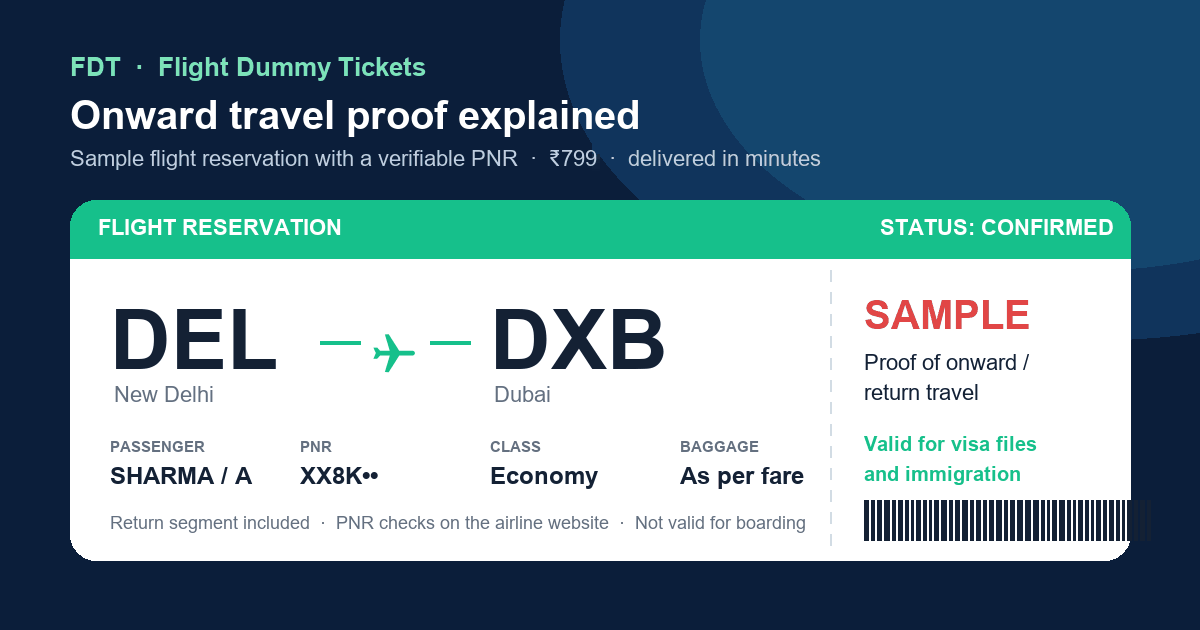
Onward travel proof illustrates how you intend to leave the country you are entering. Airlines check it because they can be responsible for transporting passengers who are refused entry back at their own expense. Many visa-free and visa-on-arrival arrangements also require a return or onward ticket. Without the required proof, the airline may refuse boarding.
| Who checks first | Airline check-in staff, before immigration |
|---|---|
| Their rulebook | IATA Timatic |
| Usual triggers | Visa-free entry, visa on arrival, one-way tickets |
| What counts | A verifiable booking out of the country within your permitted stay |
| Without it | Denied boarding or a ticket bought at the counter |
Why the airline cares where you go next
Under the international aviation rules in Annex 9 to the Chicago Convention, a passenger found inadmissible at the border is handed back to the airline that brought them, and the airline is responsible for removing them. National laws add fines on top. The United Kingdom, for example, charges carriers £2,000 for each inadequately documented arrival under section 40 of the Immigration and Asylum Act 1999, and Schengen states and many others run comparable carrier-sanction schemes.
So an airline that boards a passenger who does not meet the entry conditions pays for the mistake. Check-in staff are therefore the first line of immigration control, and they are stricter than many travellers expect.
Timatic: the screen behind the check-in desk
Airlines do not memorise the entry rules of every country. They use Timatic, a database run by IATA since 1963 that holds passport, visa and health requirements by nationality, destination and transit point. IATA says it is updated continuously from government and airline sources and is used to check hundreds of millions of passengers a year.
When the agent scans your passport, the system returns the conditions for your nationality and destination. If the entry reads that visitors must hold return or onward tickets, the agent will ask to see yours. The public version of the same data is available on the IATA Travel Centre website, so you can read the rule that will be applied to you before you leave home.
Kinds of entry that trigger the question
- Visa-free entry. Exemptions nearly always include conditions, and a ticket out is the standard one. At the time of writing, Indian tourists enter Thailand and Malaysia without a visa, and both expect proof of departure within the permitted stay. Confirm the current terms on the official immigration site before you fly, since these schemes are revised frequently.
- Visa on arrival and many e-visas. Indonesia's visa on arrival, used by most Indians visiting Bali, lists a return or onward ticket among its requirements.
- One-way tickets. A one-way booking prompts the question by itself, including for students, new job joiners and people visiting family with open dates. If you hold a long-stay or residence visa, that typically answers it.
- Transit without a visa. Airside transit schemes generally require a confirmed onward flight within a set number of hours.
Travellers who obtained a visa in advance are asked less frequently, because the consulate already looked at their itinerary. That process is described in flight itinerary for a visa application.
What is accepted as proof
The agent wants a booking, in your name, leaving the destination country within the stay you are allowed.
- A flight to any other country. It does not have to return to India. Bangkok to Kuala Lumpur satisfies Thailand's rule as well as Bangkok to Delhi.
- A paid ticket or a verifiable reservation. What matters at the desk is that the booking reference exists in an airline's system. A reservation held in your name meets that test; the difference between the two is covered in dummy ticket vs real ticket.
- Bus, train or ferry tickets. Some countries accept overland exits, but check-in staff can be reluctant because they cannot verify them. A flight booking causes the least argument.
A date beyond your permitted stay does not count, and neither does a screenshot of a fare search.
At the counter without it
The usual sequence is this. The agent requests your return or onward booking. If you have none, they call a supervisor, and you are given a choice: produce a booking or do not travel. Most people end up purchasing a ticket on their phone beside the counter, at same-day prices and with the check-in deadline approaching. Some airlines will allow you to sign an indemnity form instead, but that is at their discretion and you cannot count on it.
If you do get on board without proof, the question can come again from the immigration officer on arrival, who has the power to refuse entry. Refused passengers are sent back on the next available flight.
Preparing before you leave for the airport
- Retrieve your destination on the IATA Travel Centre and on the country's official immigration page.
- If a return or onward ticket is listed, arrange the booking one or two days before departure so it is live at check-in and on arrival.
- Keep the PDF offline on your phone and carry a printout. Airport Wi-Fi is not a plan.
- Know your exit date and be able to state it. Officers ask.
- Carry the supporting items that frequently accompany the rule: accommodation details and evidence of funds. How these fit together is covered in proof of accommodation and onward travel.
If your plans are open and you do not want to purchase a flight you may not use, a held airline reservation is the usual answer. Flight Dummy Tickets issues one with a PNR that can be checked on the airline's Manage Booking page for ₹799 per passenger. Be straightforward if asked: it is a reservation showing when you intend to leave.
Frequently asked questions
Does the onward ticket have to be on the same airline I am flying in with?
No. Any airline is fine. The booking only has to show you leaving the destination country within your permitted stay.
I have a return ticket but on a separate booking. Will that be a problem?
No, but the check-in system will not show it automatically. Keep the second itinerary useful and offer it when asked.
Do airlines ask Indians for onward proof on flights to Dubai?
Indian citizens generally need a UAE visa arranged in advance or must qualify for visa on arrival, and the airline checks whichever applies along with your return booking. Retrieve the current Timatic entry for your exact case before departure.
Is onward travel proof needed when returning to India?
Not for Indian citizens, who have the right to enter India. The rule concerns foreign nationals entering a country as visitors.
Can immigration ask for onward proof even if the airline did not?
Yes. The airline check protects the airline. The border officer makes an independent decision and can request the same evidence.
Official sources
- IATA: Timatic
- IATA Travel Centre (passport, visa and health requirements)
- GOV.UK: Passenger documents, help for carriers to reduce charges
Visa rules change. This guide was last reviewed on 3 October 2026; always confirm against the official checklist before you apply.
Need the reservation today?
The price is ₹799 / $10 per passenger for one-way, return and multi-city reservations. We include a PNR that you can validate on the airline's website and deliver the reservation by email and WhatsApp in about 10 minutes.
Book a dummy ticket Ask FDT AI