The short answer first
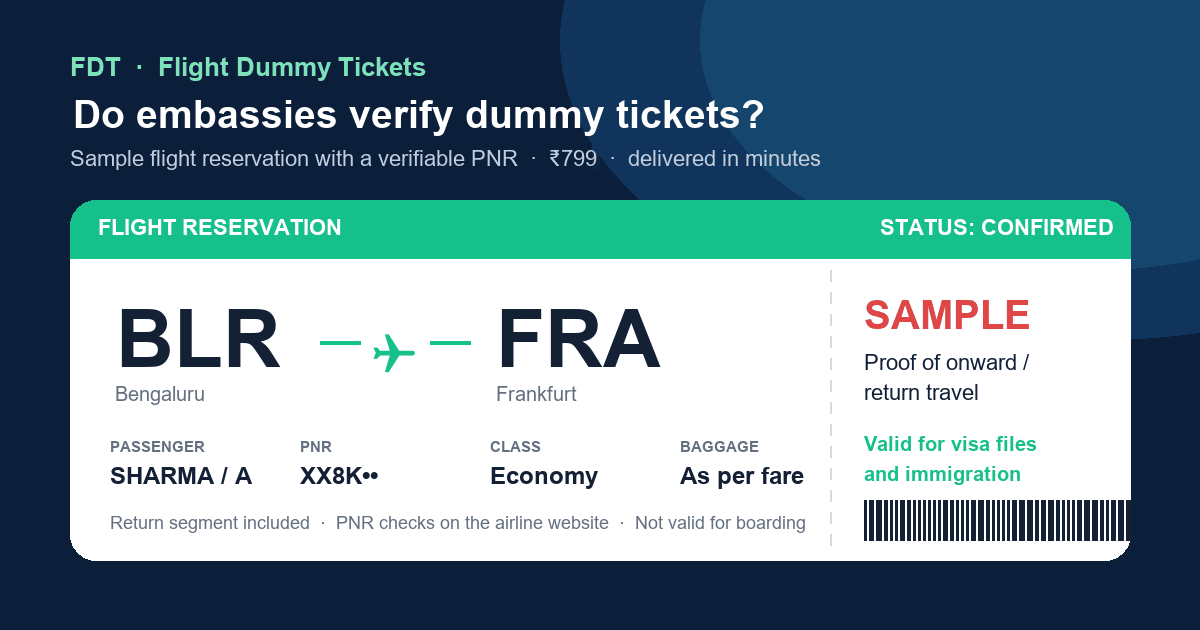
Yes, embassies and consulates can verify dummy tickets, and they do check them, though not always in the way applicants imagine. A dummy ticket is a temporary flight reservation with a real PNR, and a PNR is a live booking record in an airline's reservation system. When an officer types that six-character code into the airline's website, along with your surname, the booking appears, or it does not. If it appears, with your name, your flights and your dates, the reservation is verified. If it does not appear, or if it shows a different name or different flights, the reservation has failed the check, and the file has a serious problem.
That is the simple answer, and the rest of this guide is the detail that makes it useful. Verification is not a single act. It happens at different stages, in different ways, for different countries, and with different consequences. Some checks are done by the counter staff at VFS when you submit. Some are done by the consular officer who decides your visa, days later. Some are done by software that flags inconsistencies. Some are never done at all, because the officer decides the file on other grounds. But the possibility of a check is always there, and the only safe assumption is that your PNR will be checked, and that it should verify cleanly when it is. A reservation that verifies is a document. A reservation that does not verify is a suspicion, and a suspicion is far more damaging than a missing document, because a missing document can be supplied and a suspicion has to be explained away.
This guide explains what verification means in practice: the three levels of checking, the PNR check step by step as an officer sees it, what officers look at beyond the PNR, how Schengen, UK, USA and Canada differ, when the check happens, what happens when a PNR does not verify, and how to make your own reservation verifiable before you submit. For the general rules, read our dummy ticket for Schengen visa guide and our what is a dummy ticket guide. For the PNR check itself, read our how to verify dummy ticket PNR guide.
With FDT, a reservation costs ₹799 / $10 flat per passenger, the same for One-Way, Return and Multi-City, delivered in about 10 minutes as a PDF by email and WhatsApp with a verified PNR, valid for up to 2 weeks. Payment is through Razorpay, UPI, cards and net banking, with 5% off every booking and 10% off for 3 or more passengers. Support is at support@flightdummytickets.com and on WhatsApp at +1 786 957 8117. FDT has delivered 20,000+ tickets. A dummy ticket is a temporary flight reservation, NOT a paid ticket, NOT for boarding, and it does NOT guarantee a visa. Always check your own embassy or VFS checklist before you submit; if this guide and your checklist disagree, follow the checklist.
Key facts at a glance
| Question | Short answer |
|---|---|
| Do embassies verify dummy tickets? | Yes, they can, and they do check PNRs. Assume yours will be checked. |
| What do they check? | The PNR, your name, your flights, your dates, and whether the booking is live. |
| How do they check? | On the airline's website or reservation system, using the PNR and your surname. |
| What if the PNR does not verify? | The file is questioned, and the visa can be delayed or refused. |
| Does every application get checked? | No, but you cannot know in advance whether yours will be. |
| What makes a reservation verifiable? | A real PNR, booked with the airline, with your name exactly as in your passport. |
| FDT price | ₹799 / $10 flat per passenger, same for One-Way, Return and Multi-City. |
| FDT delivery | About 10 minutes, PDF by email and WhatsApp, verified PNR. |
| FDT validity | Up to 2 weeks. Check your own reservation expiry. |
| FDT payment | Razorpay (UPI, cards, net banking). 5% off every booking, 10% off for 3+ passengers. |
| FDT support | support@flightdummytickets.com, WhatsApp +1 786 957 8117. 20,000+ tickets delivered. |
| Does it guarantee a visa? | No. No ticket guarantees a visa. |
Contents
- What "verify" actually means: three levels of checking
- The PNR check, step by step, as an officer sees it
- Beyond the PNR: the five things officers read in a flight reservation
- Schengen, the UK, the USA and Canada: how verification differs
- When the check happens: at the counter, at the consulate, or never
- What happens when a PNR does not verify
- Real versus forged: how officers spot a reservation that was never booked
- The expiry problem: a PNR that verified last week and does not verify today
- How to make your reservation verifiable before you submit
- Seven myths about embassy verification
- What verification looks like from inside a consulate
- Frequently asked questions
1. What "verify" actually means: three levels of checking
Verification is not one thing. It is three different checks, at three different levels, and understanding the difference is the key to understanding what an embassy can and cannot see. The first level is the document check. An officer looks at the PDF you submitted and reads it: your name, the airline, the flight numbers, the dates, the times, the airport codes, and the PNR. This is a reading check, not a system check. It catches spelling mistakes, impossible routes, dates that do not match the hotels, and flight numbers that do not exist. It does not catch a PNR that was never booked, because the PDF can look perfect and still be made up. A document check is fast, it is done on every file, and it is the level at which most reservations fail, because most failures are visible on the page.
The second level is the PNR check. An officer, or a member of the consulate's staff, takes the PNR from the PDF, goes to the airline's website or reservation system, enters the PNR and your surname, and looks at the booking that comes back. If the booking appears, with your name, your flights and your dates, the reservation is verified at this level. If the booking does not appear, or if it shows a different name, different flights or different dates, the reservation has failed. This is the level that matters most, because it is the level that separates a real reservation from a made-up one. It is not done on every file, because it takes time, but it is done often enough, and on enough files, that no applicant should assume it will not be done on theirs.
The third level is the consistency check, and it is the level that catches the most sophisticated problems. An officer compares the flight reservation with the rest of the file: the hotels, the insurance, the leave letter, the invitation letter, the bank statements, and the itinerary. A flight that verifies on the airline's website but does not match the hotels is still a problem, because the file as a whole does not agree with itself. A flight to Paris when the hotels are in Rome, a return flight dated before the insurance ends, a one-way flight for a tourist with no explanation: these are consistency failures, and they are caught by reading the file as a whole, not by checking the PNR. An officer who is good at their job reads the file as a whole, and a file that agrees with itself is a file that is trusted.
There is a fourth thing that is sometimes confused with verification, which is the airline's own check. Airlines do not verify visas. They check, at check-in, whether you have a ticket, a passport and a visa for your destination. A dummy ticket is not a ticket for boarding, and it will not get you on a plane. That is not a failure of the dummy ticket; it is the definition of it. A dummy ticket is a temporary reservation for a visa application, and its only job is to be verifiable by the consulate. Do not try to use it to board a flight, and do not confuse the airline's check-in with the consulate's verification. They are different checks, by different people, for different purposes.
2. The PNR check, step by step, as an officer sees it
A PNR is a passenger name record, a six-character code that identifies a booking in an airline's reservation system. It is created when a reservation is made, and it holds the passenger's name, the flights, the dates, the times, the class, and the status of the booking. When an officer checks a PNR, they are looking at that record, and they are comparing it with the PDF you submitted. Here is what that looks like, step by step, from the officer's side of the desk.
First, the officer reads the PNR from your PDF. It is usually printed near the top, labelled as the booking reference, the reservation code, or the PNR. It is six characters, a mix of letters and numbers, and it is the key to the whole check. If the PNR is missing from the PDF, or if it is smudged, or if it is only five characters, the check cannot even start, and the file has a problem before it has begun. A reservation without a readable PNR is not a verifiable reservation.
Second, the officer goes to the airline's website, to the "manage my booking" or "my trips" page, and enters the PNR and your surname. The surname must match the booking, exactly as it was entered when the reservation was made. If your surname is spelled differently in the booking from the way it is spelled in your passport, the check may fail even though the booking is real, because the system will not find a booking under the wrong surname. That is why the name on the reservation must match the passport exactly, including the order of first name and surname, and including any middle name that appears in the passport.
Third, the booking appears, and the officer reads it. They check the passenger's name, the flights, the dates, the times, the departure and arrival airports, and the status. The status matters: a booking that says "confirmed" is live. A booking that says "cancelled" or "expired" is not live, and a reservation that has expired is a reservation that does not verify, even if it was real when it was made. A booking that says "on request" or "waitlisted" is not confirmed, and an officer will read that as a reservation that is not yet real.
Fourth, the officer compares the booking with the PDF. Do the flights match? Do the dates match? Do the times match? Does the name match? If everything matches, the reservation is verified, and the officer moves on to the rest of the file. If anything does not match, the officer has a question, and the question is not "is this a real reservation?" but "why does the document not match the booking?" A mismatch between the PDF and the PNR is visible immediately, and it is the commonest reason a real reservation fails a check, because the PDF was made from a template and the PNR was made from a real booking, and the two were never reconciled.
You can do this check yourself, before you submit, and you should. Go to the airline's website, enter the PNR and your surname, and look at the booking. If it appears, with your name, flights and dates, and a status of confirmed, your reservation verifies. If it does not appear, or if anything is different, do not submit it. Fix it first, or book a fresh reservation. Our how to verify dummy ticket PNR guide walks through the check in detail, and our dummy ticket PDF check before upload guide gives a checklist for the PDF itself.
3. Beyond the PNR: the five things officers read in a flight reservation
A PNR that verifies is necessary, but it is not sufficient. An officer reads five things in a flight reservation, and the PNR is only the first. The second is the name. It must match the passport exactly, including the order of first name and surname, and including any middle name that appears in the passport. Indian passports have a particular quirk, which is that the surname may appear in the given-names field, or the given names may be split in a way that confuses booking systems. Whatever your passport says, that is what the reservation must say. A mismatch is the commonest reason a reservation is questioned, and it is the easiest to avoid, because you can check it against the passport in ten seconds.
The third is the route. It must be a route that actually exists, on a date when it actually flies, with flight numbers that match the airline's schedule. A reservation showing a direct flight on a day when that flight does not operate, or a connection of forty minutes at an airport where the minimum is ninety, is a reservation that fails on reading, before the PNR is even checked. The route must also make sense for the applicant: a flight from the city where you live, to the city where you are going, by a route you would actually fly. A Mumbai applicant flying from Delhi for no reason, a Chennai applicant flying from Bengaluru for no reason, a tourist flying to Paris via three cities when a direct flight exists: these are routes that invite questions, and questions are delays.
The fourth is the dates. The outward flight should be the day your trip starts, and the return flight should be the day your trip ends, and both should match the hotel bookings, the insurance, the leave letter and the itinerary. A flight that does not match the hotels is a file that disagrees with itself, and an officer who has to decide which document to believe is an officer who is not going to believe either of them quickly. The dates should also be plausible for the purpose: a tourist's return after ten days is plausible; a student's return after two weeks for a two-year course is not; a worker's flight dated after the contract starts is not.
The fifth is the shape. A tourist needs a return. A student usually needs a one-way. A worker needs a flight that matches the contract. A multi-city trip needs a multi-city reservation that shows the whole shape. The shape is part of what a consulate reads, and a shape that does not match the purpose is a shape that will be noticed. Our dummy ticket vs real ticket guide explains the difference between a reservation and a paid ticket, and our dummy ticket for visa complete guide explains how the shape fits the purpose.
There is a sixth thing, which is harder to describe but easy to recognise, and that is whether the reservation looks like it was made for you, or whether it looks like it was made from a template. Consulates see thousands of reservations, and they are good at recognising a template: the same flights, the same hotel, the same itinerary, repeated across fifty files in the same week. A reservation that looks like fifty others will be read with more suspicion than a reservation that looks like it was chosen for your trip, your dates and your route. That does not mean you should avoid using a service; it means you should make sure the reservation reflects your actual trip, and not a standard package. If the package is your trip, fine. If it is not, change it.
4. Schengen, the UK, the USA and Canada: how verification differs
Verification is not the same for every country, because the countries do not ask for the same thing. For Schengen visas, the flight reservation is a standard part of the checklist, and it is checked as part of the file. The officer reads the reservation, checks the PNR if they choose to, and compares the dates with the hotels and the insurance. A Schengen reservation that does not verify is a problem, because the reservation is a required document, and a required document that fails is a file that fails. Our dummy ticket for Schengen visa guide covers the Schengen file in full, and our dummy ticket for France visa and dummy ticket for Germany visa guides cover the two commonest Schengen destinations.
For the UK, the position is different. UK guidance generally says do not routinely submit flight bookings unless transiting, which means that a UK applicant should check the checklist before including a flight reservation at all. If you do include one, it should verify, because a document that is submitted and then fails a check is worse than a document that was never submitted. But the UK's emphasis is on funds, ties, and purpose, not on the flight, and a UK officer is less likely to check a PNR than a Schengen officer is. Read our dummy ticket for UK visa guide before you decide whether to include a reservation in a UK file.
For the USA, the flight reservation is usually not the central document. A USA tourist visa is about the interview, and a USA student visa is about the I-20 and the interview. The applicant is asked about travel plans, and a reservation with a verifiable PNR is a calm answer, but the absence of a reservation is not usually a refusal by itself, because the USA does not routinely require a flight booking before the visa is issued. Our dummy ticket for USA B1 B2 visa guide covers USA travel. For Canada, the flight reservation is a supporting document for a visitor visa, and it is checked in the same way as a Schengen reservation: the PNR, the name, the dates, and the consistency with the rest of the file. Our dummy ticket for Canada visa guide covers Canada in full.
The practical consequence is that you should not assume that verification is the same everywhere. Check your own checklist, and if the checklist asks for a flight reservation, assume it will be verified. If the checklist does not ask for one, think carefully before including one, because a document that is not required and then fails a check is a problem you created for yourself. When in doubt, follow the checklist, and if the checklist and this guide disagree, follow the checklist.
5. When the check happens: at the counter, at the consulate, or never
A flight reservation can be checked at three moments, and the moment matters, because a reservation that is live at one moment may not be live at another. The first moment is at the VFS counter, when you submit. The counter staff will check that the reservation is present, that it looks complete, that the name is there, that the dates are there, and that the PNR is printed. They will not usually check the PNR on the airline's website, because that takes time and they have a queue behind you. But they can, and in some centres they do, for a sample of files. A reservation that is missing, or that is obviously wrong, will be caught here, and you will be told to fix it. A reservation that looks right will pass the counter, and that is not a guarantee that it will pass the consulate.
The second moment is at the consulate, days after submission, when the officer who decides your visa reads the file. This is the moment that matters most, because this is the moment when the PNR is most likely to be checked, and when the consistency of the file is most likely to be tested. The officer has time, they have the whole file in front of them, and they have the airline's website open. A reservation that was live at the counter but has expired by the time the consulate reads the file is a reservation that does not verify at the moment it matters. That is why the reservation should be booked close to the appointment, not weeks before it, and why FDT's validity of up to two weeks should be counted from the appointment, not from the day you first thought about applying.
The third moment is never. Some files are decided without the PNR ever being checked, because the officer decides on other grounds: the funds are strong, the travel history is long, the purpose is clear, and the flight is a minor document. That happens, and it happens often. But you cannot know in advance whether your file will be one of those, and you cannot make it one of those by hoping. The only safe assumption is that the PNR will be checked, and the only safe preparation is a reservation that verifies. A reservation that verifies costs the same as a reservation that does not, and it is the difference between a file that moves and a file that stalls.
There is a related question, which is whether the consulate checks the reservation after the visa is issued, for example when you travel. The answer is generally no: the consulate's job is done when the visa is issued, and the airline's job at check-in is to check that you have a real ticket, a passport and a visa. A dummy ticket will not get you on a plane, and it is not meant to. After the visa is issued, book a real ticket, on the route your reservation showed or as close to it as you can, and travel on that.
Book your dummy ticket, ₹799 flat
One-Way, Return or Multi-City, with a verified PNR. Delivered in about 10 minutes by email and WhatsApp.
Book Dummy Ticket, ₹799 WhatsApp Us6. What happens when a PNR does not verify
When a PNR does not verify, the consequences depend on why it does not verify, and on what the officer does next. The mildest outcome is a delay. The officer, or the consulate's staff, contacts VFS or the applicant and asks for a fresh reservation, or for proof that the booking is real. That costs days, and in peak season it can cost weeks, because the file goes back into a queue. The applicant who booked a fresh reservation quickly, with a PNR that verifies, can recover from this. The applicant who argues, or who sends the same reservation again, cannot.
The next outcome is a refusal, and it is the outcome that applicants fear most. A PNR that does not verify is not, by itself, a standard refusal reason in the way that insufficient funds or an unclear purpose is. But it is evidence that a document in the file is not genuine, and a document that is not genuine is a serious problem. An officer who finds one document that is not genuine will look harder at every other document in the file, and a file that is looked at harder is a file that can be refused on other grounds as well. In the worst case, a forged document can lead to a finding of misrepresentation, which can affect future applications, not just this one. That is why a free generator's reservation, with a PNR that was never booked, is the most dangerous document in a visa file: it is not a mistake, it looks like a forgery, and a forgery is treated far more seriously than a mistake.
The third outcome is a request for an interview, or for additional documents. An officer who is unsure about a reservation may call the applicant in, or ask for bank statements, or for a letter from the airline. That is not a refusal, but it is a delay, and it is a sign that the file has lost the officer's trust. Trust, once lost, is hard to regain in a single interview, and the applicant who has to explain a reservation that does not verify is an applicant who is already on the defensive.
The way to avoid all three outcomes is to verify the PNR yourself before you submit, and to book the reservation close to the appointment, so that it is live when the consulate checks it. If the PNR does not verify when you check it, do not submit it. Book a fresh reservation, check it again, and submit the one that verifies. That is the whole of the advice, and it is worth more than any other paragraph on this page, because it is the one action that prevents the problem entirely.
7. Real versus forged: how officers spot a reservation that was never booked
Officers do not need a PNR check to suspect a reservation, because a forged reservation usually gives itself away on the page. The first sign is the template. A reservation that looks exactly like fifty others the officer saw that week, with the same flights, the same hotel, the same itinerary, and the same formatting, is a reservation that was made from a template, not for a traveller. A real reservation has the marks of a real booking: the airline's own formatting, the booking reference in the airline's own style, and the details that match the airline's schedule. A template has the marks of a template: a generic layout, a flight that does not operate on that day, and a PNR that is the wrong length or the wrong format.
The second sign is the impossible route. A flight that does not exist, a connection that cannot be made, a flight number that belongs to a different route: these are visible on reading, and they are the marks of a document that was made by someone who did not check the airline's schedule. An officer who flies regularly, or who checks the schedule as part of their job, will notice. A real reservation, made through an airline's system, cannot show a flight that does not exist, because the system will not let it. A forged reservation can show anything, and that is its weakness.
The third sign is the inconsistency with the rest of the file. A flight to Paris when the hotels are in Rome, a return flight dated before the insurance ends, a name that is spelled one way on the flight and another way on the passport: these are the marks of a file that was assembled from separate pieces, not written as a whole. A real trip has a shape, and a forged reservation has no shape, because it was not made for a trip. It was made for a file, and a file that is not a trip is visible to an officer who reads files for a living.
The fourth sign is the PNR itself. A real PNR is six characters, a mix of letters and numbers, and it verifies on the airline's website. A forged PNR may be the wrong length, or it may be a real PNR belonging to someone else, or it may be a PNR that was real once and has since been cancelled. An officer who checks the PNR will see all of these. A PNR belonging to someone else is the most damaging, because it shows a different name, and a different name is evidence that the document was not made for the applicant. Our free dummy ticket generator risks guide explains why free generators are the commonest source of forged reservations, and why they are the most dangerous document in a visa file.
The fifth sign is the seller. A reservation from a seller who cannot be contacted, who has no website, who asks for payment by a direct transfer to a personal number, and who cannot show you the PNR on the airline's website before you pay, is a reservation to walk away from. A legitimate provider will let you verify the PNR yourself before you submit, will give you a PDF that matches the booking, and will answer when you contact them. FDT's support is at support@flightdummytickets.com and on WhatsApp at +1 786 957 8117, and a reservation from FDT comes with a PNR you can check yourself in two minutes. If a seller will not let you check, do not buy.
8. The expiry problem: a PNR that verified last week and does not verify today
A dummy ticket is a temporary reservation, and temporary means that it expires. With FDT, validity is up to two weeks, and the reservation needs to be live when the consulate checks it, which is usually in the days after your appointment. A reservation booked a month before the appointment may have been live when it was booked, and dead by the time the consulate looks at it. That is not a forgery, and it is not a mistake in the same way as a wrong name, but it is a failure of timing, and the consequence is the same: the PNR does not verify, and the file is questioned.
The answer is to book the reservation close to the appointment, not weeks before it. Get the appointment first, then gather the documents, then book the hotels and the insurance, and then, one or two days before the appointment, book the dummy ticket. Check the PNR on the morning of the appointment, before you leave home, and print a fresh copy if anything has changed. After the appointment, do not worry about the reservation expiring, because the consulate will normally check it in the days after submission, while it is still live. If processing drags on for a month and the reservation has expired by then, that is not usually held against you, because the reservation was live when it was submitted, but a fresh reservation at submission is always stronger than an old one.
There is a special case, which is the reapplication. If your visa was refused and you are applying again, your new flight reservation should show new dates, and your file should address the reason for the refusal. A fresh reservation with the same dates as the refused application suggests that nothing has changed, and an officer will notice. Change the dates, fix the problem that caused the refusal, and write a short covering note that says what you have changed. Our dummy ticket mistakes visa rejection guide covers the common refusal reasons, and our dummy ticket validity how long guide explains validity in full.
9. How to make your reservation verifiable before you submit
Making a reservation verifiable is a short checklist, and it takes ten minutes. First, book the reservation one or two days before your appointment, so that it is fresh. Second, check the name spelling against your passport, letter by letter, including the order of first name and surname. Third, check the route on the airline's website: does the flight exist, on that date, at that time? Fourth, check the dates against your hotels, your insurance, your leave letter and your itinerary, and make them agree. Fifth, verify the PNR on the airline's website, with your surname, and check that the booking appears with your name, flights and dates, and a status of confirmed. Sixth, print the PDF, and check it against the booking: flight numbers, dates, times, airport codes, PNR, and the airline's name. Seventh, print the verification page from the airline's website as well, and keep it in your file, so that you have proof in your hand if anyone asks.
If any step fails, do not submit the reservation. Fix it, or book a fresh one. A reservation that fails your own check will fail the consulate's check, and a reservation that passes your own check is a reservation that is ready. That is the whole of the advice, and it is worth doing carefully, because it is the one action that prevents the problem entirely. Keep a copy of everything you submitted, in the same order, in a folder at home, so that if the consulate asks for an additional document, you know exactly what you already gave them.
10. Seven myths about embassy verification
Myth one: embassies never check dummy tickets. They do check them, and they check them often enough that no applicant should assume they will not. Myth two: a PNR check is the same as a visa approval. It is not. A verified PNR is a document that passes; it does not guarantee a visa, because the visa depends on the whole file. Myth three: a paid ticket is always better than a dummy ticket. A paid ticket is stronger, because it is paid, but a paid ticket booked before the visa is approved is a risk, and a dummy ticket is the safer choice for the visa stage. Our dummy ticket vs real ticket guide explains the difference.
Myth four: if the counter staff accept the reservation, it has been verified. They have checked that it is present and looks complete, not that the PNR verifies. The real check happens later, at the consulate. Myth five: a reservation that verified last month will verify today. It will not, if it has expired. Validity is up to two weeks with FDT, and the reservation needs to be live when the consulate checks it. Myth six: a free generator's reservation is safe because it looks real. It is the most dangerous document in a visa file, because its PNR does not verify, and a PNR that does not verify looks like a forgery. Myth seven: verification is about catching liars. It is about checking documents, and a careful applicant with a real reservation has nothing to fear from it. Verification is not the enemy of a genuine applicant; it is the reason a genuine applicant's file is trusted, because the check is what makes the document real.
Official sources to check before you submit: vfsglobal.com for VFS checklists and appointments, schengenvisainfo.com for Schengen rules, and mea.gov.in for Indian government guidance.
11. What verification looks like from inside a consulate
It helps to imagine the room where your file is decided, because it explains why verification works the way it does. A consular officer sits at a desk with a stack of files, each one a person's trip, each one a set of documents that must agree with each other. The officer does not know you, has never met you, and will decide your visa on the paper in front of them. The flight reservation is one piece of that paper, and the officer reads it the way a careful reader reads any document: quickly, looking for what is there, and looking for what is missing.
The officer starts with the purpose. Why is this person going, and does the file prove it? Then the funds. Can this person afford the trip, and do the bank statements show it? Then the ties. Will this person come back, and do the employment letter, the property papers and the family show it? Then the details: the hotels, the insurance, the itinerary, and the flight. The flight is not first, and it is not last. It is one of the details, and its job is to agree with the purpose, the funds and the ties. A flight that agrees is a detail that helps. A flight that disagrees is a detail that hurts, because it suggests that the file was not written as a whole.
When the officer checks a PNR, they are not trying to catch you. They are trying to confirm a document, the way they confirm a bank statement by reading it, or an invitation letter by reading it. A confirmed document is a document they can rely on, and a file full of documents they can rely on is a file they can approve. A document that cannot be confirmed is a document they cannot rely on, and a file full of documents they cannot rely on is a file they cannot approve. That is the logic of verification, and it is not hostile. It is careful, and care is what a visa decision should be.
There is also a practical side to the room, which is volume. An officer in a busy consulate reads dozens of files a day, and they read them fast. A file that is tidy, in the right order, with the flight reservation near the front and the PNR clearly printed, is a file that is read quickly and kindly. A file that is untidy, out of order, with the flight reservation buried at the back and the PNR smudged, is a file that is read slowly and suspiciously. The difference is not the visa decision, but it is the time the officer spends on your file, and time spent on a file is time spent looking for problems. Make your file easy to read, and the officer will read it easily. Make it hard to read, and the officer will read it hard.
Finally, remember that the officer's job is not to refuse visas. It is to issue visas to genuine applicants and to refuse visas to applicants who are not genuine, or whose files do not prove that they are. A genuine applicant with a verifiable reservation, a clear purpose, sufficient funds and strong ties is an applicant the officer wants to approve, because approving genuine applicants is the job. Verification is the tool that lets the officer tell the genuine from the not genuine, and a verifiable reservation is how a genuine applicant proves it. Do not fear the check. Pass it, and move on to the rest of the file, which is where the visa is actually decided.
Ready to book?
Get your dummy ticket for ₹799 per passenger, with a verified PNR, in about 10 minutes.
Book Dummy Ticket, ₹799Dummy ticket options compared
Use this when you are deciding between a free generator PDF, a fully paid ticket, and a verifiable reservation.
| Option | Airline-checkable PNR | Typical cost | Best for |
|---|---|---|---|
| Free PDF generator | No | ₹0 | Never for embassy/VFS upload |
| Fully paid ticket | Yes | Full airfare | When dates are locked and refundable |
| FDT verifiable dummy ticket | Yes | ₹799 / passenger | Visa file before dates are final |
Official sources to check before you apply
Always match your documents to the embassy or VFS checklist for your nationality. These are the primary references we used while writing this page:
12. Frequently asked questions
1. Do embassies really verify dummy tickets? Yes, they can, and they do check PNRs. Not every file is checked, but you cannot know in advance whether yours will be, so assume it will be, and make sure your PNR verifies.
2. How do I check my own PNR before I submit? Go to the airline's own website, enter the six-character PNR and your surname, and check that the booking appears with your name, flights and dates, and a status of confirmed. Our how to verify dummy ticket PNR guide explains the check.
3. What happens if my PNR does not verify at the consulate? The file can be delayed, or the applicant can be asked for a fresh reservation, or the visa can be refused if the document looks forged. Verify the PNR yourself before you submit, and book the reservation close to your appointment.
4. Does a verified PNR guarantee my visa? No. A dummy ticket is a temporary flight reservation, not a paid ticket and not for boarding, and it does not guarantee a visa. The decision depends on your full file, including purpose, funds, ties to India, insurance and accommodation.
5. When should I book the dummy ticket so it is still live when checked? One or two days before your VFS appointment, so it is fresh when the consulate checks it in the days after submission. FDT validity is up to 2 weeks, and FDT delivers in about 10 minutes.
6. What is the price of a verifiable dummy ticket with FDT? ₹799 / $10 flat per passenger, the same for One-Way, Return and Multi-City. Payment is through Razorpay, UPI, cards and net banking, with 5% off every booking and 10% off for 3 or more passengers.
7. Do UK embassies verify flight bookings? UK guidance generally says do not routinely submit flight bookings unless transiting, so check the UK checklist before you include one. If you do include one, it should verify. Read our dummy ticket for UK visa guide.
8. Do USA consulates verify dummy tickets? A USA visa is usually about the interview, and a flight booking is not routinely required before the visa is issued. If you do submit one, it should verify. Read our dummy ticket for USA B1 B2 visa guide.
9. What if my reservation expires while my visa is being processed? If it was live when submitted, an expired reservation is not usually held against you, but a fresh reservation at submission is always stronger. Apply early and book the reservation close to your appointment.
10. How can I tell if a provider's PNR is real? Verify it yourself on the airline's website before you submit. A legitimate provider will let you check, and will answer when you contact them. FDT support is at support@flightdummytickets.com and on WhatsApp at +1 786 957 8117.
11. Is a free dummy ticket generator safe? No. A free generator's PNR usually does not verify, and a reservation that does not verify looks like a forgery to an officer. Our free dummy ticket generator risks guide explains the risks.
12. What should I do if my visa was refused because of a flight document? Fix the problem, book a fresh reservation with new dates, and write a short covering note saying what you have changed. Our dummy ticket mistakes visa rejection guide covers refusal reasons and fixes.