The Short Answer First
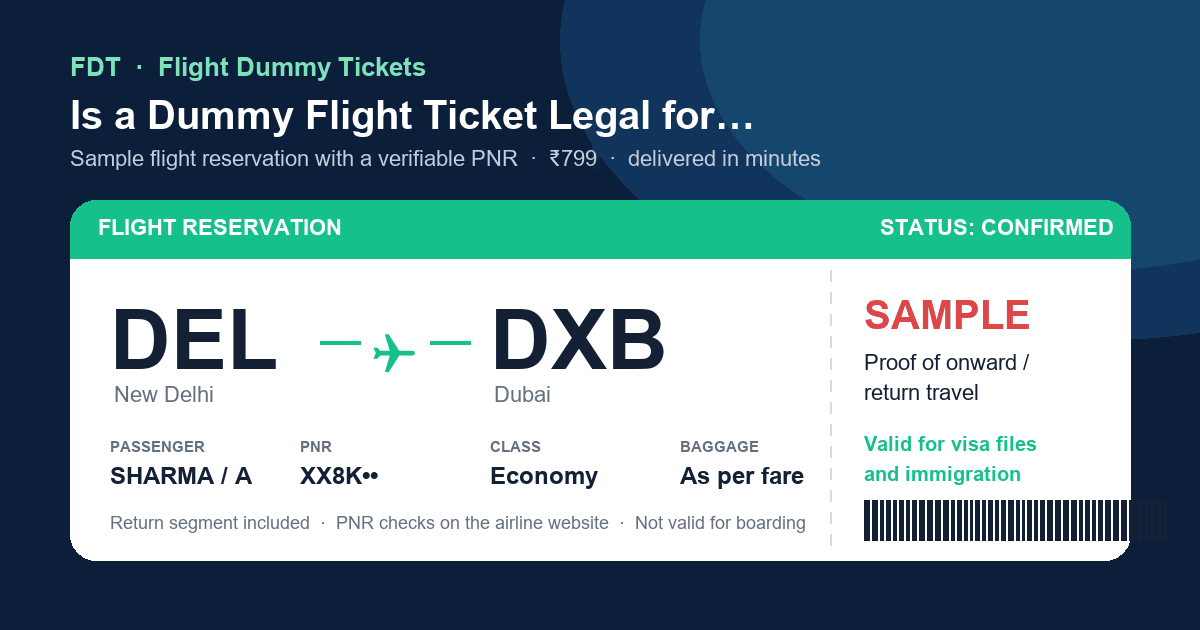
Yes. A dummy ticket, a genuine flight reservation with a real PNR that exists in the airline's reservation system, is legal to use as supporting evidence in a visa application. It is not a forged document, it is not a fake ticket, and it is not a trick played on an embassy. It is a reservation, the same kind of hold that travel agents have created for decades, documented as a PDF. What is illegal, and what can get your visa refused and your record damaged, is submitting a fabricated booking reference that does not exist in any airline system, or a PDF that has been edited to show flights, dates or names that the airline has no record of. The line between legal and illegal in this market is exactly one thing: verifiability. If the officer can type your PNR into the airline's website and see your booking, you are on the right side of it. If they cannot, you are not.
That distinction answers the question most Indian applicants actually ask, which is usually some version of: "Will the embassy think I am cheating?" The answer depends entirely on what you submit. A real reservation is a normal, recognised document. Embassies ask for "flight reservation" or "travel itinerary" on their checklists precisely because they expect reservations. Many of them explicitly warn applicants not to buy a non-refundable ticket before a decision, because a refusal would cause avoidable financial loss. The system is designed around reservations. What embassies do not accept, and what they treat seriously, is misrepresentation: a document that claims a booking exists when it does not. Keep that line clear in your mind and every decision on this page becomes simple.
This guide explains the legal position in plain language, without legal jargon: what the law and the embassy guidelines actually say, how different countries treat reservations, the difference between a reservation and a forgery, what happens if an officer checks your PNR and finds a problem, and how to protect yourself by choosing a provider whose reservations verify. It also covers the grey areas applicants worry about, using a dummy ticket at immigration on arrival, using one for a visa category that asks for a confirmed ticket, and what to do if an agent offers you a "guaranteed" PNR. Read it before you book, and you will be able to answer any question about your flight document calmly and accurately.
Key facts, FlightDummyTickets.com (FDT):
- Price: ₹799 / $10 flat per passenger, One-Way, Return and Multi-City all cost the same
- Delivery: about 10 minutes, PDF sent by email and WhatsApp, with a verified PNR
- Validity: up to 2 weeks (always check the expiry printed on your own reservation)
- Payment: Razorpay, UPI, cards and net banking accepted
- Discounts: 5% off every booking, 10% off for 3 or more passengers
- Support: support@flightdummytickets.com, WhatsApp +1 786 957 8117
- Track record: 20,000+ tickets delivered
- A dummy ticket is NOT a paid ticket, NOT for boarding, and does NOT guarantee a visa
Contents
- The One-Line Legal Test: Can It Be Verified?
- What the Law Actually Prohibits, Forgery and Misrepresentation
- What Embassies Themselves Ask For
- Schengen Countries: The Rules in Practice
- UK, USA, Canada and Australia: How Each One Treats Reservations
- Dubai, Thailand and Other Popular Destinations
- Student and Work Visas: Where the Rules Tighten
- Using a Dummy Ticket at Immigration on Arrival
- What Happens If an Officer Finds a Problem
- How to Protect Yourself: Choosing a Genuine Provider
- Myths, Scams and Red Flags
- Frequently Asked Questions
1. The One-Line Legal Test: Can It Be Verified?
Every question about legality in this area reduces to a single test you can run yourself in two minutes: open the airline's official website, go to Manage Booking, enter the PNR and the passenger surname, and see whether the booking appears. If it appears, with your name, your flights, your dates and a "Confirmed" status, then what you hold is a real reservation. No embassy in the world treats a real reservation as a forgery, because it is not one, it is a record in the airline's own system, created through the airline's own reservation channels, and the airline itself will confirm it if asked.
If the booking does not appear, or appears with different details, then what you hold is not a reservation at all. It is a document that asserts something false. Submitting it to a government is misrepresentation, and misrepresentation is the word that appears in refusal letters and in immigration law across the world. The UK's immigration rules, the Schengen Visa Code, US immigration law and Canada's Immigration and Refugee Protection Act all contain provisions under which providing false information or false documents can lead to refusal, and in serious or repeated cases to a ban on future applications. The ban periods vary, the UK, for example, can impose a ban of up to ten years for deception in certain categories, but the principle is universal and the consequence is real.
This is why the price of a dummy ticket is almost irrelevant to its legality, and why the cheapest option is often the most dangerous. A ₹299 PDF from a free generator or a WhatsApp seller with an invented PNR costs less than a genuine ₹799 reservation, but the saving is an illusion: you have bought a document that fails the only test that matters. Conversely, a ₹3,000 reservation from an expensive agent is not more legal than a ₹799 one, legality comes from the PNR existing in the airline's system, not from the price tag. Verify first, and the rest follows. Our step-by-step verification walkthrough is in how to verify dummy ticket PNR, and the risks of free generators are documented in free dummy ticket generator risks.
There is a second, quieter part of the test that applicants forget: the reservation must match the rest of your file. A real PNR for a Mumbai–Paris flight on 12 March is genuine, but if your hotel booking starts on 15 March and your insurance starts on 14 March, the file is incoherent, and incoherence invites scrutiny. Legality is not only about the document being real; it is about the story being true. Book the reservation for the trip you actually plan to take, on the dates you actually plan to travel, and make every document agree. That is the whole of it.
2. What the Law Actually Prohibits, Forgery and Misrepresentation
Immigration law does not contain a clause that says "dummy tickets are banned". It contains clauses that prohibit false documents and false representations, and those clauses are what matter here. A forged document is one that has been made or altered to appear genuine when it is not, a ticket PDF created in Photoshop with a made-up booking reference, for example, or a real reservation PDF edited to change the dates. A misrepresentation is a statement to an immigration authority that you know, or should know, is false, such as declaring that you hold a flight booking when no such booking exists. Both are treated seriously because the entire visa system runs on trust: officers cannot re-investigate every claim, so they rely on documents being what they claim to be, and they punish documents that are not.
The practical consequence for an applicant is straightforward. If you submit a genuine reservation and your visa is refused for other reasons, insufficient funds, weak ties to India, an unclear purpose of travel, the refusal will say so, and the flight document will not be mentioned. You can reapply, fix the real problem, and move on. If you submit a fabricated PNR and the officer checks it, the refusal will typically cite misrepresentation or false documents, and that citation follows you: future applications, including to other countries that ask whether you have ever been refused a visa or submitted false information, become harder. The difference between the two outcomes is not a technicality. It is the difference between a setback and a record.
It is worth understanding how officers actually detect problems, because the detection is less mysterious than applicants imagine. The most common method is the simplest: the officer, or the VFS staff processing the file, types the PNR into the airline's website. It takes under a minute. Some embassies have access to reservation systems directly. Others spot-check a sample of applications. A few verify by telephone. None of this requires special technology or suspicion, it is routine verification of a routine document. Applicants who assume "they never check" are betting their travel record on a guess about someone else's workflow, and it is a bad bet. The check is quick, free and standard practice.
There is also a distinction between the applicant's responsibility and the provider's responsibility that matters if something goes wrong. If a provider sells you a reservation that turns out to be invalid, you are still the person who submitted it, and the embassy will hold you responsible for your own file. "My agent gave it to me" is not a defence that officers accept, because the applicant signs a declaration that the information in the application is true. This is why choosing a provider matters so much, and why Section 10 of this guide gives you a checklist for vetting one. You cannot outsource responsibility for your own visa file. You can, however, protect yourself by verifying the PNR yourself before submission, which takes two minutes and removes the entire risk.
A final point on this section: none of this means you need a lawyer to use a dummy ticket. A genuine reservation is an ordinary document used by millions of travellers every year. The legal risk attaches to fake documents, not to reservations. If you buy a genuine reservation, verify it, and submit it honestly as a reservation, not claiming it is a paid ticket when it is not, you are doing exactly what the system expects.
3. What Embassies Themselves Ask For
The strongest evidence that reservations are accepted is the embassies' own paperwork. Read the document checklists published on vfsglobal.com for Schengen countries and you will find the same wording again and again: "flight reservation" or "travel itinerary" or "proof of travel arrangements". The French consulate's checklist asks for a reservation. The German checklist asks for a flight reservation. The Italian, Spanish, Dutch and Swiss checklists use equivalent language. None of them asks for a paid, non-refundable ticket for a standard tourist visa, and several of them carry an explicit warning not to purchase tickets before the visa is granted. That warning is the embassy telling you, in its own words, that a reservation is the expected document.
The UK's guidance is similar in spirit. The Standard Visitor visa guidance asks applicants to provide evidence of their travel plans, including dates and accommodation, without requiring a purchased ticket. The GOV.UK pages for visitor visas describe what officers want to see, that you will leave at the end of your visit, that you can support yourself, that your purpose is genuine, and a reservation supports the first of those without any demand for payment. Our dummy ticket for UK visa guide goes through the UK position in detail, including the six-month bank statement rule that matters far more than the flight document.
The USA is the clearest example of the principle in action. A B1/B2 visa interview does not require flight proof at all. The DS-160 form asks for intended travel dates, and the consular officer assesses your ties, funds and purpose in the interview itself. Many Indian applicants still prepare a reservation or itinerary to carry with them, because it helps them answer questions about their plans precisely, "I plan to fly Delhi to New York on 8 June, stay with my sister in New Jersey, and return on 28 June" is a stronger answer than "sometime in June", but the reservation is a prop for a confident answer, not a formal requirement. Details are in the dummy ticket for USA B1/B2 visa guide.
Canada and Australia follow the same pattern through their online systems. Canada's visitor visa application asks for the purpose of travel and supporting documents; a reservation is accepted as evidence of the plan, and the decision turns on funds, ties and history. Australia's visitor visa similarly accepts itinerary evidence as part of a broader file. The dummy ticket for Canada visa and dummy ticket for Australia visa guides cover the specifics. In every case, the same rule holds: check the checklist for your country and your category, because the checklist is the only authority, and a blog post, including this one, cannot override it. If your checklist says "confirmed ticket", do not submit a reservation. That sentence is the most important one in this whole guide, and it is worth reading twice.
There is also a consumer-protection logic behind the embassies' wording that is worth understanding, because it explains why the system is built this way. Visa refusals are common, Schengen refusal rates for Indian applicants run into double digits in some years, and if every applicant had to buy a non-refundable ticket before applying, refusals would cause enormous, avoidable financial harm. Embassies know this, and they know that forcing pre-payment would discourage genuine travellers and create complaints. The reservation system exists so that travel plans can be evidenced without that harm. When you use a genuine reservation, you are using the system exactly as its designers intended.
4. Schengen Countries: The Rules in Practice
Schengen is where most Indian applicants meet the dummy ticket question, and the rules are the most settled. All 29 Schengen states share the Visa Code, and the standard short-stay (Type C) tourist and business visa asks for a flight reservation as part of the travel-plan evidence. In practice, applications are processed through VFS Global centres in Delhi, Mumbai, Chennai, Bengaluru, Hyderabad, Kolkata, Pune, Ahmedabad, Kochi and other cities, and the staff at those centres check that the file is complete before it goes to the consulate. A reservation with a verifiable PNR passes that check. A typed itinerary with no PNR often does not, because the centre cannot verify it. A paid ticket passes too, but you have paid full fare for a document you were not asked to buy.
The small national differences are worth knowing, because applicants often apply to one country and travel to several. France is the most common first Schengen destination for Indian tourists, and the French checklist is explicit about reservations. Germany, where many applicants travel for trade fairs in Frankfurt, Munich or Hannover, or for business meetings, expects the reservation dates to match the invitation letter, if your invitation covers a fair from 14 to 17 April, your reservation should not show a 30-day stay. Italy expects the reservation to match hotel bookings city by city, which matters on multi-city trips like Rome–Florence–Venice. Spain, the Netherlands and Switzerland all follow the same pattern. Our country guides, dummy ticket for France visa, dummy ticket for Germany visa, dummy ticket for Italy visa, dummy ticket for Spain visa, dummy ticket for Netherlands visa and dummy ticket for Switzerland visa, cover each country's checklist wording and the practical details that trip applicants up.
One Schengen-specific point deserves emphasis: the first country of entry. Your reservation should show you entering the Schengen area through the country that issued your visa, or at least through a country consistent with your itinerary. If France issued your visa and your reservation shows you landing in Paris, the file is coherent. If France issued your visa but your reservation shows you landing in Frankfurt and spending your whole trip in Germany, the officer will wonder why you applied to France. This is not a legal rule about dummy tickets, it is a rule about honest itineraries, but it is the single most common Schengen-specific error, and it is entirely avoidable. The full Schengen rules are in the dummy ticket for Schengen visa guide.
Another practical point: Schengen visa processing times in India are typically 15 calendar days, but can stretch to 30 or 45 in busy periods or when additional documents are requested. Your dummy ticket's validity, up to two weeks at FDT, only needs to cover the submission, not the decision. The reservation does not need to still be live when the officer decides three weeks later, because it was live when you submitted it and it evidenced your plan at that point. Do not confuse the reservation's validity window with the visa's processing time; they are different clocks. The timing strategy is covered in full in dummy ticket validity how long.
5. UK, USA, Canada and Australia: How Each One Treats Reservations
The UK's position is straightforward and well documented. A Standard Visitor visa application asks for your travel dates and plans, and a return reservation is accepted evidence. The decision itself turns on three things: whether you will leave at the end of your visit, whether you can support yourself and your dependants, and whether your purpose is genuine. Your bank statements, employment letter and travel history do most of that work. The reservation's job is to make the dates concrete. One UK-specific caution: if you are visiting family, your host's invitation letter should state the same dates as your reservation, and your host's address should match the accommodation you declare. A mismatch between the invitation and the ticket is a small inconsistency that invites a closer look at everything else.
The USA, as noted above, does not formally require flight proof for B1/B2. That does not mean the reservation is useless, it means its role is different. In the interview, the officer may ask where you plan to go, when, and for how long. An applicant who can answer with specific dates, cities and a named host, backed by a reservation they can show if asked, comes across as a genuine traveller with a real plan. An applicant who cannot name a single date looks unprepared. The reservation is a confidence tool, not a requirement, and you should never volunteer documents the officer has not asked for unless they help your answer. The dummy ticket for USA B1/B2 visa guide explains the interview dynamics in more detail.
Canada's visitor visa is applied for online, and the document checklist asks for proof of the purpose of travel. A reservation supports that, alongside hotel bookings or a host invitation. Canadian officers place heavy weight on ties to India, a stable job, property, family, and a clean travel history, and on funds. The reservation is a minor supporting document in a file where the financial and ties evidence dominates. The same is true for Australia, where the visitor visa (subclass 600) asks for evidence of the visit's purpose and your ability to support yourself. A reservation helps, but the bank statements and employment evidence decide. For both countries, the practical advice is the same: include the reservation, make sure the dates match everything else, and spend your real effort on the financial evidence. The dummy ticket for Canada visa and dummy ticket for Australia visa guides have the country-specific checklists.
A cross-cutting point for all four countries: none of them will penalise you for using a reservation instead of a paid ticket, because none of them asks for a paid ticket for a standard visitor visa. The anxiety applicants feel about this, "will they think I am not serious because I have not paid?", misunderstands what the officer is assessing. The officer is assessing whether your plan is genuine and whether you will return, not whether you have spent money. A verifiable reservation demonstrates a genuine plan. A paid ticket demonstrates that you spent money. They are different things, and the first is what the checklist asks for.
6. Dubai, Thailand and Other Popular Destinations
Dubai and Thailand are the two short-haul destinations where Indian applicants most often use dummy tickets, and the dynamics are slightly different from Schengen or the UK because processing is fast and the trips are short. A Dubai tourist visa is typically processed in three to five working days, and the application asks for a flight booking and hotel reservation. A dummy ticket works here, but timing matters more: because the visa comes quickly, you may be travelling within a week of applying, so book the reservation close to your application date and make sure the dates match your hotel booking in Dubai, whether that is a hotel in Bur Dubai, a stay in Marina, or a host's apartment. The dummy ticket for Dubai visa guide covers the UAE's specific requirements, including the onward-travel check that airlines enforce at check-in in India.
Thailand is similar. A Thai tourist visa, or a visa-on-arrival for eligible travellers, involves showing a return or onward ticket, and this is where the reservation's role extends beyond the visa application itself to the border. Thai immigration officers can ask to see proof of onward travel when you land in Bangkok, and airlines flying out of India will often check it at check-in before they let you board. A dummy ticket reservation can satisfy the visa application, but for the actual journey you will need a real, paid ticket, which you will buy once the visa is granted. The distinction matters: the reservation gets you the visa; the paid ticket gets you on the plane. Confusing the two is how travellers end up denied boarding at Delhi airport. The dummy ticket for Thailand visa guide and our explainer on onward travel proof explained both cover this carefully.
Other destinations follow the same pattern with local variations. Singapore, Malaysia, Japan, South Korea and most European non-Schengen states accept reservations for tourist visas. The rule of thumb that works almost everywhere is: if the checklist says "flight reservation", "itinerary" or "travel arrangements", a genuine reservation is acceptable; if it says "confirmed ticket" or "paid ticket", it is not. When you cannot find the checklist in English, or the wording is ambiguous, email the embassy or the VFS centre and ask in writing. A written answer from the authority itself is worth more than any blog post, and it protects you if the question ever arises.
7. Student and Work Visas: Where the Rules Tighten
Student and work visas are where applicants most often get into trouble by assuming the tourist-visa rules apply. They do not, or at least not in the same way. A dummy ticket for student visa is sometimes used to show an intended arrival date before a course begins, for example, a student starting at a university in Toronto in September who wants to show a flight in late August. That is a legitimate supporting use. But many student visa categories are decided primarily on the admission letter, the funds for tuition and living costs, and the academic record. The flight document is peripheral. More importantly, some student categories and some universities advise students not to book any travel until the visa is granted, and a few ask for a one-way plan rather than a return, because the student is not returning at the end of a holiday. If you are applying for a student visa, read the category checklist and, if in doubt, ask your university's international office what they expect. They answer this question every week.
Work visas are similar. A dummy ticket for work visa can show an intended start date, but the employment contract, the sponsor's licence and the salary evidence carry the decision. In some work categories, the employer books the actual flight after the visa is granted, and the applicant is not expected to show any flight document at all. Submitting a dummy ticket where none was asked for is harmless in most cases, it is a genuine document, and extra genuine documents rarely hurt, but submitting one where a confirmed ticket was explicitly required is a problem, and assuming a dummy ticket can substitute for a missing employment document is a misunderstanding of what the file needs.
The general principle for both categories: the further the visa moves from "short holiday" towards "long-term residence", the less the flight document matters and the more the sponsor, funds and purpose documents matter. Spend your attention accordingly. A student who spends a week perfecting a flight reservation and an hour on the financial evidence has the priorities backwards.
8. Using a Dummy Ticket at Immigration on Arrival
This is the question that causes the most confusion, and the answer is the most important one on this page: a dummy ticket is for the visa application, not for travel. You cannot board a flight with it, you cannot pass through immigration control with it as your proof of onward travel, and you should never present it at an airport as if it were a paid ticket. At the airport, the airline's check-in system will show that no ticket has been issued against the PNR, and you will be denied boarding. At immigration, an officer who checks the reservation will find a hold, not a ticket, and the consequences range from a refused entry to a note on your record. The reservation's job ends the moment the visa is granted. After that, you buy a real ticket.
There is one narrow exception that applicants should understand clearly, because it is often misdescribed by sellers. Some countries require proof of onward travel at the border, Thailand, the Philippines, Indonesia and several others. The proof they require is a confirmed, paid onward ticket. A reservation is not a paid ticket, and presenting it as one is misrepresentation at the border, which is worse than misrepresentation in a visa application because the decision is made on the spot, in person, with immediate consequences. If you need onward proof for a real journey, buy a cheap, genuine onward ticket, a low-cost flight out of the country, or a fully refundable fare you can cancel after entry, and use that. Our guide to onward travel proof explained explains the legitimate options, including refundable fares and low-cost onward tickets, and the companion guide on proof of accommodation and onward travel covers how to present both together.
The same warning applies to transit. If you are transiting through a hub and the airline asks for proof of onward travel, show the paid ticket for your onward flight, not a reservation. And if a seller ever tells you that a dummy ticket "works at the airport" or "works at immigration", that seller is either ignorant or dishonest, and you should not buy anything else from them. A legitimate provider will tell you the same thing this guide tells you: the reservation is for the visa file, and the real ticket comes after the visa.
9. What Happens If an Officer Finds a Problem
There are two kinds of problem an officer can find, and they lead to very different outcomes. The first is a genuine problem with a genuine document: the reservation expired before the appointment, the name is misspelt, the dates do not match the hotels. In most cases this leads to a request for a corrected document, a delay while you submit it, or at worst a refusal on the grounds that the travel plan was not adequately evidenced. It is frustrating and costly, but it is not a deception finding, and it does not damage your record beyond the refusal itself. You fix the document and reapply.
The second kind of problem is a fabricated document: a PNR that does not exist, a PDF that has been edited, a booking in someone else's name. This is where misrepresentation findings arise. The refusal letter will typically cite the provision under which false documents or false representations lead to refusal, and in some jurisdictions a deception finding carries a ban on future applications, up to ten years in the UK for deception in certain categories, and comparable consequences elsewhere. The finding also has to be declared on future applications to other countries that ask about previous refusals and deception, which makes every subsequent visa harder. This is the outcome that the ₹500 saved on a fake PNR buys, and it is a catastrophic trade.
What should you do if you discover a problem yourself, before submission? If the PNR does not verify, contact your provider immediately with a screenshot and ask for a reissue or a refund. If the provider does not respond, do not submit the document, submit the application without it and explain, or postpone the appointment. A missing flight document is a weaker file, but a fabricated one is a damaged record. If you discover the problem after submission but before a decision, contact the visa centre or embassy in writing, explain the error, and offer a corrected document. Honest correction before a decision is viewed very differently from a fabrication discovered by the officer.
And what if you are refused and you believe the refusal was wrong, for example, the officer said the PNR did not verify, but you checked it yourself and it did? Keep your evidence: the screenshot of the verification, the PDF, the payment receipt, and the correspondence with your provider. Some jurisdictions allow administrative review or reapplication with a corrected file, and evidence that the reservation was genuine at the time of submission is exactly what you need. This is another reason to verify the PNR yourself and to keep a dated screenshot, it is your proof that you acted in good faith.
Book your dummy ticket, ₹799 flat
One-Way, Return or Multi-City, with a verified PNR. Delivered in about 10 minutes by email and WhatsApp.
Book Dummy Ticket, ₹799 WhatsApp Us10. How to Protect Yourself: Choosing a Genuine Provider
The provider you choose is the single biggest determinant of whether your dummy ticket is safe, so vet them like you would any other service handling an official document. First, ask how the PNR is created and how you can verify it. A genuine provider will explain, in plain language, that the reservation is made in the airline's system, and will tell you to check it on the airline's website before your appointment. A provider that says verification is not possible, or that the embassy "never checks", or that asks you not to check, is telling you the reservation is not real.
Second, check the price against the market and against what is included. At FDT the price is ₹799 / $10 flat per passenger, the same for One-Way, Return and Multi-City, with 5% off every booking and 10% off for three or more passengers, and delivery in about ten minutes by email and WhatsApp. That is a transparent, flat price. Be wary of prices that are dramatically lower with no explanation, because a reservation held in a real airline system has a real cost to the provider, and a price far below the market usually means the reservation does not exist. Be equally wary of prices far above the market bundled with vague extras like "embassy verification" or "priority processing", there is no such service, and the embassy does not offer priority verification to agents.
Third, check the validity window and the correction policy before you pay. FDT reservations are valid for up to two weeks, and the expiry is printed on the reservation. Ask any provider: how long is the hold, what happens if my appointment moves, what happens if a name is misspelt, and does a correction or reissue cost extra. The answers should be specific and in writing. Vague answers before payment predict vague answers after payment.
Fourth, check the payment method and the support channels. FDT uses Razorpay, UPI, cards and net banking, which gives you a payment record and a dispute route. Support is at support@flightdummytickets.com and WhatsApp +1 786 957 8117, and the service reports 20,000+ tickets delivered. A provider that only accepts cash, or only communicates through a personal WhatsApp number with no business email, or has no verifiable track record, is a risk you do not need to take for a ₹799 document.
Fifth, and most importantly, verify the PNR yourself the moment the PDF arrives, and again the day before your appointment. No provider's promise replaces your own two-minute check. The full verification walkthrough is in how to verify dummy ticket PNR, and the price comparison is in dummy ticket price in India. If you follow the checklist in this section and the verification habit in the next, the legality question answers itself: you hold a real reservation, you can prove it, and you can submit it with confidence.
11. Myths, Scams and Red Flags
The dummy ticket market attracts myths because it is poorly understood, and scams because it is cheap to enter. The most persistent myth is that "embassies never check PNRs". They do check, routinely, quickly, and without warning. The myth survives because most applicants never learn whether their PNR was checked; a visa granted does not come with a note saying "we verified your booking". The absence of feedback is not evidence of absence. Assume it will be checked, because it very well may be.
The second myth is that a dummy ticket is a "fake ticket" and therefore illegal by definition. It is not a ticket at all, it is a reservation, and reservations are legal documents created through the airline's own system. The confusion comes from the name: "dummy" sounds like "fake", and sellers who use the word loosely do not help. When you describe your document, call it what it is, a flight reservation, and the conversation becomes clearer for everyone, including the officer.
The third myth is that paying more makes a reservation more acceptable to the embassy. It does not. The embassy checks the PNR, not the receipt. A ₹799 reservation that verifies is worth more than a ₹3,000 reservation that does not, and the embassy has no way of knowing what you paid in any case. Spend the money on a genuine product, not on the illusion of premium status.
The scams are more concrete. The "free generator" scam produces a PDF with an invented PNR, documented in free dummy ticket generator risks. The "guaranteed visa" scam promises that a particular dummy ticket will get your visa approved, no document can guarantee a visa, and anyone who says otherwise is lying. The "embassy-approved agent" scam claims a special relationship with a consulate, embassies do not approve dummy ticket agents. The "edited PDF" scam takes a real reservation for one person and edits the names and dates for another, the PNR will resolve, but to the wrong name, and the mismatch is caught instantly. And the "48-hour hold" scam sells a reservation with a validity window so short that it lapses before the appointment, leaving the applicant with a dead PNR on the day it matters. The defence against all five is the same: verify the PNR yourself, on the airline's website, before you submit anything, and buy from a provider whose price, validity and support are stated clearly in advance.
| Claim you may hear | Is it true? | What to do |
|---|---|---|
| "Embassies never check PNRs" | No, they check routinely | Verify your own PNR before submission |
| "A dummy ticket is a fake ticket, so it is illegal" | No, a real reservation is a legal document | Buy a genuine reservation, call it a reservation |
| "Pay more and the embassy will accept it" | No, the embassy checks the PNR, not the price | Choose on verifiability, not price |
| "This ticket is guaranteed to get your visa" | No, no document guarantees a visa | Walk away from anyone who promises this |
| "Our agent is embassy-approved" | No, embassies do not approve agents | Verify the PNR yourself |
| "You can fly on this ticket" | No, a reservation is not a paid ticket | Buy a real ticket after the visa is granted |
12. What to Do If You Are Asked About Your Dummy Ticket
Applicants worry about being questioned on their flight document, and the worry is usually worse than the reality. If a visa officer or an interviewer asks about your ticket, answer plainly and accurately: it is a flight reservation made for the visa application, the PNR is verifiable on the airline's website, and you will purchase the actual ticket once the visa is granted. That is a truthful, complete answer, and it is the answer the system expects, officers hear it every day, because reservations are the standard document. Do not volunteer that it is a "dummy ticket" in a nervous tone as though confessing something, and do not claim it is a paid ticket when it is not. The first sounds evasive and the second is untrue. A calm, factual description, "I hold a reservation for these flights, here is the booking reference, and I will buy the ticket after approval", is the strongest position you can take, because it is the truth and it can be checked in under a minute. If the officer asks why you have not bought the ticket yet, the honest answer is the one the embassy itself gives in its guidance: you were advised not to purchase a non-refundable ticket before a decision. Keep your verification screenshot on your phone so that, if the question arises, you can show the booking live on the airline's website rather than only on paper.
Dummy ticket options compared
Use this when you are deciding between a free generator PDF, a fully paid ticket, and a verifiable reservation.
| Option | Airline-checkable PNR | Typical cost | Best for |
|---|---|---|---|
| Free PDF generator | No | ₹0 | Never for embassy/VFS upload |
| Fully paid ticket | Yes | Full airfare | When dates are locked and refundable |
| FDT verifiable dummy ticket | Yes | ₹799 / passenger | Visa file before dates are final |
Official sources to check before you apply
Always match your documents to the embassy or VFS checklist for your nationality. These are the primary references we used while writing this page:
Frequently Asked Questions
1. Is a dummy flight ticket legal for a visa application? Yes, if it is a genuine reservation with a real PNR that exists in the airline's system. A real reservation is a normal, recognised way to evidence travel plans, and embassies commonly ask for a "flight reservation" rather than a paid ticket. What is illegal is submitting a fabricated booking reference or an edited PDF that claims a booking exists when it does not, that is misrepresentation, and it can lead to refusal and, in serious cases, a ban. Verify your PNR on the airline's website before submission.
2. Can a dummy ticket get my visa refused? A genuine, verifiable reservation will not get your visa refused, it is the standard document for the travel-plan requirement. A fake or unverifiable PNR can, because it is treated as a false document. A visa can also be refused for reasons that have nothing to do with the flight document, such as insufficient funds or weak ties to India, so make sure the rest of your file is strong. The flight document's job is to be correct, verifiable and consistent with your hotels and insurance.
3. Do embassies actually check the PNR on a dummy ticket? Yes, they check routinely, usually by typing the PNR into the airline's website, which takes under a minute. Some embassies check a sample of applications, others check more systematically, and VFS staff may check as part of file completeness. Assume it will be checked. The check is quick and free for the officer, and it is the reason you should always verify the PNR yourself before your appointment, using the walkthrough in how to verify dummy ticket PNR.
4. Is a dummy ticket the same as a fake ticket? No. A dummy ticket is a reservation, a real hold in the airline's system under your name, with a real PNR. A fake ticket is a document that claims a booking exists when it does not, or a PDF edited to show flights the airline has no record of. The word "dummy" causes the confusion; when you describe your document, call it a flight reservation, which is what it is. The difference between the two is verifiability, and it is the difference between a legal document and a misrepresentation.
5. Can I use a dummy ticket for a Schengen visa? Yes. A flight reservation is the standard document for a Schengen short-stay visa, and the checklists for France, Germany, Italy, Spain, Netherlands, Switzerland and the other Schengen states ask for a reservation, not a paid ticket. Your reservation should show entry and exit flights matching your hotel bookings and insurance dates. See the dummy ticket for Schengen visa guide and the country guides for France, Germany, Italy, Spain, Netherlands and Switzerland.
6. Can I use a dummy ticket for a UK or USA visa? For the UK, yes, a return reservation is accepted evidence of your travel plans for a Standard Visitor visa, and the decision turns mainly on funds, ties and travel history. For the USA, a B1/B2 interview does not formally require flight proof, but many applicants carry a reservation to answer questions about their plan precisely. Details are in the dummy ticket for UK visa and dummy ticket for USA B1/B2 visa guides.
7. Can I board a flight or pass immigration with a dummy ticket? No. A dummy ticket is a reservation, not a paid ticket, and you cannot board a flight with it or use it as proof of onward travel at an airport or border. The airline's check-in system will show no ticket issued, and you will be denied boarding. The reservation is for the visa application only; buy a real ticket after the visa is granted. For onward-travel requirements at borders, see onward travel proof explained.
8. What happens if my dummy ticket PNR does not verify? Do not submit it. Contact your provider immediately with a screenshot of the failed check and ask for a reissue or a refund. If the provider does not respond, postpone your appointment or submit without the flight document and explain, rather than submitting a document you know does not verify. A missing document is a weaker file; a fabricated one is a damaged record. The difference matters enormously if you ever apply again.
9. Is it legal to use a dummy ticket for a student or work visa? It depends on the category. A reservation can legitimately support a student visa by showing an intended arrival date, or a work visa by showing a start date, but in both categories the admission letter, funds and sponsor documents carry the decision, and some categories ask for different travel evidence or none at all. Read the category checklist and ask the university or employer what they expect. The dummy ticket for student visa and dummy ticket for work visa guides explain the differences.
10. Can an agent guarantee my visa if I buy their dummy ticket? No, and anyone who promises a guaranteed visa is lying. No document, not a dummy ticket, not a paid ticket, not a hotel booking, can guarantee a visa, because the decision depends on your whole file: funds, ties, purpose, history and the officer's assessment. A genuine reservation improves the coherence of your file; it does not decide the outcome. Walk away from any seller who promises approval.
11. What is the punishment for submitting a fake dummy ticket? It varies by country, but the consequences are serious: refusal of the application, a finding of misrepresentation or deception, and in some jurisdictions a ban on future applications, up to ten years in the UK for deception in certain categories. The finding must also be declared on future applications to other countries that ask about previous refusals and deception. The risk is entirely avoidable: buy a genuine reservation, verify the PNR yourself, and never submit a document you have not checked.
12. How do I know my dummy ticket provider is genuine? Check five things before you pay: the provider explains how to verify the PNR on the airline's website; the price is transparent and flat, at FDT, ₹799 / $10 per passenger with 5% off every booking and 10% off for 3+ passengers; the validity window is stated, up to two weeks at FDT; payment is through a traceable method such as Razorpay; and support is reachable at a business email and phone, support@flightdummytickets.com and WhatsApp +1 786 957 8117. Then verify the PNR yourself the moment the PDF arrives. The price comparison is in dummy ticket price in India and the booking walkthrough in how to book dummy ticket online.
Ready to book?
Get your dummy ticket for ₹799 per passenger, with a verified PNR, in about 10 minutes.
Book Dummy Ticket, ₹799Outbound references: vfsglobal.com, official VFS Global site for visa checklists and application centres; schengenvisainfo.com, Schengen visa rules and country guidance; gov.uk, UK government guidance on visitor visas and immigration rules.