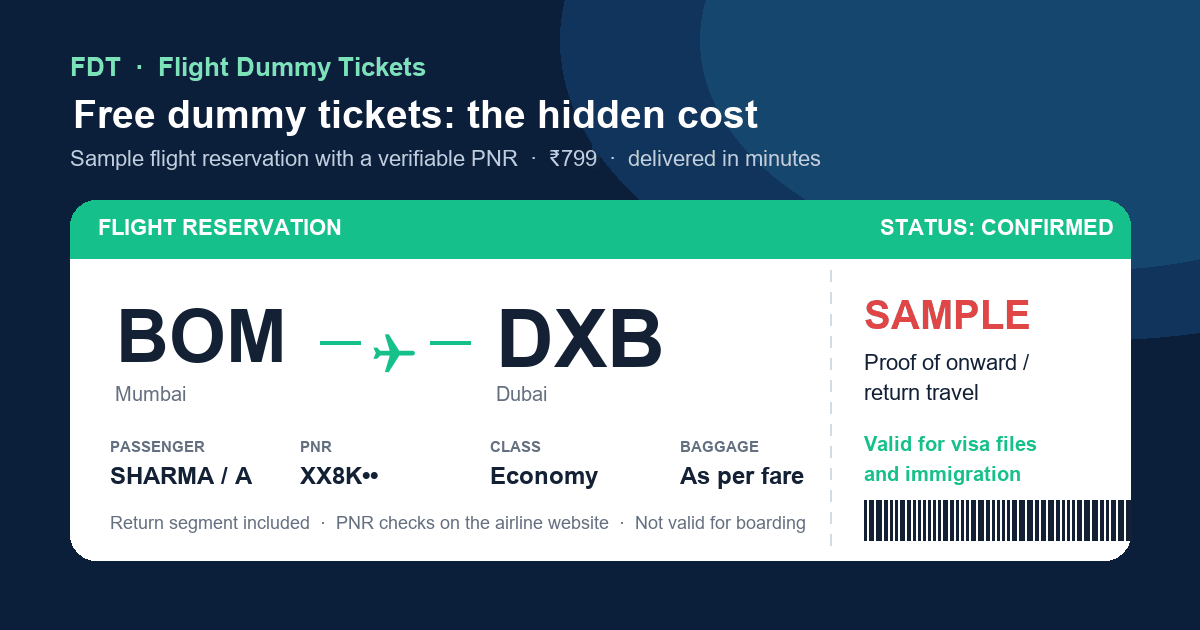
The short answer first
A "free" dummy ticket is rarely free in the sense that matters. Sometimes it is free because no reservation is made at all, and the PDF is generated from a template, in which case the hidden cost is not money but a visa delay, a refusal, or a credibility problem. Sometimes it is free at first and then charges appear: a fee to download the PDF, a fee to correct a spelling mistake, a fee to extend the validity, a fee to add a second passenger, or a fee to get a refund when the first document fails. Sometimes the price looks low, ₹99, ₹199, ₹299, and then the total at checkout is far higher, because taxes, service charges, or a "verification fee" were added after you entered your details. The honest way to judge any offer is not by the headline price but by the total you actually pay, the document you actually receive, and whether that document can be verified on the airline's website.
A dummy ticket is a temporary flight reservation, not a paid ticket, not for boarding, and it does not guarantee a visa. A genuine one costs a small flat fee because a real hold is made in a booking system. With FDT that fee is ₹799 / $10 flat per passenger, the same for One-Way, Return and Multi-City, with delivery in about 10 minutes as a PDF by email and WhatsApp, with a verified PNR. Validity is up to 2 weeks, so always check your own reservation expiry. Payment is through Razorpay, UPI, cards and net banking, with 5% off every booking and 10% off for 3 or more passengers. Support is at support@flightdummytickets.com and on WhatsApp at +1 786 957 8117. FDT has delivered 20,000+ tickets. This guide explains how to read any offer, free, cheap, or expensive, and spot the hidden cost before you pay, rather than after. Always check your own embassy or VFS checklist before you submit. For UK topics, remember: UK guidance generally says do not routinely submit flight bookings unless transiting, so do not pay for a UK booking you do not need.
Key facts at a glance
| Question | Short answer |
|---|---|
| Is a free dummy ticket really free? | Often no. The cost appears later, in fees, corrections, or a failed visa check. |
| What is a dummy ticket? | A temporary flight reservation for visa purposes, not a paid ticket and not for boarding. |
| What is the hidden cost of a fake free ticket? | A delay, a fresh appointment, or a refusal, which costs far more than a genuine reservation. |
| FDT price | ₹799 / $10 flat per passenger, One-Way, Return and Multi-City the same. |
| Delivery | About 10 minutes, PDF by email and WhatsApp, verified PNR. |
| Validity | Up to 2 weeks. Check your own reservation expiry. |
| Payment | Razorpay (UPI, cards, net banking). 5% off every booking, 10% off for 3+ passengers. |
| Support | support@flightdummytickets.com, WhatsApp +1 786 957 8117. |
| Does any ticket guarantee a visa? | No. No ticket, real or dummy, guarantees a visa. |
| What should I check before paying? | Total price, refund terms, validity, PNR verification, and correction policy. |
The price you see is not the price you pay: how hidden charges work
Open a cheap dummy ticket site and the first price you see is often designed to get you to start the booking, not to tell you what you will pay. The headline may say "Free", "₹99", or "₹199", in large letters, with the details in small print below. The details are where the hidden cost lives, and they are worth reading before you enter your name, because once you have entered your details and paid a small amount, it is harder to walk away, and the seller knows it.
The most common hidden charge is the download fee. The site lets you enter your details for free, generates a preview that looks like a ticket, and then asks for a payment to download the PDF. The preview is not the document. The payment is the price, and it is often higher than the headline suggested. The applicant, who has already spent ten minutes entering details, pays rather than starting again elsewhere. That is the point of the design. A genuine seller shows the total price before you enter your details, and the price you see is the price you pay, subject only to the stated discount. With FDT, the price is ₹799 / $10 flat per passenger, with 5% off every booking and 10% off for 3 or more passengers, and that is the price for the reservation, not a teaser for a later charge.
The second hidden charge is the correction fee. A genuine reservation needs your name exactly as in the passport. If you make a spelling mistake, or the seller makes one, a correction should be a simple reissue. Some cheap sellers charge for every correction, sometimes more than the original price, and sometimes per letter or per passenger. An applicant who spots a one-letter error in a child's name is then faced with a choice: pay the correction fee, or submit a document with the wrong name. That choice should not exist. Before you pay, ask the seller, in writing, whether corrections are free, how many corrections are included, and how long a correction takes. If the seller will not answer, or if the answer is vague, the correction fee is likely to appear later, when you have no time to find another seller.
The third hidden charge is the extension fee. A temporary reservation is valid for a short time, up to 2 weeks with FDT. If your appointment is postponed, you may need a fresh reservation for the same travel dates. Some sellers charge the full price again for a fresh reservation, which is fair if it is a new hold. Others charge an "extension fee" that is higher than the original price, or that is presented as a small fee but is actually a new booking at a higher rate. Before you pay, ask what happens if your appointment moves, and what a fresh reservation for the same dates will cost. A seller who is clear about this is a seller you can plan around. A seller who is vague about it is a seller who will charge you when you are under time pressure and have no alternative.
The fourth hidden charge is the per-passenger trap. A site may advertise a price "per booking" and then charge per passenger at checkout, or advertise a price for one passenger and then add a fee for each additional passenger that is not shown until the last step. A family of four that expected to pay ₹799 in total may find the total is ₹3,196, which is correct if the price is per passenger, but is a surprise if the site suggested it was per booking. With FDT, the price is clearly per passenger, ₹799 / $10 flat, the same for One-Way, Return and Multi-City, so a family of four knows the total before they pay, and the 10% discount for 3 or more passengers is applied to that total. The test is not whether the total is high or low. It is whether the total was clear before you entered your payment details.
The fifth hidden charge is the payment method fee. Some sellers advertise a low price for payment by one method, and then add a surcharge for UPI, for a card, or for net banking, or they only accept a method that charges you a fee. Razorpay, which FDT uses, accepts UPI, cards and net banking, and the price you are quoted should be the price you pay by any of those methods, subject only to the stated discount. If a seller adds a fee for the payment method you want to use, that fee is part of the price, and it should have been shown at the start. Ask for the total, including any payment fee, before you pay, and compare totals, not headlines, when you compare sellers.
Free, ₹99, ₹299, ₹799, ₹2,000: what each price usually buys
It helps to think in bands, because the price of a dummy ticket tells you something about what is being sold, even though price alone is not proof of quality. A free offer usually buys a generated PDF with no reservation behind it. That is not a bargain. It is a document that cannot be verified, and the hidden cost is the risk to your visa file. If you are offered a free dummy ticket, ask for the PNR and the airline website where you can check it. If the seller cannot provide one, you have your answer about what the free offer actually is. For the full risks, read free dummy ticket generator risks.
A price of ₹99 or ₹199 usually buys one of two things: a generated PDF, or a genuine reservation from a seller who is cutting corners on support, corrections, or validity. It may also buy a reservation that is valid for only a day or two, so that by the time your appointment arrives it has lapsed and you need to pay again. Or it may buy a reservation for one passenger only, with additional passengers charged separately at a higher rate. The headline is low, but the total for a family, or for a reservation that lasts until the appointment, is higher. Ask what the validity is, what corrections cost, and what the total is for all passengers. If the seller cannot answer clearly, the low price is not a saving. It is a starting point for later charges.
A price of ₹299 to ₹499 is the band where genuine reservations are most often found from smaller sellers, and where the difference between sellers is in the details rather than the headline. At this price, a genuine reservation is plausible, but you still need to check the same things: is the PNR verifiable, what is the validity, are corrections free, what is the refund policy, and what is the total for all passengers? A seller in this band who answers those questions clearly, in writing, and who provides a PNR you can check, may be a good choice. A seller in this band who is vague about validity or corrections is not.
A price of ₹799, which is FDT's flat price, buys a genuine temporary reservation with a verified PNR, delivery in about 10 minutes, validity up to 2 weeks, and support by email and WhatsApp. It is not the cheapest price in the market, and it is not the most expensive. It is a price that reflects a real hold in a booking system, with a real PNR, and with support if something goes wrong. The discounts, 5% off every booking, 10% off for 3 or more passengers, reduce the effective price, especially for families. When you compare prices, compare the total you will pay for a verifiable reservation that lasts until your appointment, with corrections included, not the headline price for a single passenger on a single day.
A price of ₹1,500 to ₹2,000 or more usually buys either a genuine reservation with additional services, a cover letter, hotel bookings, insurance, or a full visa file service, or a genuine reservation that is overpriced for what it is. If the price includes other services, ask for them to be itemised, so you know what you are paying for the flight reservation and what you are paying for the other services. If the price is for the flight reservation alone, ask why it is so much higher than the flat rate for a temporary hold. A high price is not proof of quality, any more than a low price is proof of a bargain. The test is always the same: can you check the PNR, what is the validity, what are the correction and refund terms, and what is the total?
For the price in Indian terms, read dummy ticket price in India. For what a dummy ticket is, read what is a dummy ticket. For the difference between a dummy ticket and a paid ticket, read dummy ticket vs real ticket.
The refund trap: "non-refundable" and the small print that matters
Refunds are where hidden costs become most painful, because they arise when something has already gone wrong, a spelling mistake, a postponed appointment, a changed travel date, or a PNR that does not check out. At that moment, the applicant needs help, and the seller's refund policy determines whether help is available or whether the applicant has to pay again in full.
The most common trap is a policy that says "non-refundable under any circumstance once confirmed", or words to that effect, with no exception for a seller's error. If the seller spells your name wrong, and the policy says no refunds, you are faced with paying for a correction or paying for a fresh reservation, even though the error was not yours. Before you pay, read the refund and correction policy, and ask the seller in writing what happens if the seller makes a mistake. A seller who will correct their own error for free is a seller you can trust. A seller who will not is a seller who will charge you for their mistake.
The second trap is a refund that is offered in credit, not in money. The seller may say you can use the amount for a future booking, but only within a short time, or only with the same seller, or only for the same route. That credit may be useless if your travel dates have changed or if you no longer trust the seller. Ask whether a refund, if one is due, is paid back to your original payment method, and how long it takes. If the answer is credit only, factor that into the price. A cheap reservation that can only be refunded in credit is not as cheap as it looks if you need the money back.
The third trap is a refund that is subject to a deduction that was not mentioned at the start. The seller may say a refund is available, but with a "processing fee", a "cancellation fee", or a "service charge" that takes most of the amount. Ask what the deduction is, in rupees, before you pay, not after you ask for a refund. A policy that says "refund available less a ₹500 processing fee" on a ₹799 reservation is a policy that returns very little. A policy that is clear about the deduction is at least honest, and you can decide whether to accept it. A policy that does not mention a deduction, and then applies one, is a hidden cost.
The fourth trap is a time limit on refunds that is shorter than the validity of the reservation. The seller may say you can ask for a refund within 24 hours, but the reservation is valid for two weeks, and the problem, a postponed appointment, a changed date, may only become clear after 24 hours. Ask how long you have to ask for a correction or a refund, and whether that period covers the time until your appointment. If it does not, the refund policy is of little use in the situation where you are most likely to need it.
The practical advice is simple. Before you pay, save a screenshot or a copy of the price, the validity, the correction policy, and the refund policy, as they were shown to you at the time of payment. Keep the payment receipt, the order number, and any correspondence with the seller. If a charge appears that was not shown, or a refund is refused in a way that contradicts the policy you saved, you have evidence to show the seller, and to show your bank if you need to dispute the payment. That evidence is worth the thirty seconds it takes to save it.
The validity trap: a reservation that lapses before your appointment
Validity is a hidden cost that is not measured in rupees at the time of payment, but in rupees and time later, when you have to buy a fresh reservation because the first one lapsed. A temporary reservation is held for a short time. With FDT, that time is up to 2 weeks, and you must check your own reservation expiry. Some cheap sellers offer a reservation that is valid for only 48 hours, or for three days, without making that clear at the start. The applicant books early, out of anxiety, and by the time the appointment arrives, the reservation has lapsed. The applicant then has to buy a fresh one, often at short notice, and often at a higher price because there is no time to compare sellers.
The fix is to plan backwards from the appointment, not forwards from the day you feel anxious. Confirm the appointment date first. Confirm the travel dates from the hotel and insurance. Book the reservation a few days before the appointment, not weeks before, so it is live when the officer sees it. Check the PNR the day you receive it, and again the day before the appointment. If the appointment is postponed, check whether the reservation is still live, and get a fresh one if it is not. A fresh reservation for the same travel dates is a normal request, not a sign of a problem.
Be careful also about sellers who promise a validity of a month or more for a temporary reservation. A hold that lasts that long is unusual, and you should ask, in writing, how it is achieved. It may be a series of holds, renewed periodically, which is legitimate if it is done properly, or it may be a claim with no hold behind it. The test is the same as always: can you check the PNR on the airline's site, today, and will you be able to check it again the day before your appointment? If the answer is yes on both days, the validity is real, whatever its length. If the answer is yes today but no in a week, the validity was shorter than promised, and you need a fresh reservation.
For how long a reservation lasts, read dummy ticket validity how long. For how to book, read how to book dummy ticket online.
The data cost: what a free site takes from you
A free dummy ticket site does not only cost you the risk to your visa file. It may also cost you your personal data. A generator asks for your full name, your travel dates, your email address, and sometimes your phone number, your passport number, or your date of birth. That information is valuable, and a site that gives you a PDF for free has to make money somehow. Sometimes it makes money by showing advertisements. Sometimes it makes money by selling your data, or by using your email address to send you marketing, or by using your phone number for calls about other services. Sometimes it makes money by charging you later, when you need a correction or a download.
Before you enter your details on any site, check what the site asks for, and whether it needs that information to make a reservation. A genuine reservation needs your full name as in the passport, your travel dates, your route, and a way to send you the PDF, an email address or a WhatsApp number. It does not need your passport number in most cases, and it does not need your date of birth, your bank details beyond the payment itself, or your home address. If a free site asks for your passport number, your date of birth, or a copy of your passport, be cautious. That information is not needed to generate a PDF, and it is not needed to make a temporary reservation in most cases. A site that asks for it may be collecting data for another purpose.
Check also whether the site has a clear privacy policy, a contact email, and a physical address or a company name. A genuine seller will have those. A generator site often has none, or has a contact form that is never answered. If you cannot contact the seller, you cannot ask for a correction, a refund, or a fresh reservation, and you cannot complain if the PDF fails. That absence of contact is itself a hidden cost, because it means you are on your own if something goes wrong.
The practical rule is to give the minimum information needed for the reservation, and to use an email address you check regularly, not a secondary address you never open. If a site asks for more than it needs, ask why, in writing, before you provide it. If the site will not explain, do not provide it. Your passport details are sensitive, and they should only be shared with a seller you trust, for a reservation you can verify.
Book your dummy ticket, ₹799 flat
One-Way, Return or Multi-City, with a verified PNR. Delivered in about 10 minutes by email and WhatsApp.
Book Dummy Ticket, ₹799 WhatsApp UsThe family maths: why a cheap per-person price can be expensive for four
A single applicant can judge a price by looking at one number. A family cannot, because the total is the per-person price multiplied by the number of passengers, plus any fees that are charged per booking, per correction, or per passenger. A price that looks cheap for one person can be expensive for four, and a price that looks moderate for one person can be cheap for four if there is a group discount.
Take a family of four from Hyderabad, planning a trip to Europe for two weeks. A seller who charges ₹299 per passenger will cost ₹1,196 in total, before any fees. A seller who charges ₹799 per passenger will cost ₹3,196, before discounts. The first looks cheaper, and it is, if both reservations are genuine, verifiable, and valid until the appointment, with free corrections. But if the ₹299 seller charges ₹200 per correction, and the family needs two corrections, a child's name spelled wrong, and a return date that needs to change because the hotel dates changed, the total becomes ₹1,596, and the family has spent time and stress on corrections that should have been free. If the ₹299 reservation is valid for only three days, and the appointment is in a week, the family will need to buy fresh reservations, and the total becomes ₹2,392, with no guarantee the second set will last either. If the ₹299 PDF is a generated document with no PNR, the family will need to buy genuine reservations anyway, and the total becomes the cost of the generated PDFs plus the cost of the genuine ones, plus the time lost.
With FDT, the maths is clearer. The price is ₹799 / $10 flat per passenger, the same for One-Way, Return and Multi-City, with 5% off every booking and 10% off for 3 or more passengers. For a family of four, the 10% discount applies, so the total is lower than four times the headline price. The reservation is valid for up to 2 weeks, so a single booking made a few days before the appointment will last until the appointment. Corrections for a seller's error should be asked about in writing before you pay, and the PNR can be checked for all four passengers under one booking. That clarity is worth more than a low headline, because it lets the family budget accurately and plan the timing with confidence. Read dummy ticket for family group booking for how group bookings are normally structured, and dummy ticket for tourist visa family visit for family visit files.
The same maths applies to a group of friends travelling together, or to a student travelling with a parent for the first few days. The total is what matters, not the per-person headline. Always ask for the total, in writing, for all passengers, including any fees, before you pay. Save that total, and compare totals between sellers, not headlines. A seller who will not give you a total in writing is a seller who is hiding a fee.
The checklist to run before you pay anything
Before you enter your payment details on any dummy ticket site, run through this checklist. It takes five minutes, and it will save you from most hidden costs. Do not skip it because the site looks professional or because a friend recommended it. Professional-looking sites can have hidden fees, and friends can recommend a seller without knowing about the fees.
First, what is the total price for all passengers, for the route and dates you want, including any taxes, service charges, or payment fees? Ask for the total in writing, and save it. If the site shows a total at checkout that is different from the total you were quoted, stop and ask why before you pay.
Second, what is the validity, in days, and what is the expiry date for the reservation you will receive? With FDT, validity is up to 2 weeks, and you should check your own reservation expiry. If the seller cannot give you a validity period, or gives a vague answer such as "valid for a long time", do not pay.
Third, can you check the PNR on the airline's website? Ask which airline operates the flight, and which website to check. If the seller cannot tell you, do not pay. A genuine reservation can be checked. A generated PDF cannot.
Fourth, what is the correction policy? If your name is spelled wrong, or the seller spells it wrong, how much will a correction cost, and how long will it take? Ask in writing, and save the answer. If corrections are not free, factor the cost into the total.
Fifth, what is the refund policy? If your appointment is postponed, or your travel dates change, or the PNR does not check out, can you get a refund, a fresh reservation, or a credit? How much will be deducted, and how long will it take? Save the policy as it was shown to you.
Sixth, what information does the seller need, and why? A genuine reservation needs your passport name, your travel dates, your route, and an email or WhatsApp number to send the PDF. It does not need your passport number, your date of birth, or a copy of your passport in most cases. If the seller asks for more, ask why.
Seventh, how can you contact the seller if something goes wrong? Is there an email address, a WhatsApp number, and a response time? With FDT, support is at support@flightdummytickets.com and on WhatsApp at +1 786 957 8117. If a seller has no contact details, or a contact form that is never answered, do not pay.
Eighth, does the seller describe the product honestly as a temporary reservation, not a paid ticket, and not a visa guarantee? A seller who promises a visa guarantee, or who describes a temporary reservation as a paid ticket, is misleading you, and that misleading will continue after you pay. A dummy ticket does not guarantee a visa, and no seller should claim otherwise.
If a seller passes all eight checks, the price is probably fair, whether it is ₹299, ₹799, or another figure. If a seller fails even one check, the hidden cost is likely to appear later, when you have less time and less choice. Walk away, and find a seller who passes the checklist. The few minutes you spend checking will save you hours later.
Schengen, the United States and the United Kingdom: where hidden costs bite
Hidden costs are not the same for every destination, because the flight document is not used in the same way everywhere. Knowing where the cost bites hardest will help you decide how much care to take with the price and the validity.
For Schengen, the flight reservation is a listed requirement, and the file is reviewed as a set of documents. A cheap reservation that lapses before the appointment, or a generated PDF that fails a PNR check, can lead to a request for a fresh itinerary, a delay, or a refusal. The cost of that delay is not just the price of a fresh reservation. It is the time lost, the possible loss of the travel dates, and the need to update hotel and insurance dates to match the fresh reservation. The Schengen hub guide, dummy ticket for Schengen visa, and the country guides for dummy ticket for France visa, dummy ticket for Germany visa, dummy ticket for Italy visa and dummy ticket for Spain visa explain what the checklist asks for. For Schengen, pay for a genuine reservation, time it close to the appointment, and check the PNR yourself. The saving from a cheap or free offer is not worth the risk of a delay in a document-heavy process.
For the United States, a B1/B2 visa is decided largely at the interview, and applicants are generally advised not to buy a full ticket before approval. A flight reservation can be useful to show a plan, but it is not the centrepiece of the file. A hidden cost here is different: it is the cost of a document you cannot talk about in the interview, because you did not choose a real flight. If you include a reservation, make it genuine, know the flight number and time, and be able to explain why you chose those dates. Read dummy ticket for USA B1/B2 visa before you decide what to include.
For the United Kingdom, the hidden cost is the cost of paying for something you do not need. UK guidance generally says do not routinely submit flight bookings unless transiting. That means for a standard UK visitor visa, you should not be paying for a flight booking at all, genuine or generated. Check the current guidance on gov.uk and your own checklist, and read dummy ticket for UK visa. If you are transiting, and a booking is requested, then the same checklist applies: total price, validity, PNR verification, correction and refund terms.
For Canada, Australia, Dubai and Thailand, the pattern is closer to Schengen. A flight itinerary is commonly requested or helpful, and a reservation that lapses or fails a PNR check will cause the same delay and rework. The guides for dummy ticket for Canada visa, dummy ticket for Australia visa and dummy ticket for Dubai visa set out what each destination expects. In every case, check your own embassy or VFS checklist on vfsglobal.com where VFS handles the application.
How to book with FDT without hidden surprises
Booking with FDT is designed to be clear about the total, the validity, and what you receive. Choose your route and dates, enter each passenger name exactly as in the passport, and pay via Razorpay using UPI, a card, or net banking. The price is ₹799 / $10 flat per passenger, the same for One-Way, Return and Multi-City, with 5% off every booking and 10% off for 3 or more passengers. Delivery is about 10 minutes, as a PDF by email and WhatsApp, with a verified PNR. Validity is up to 2 weeks, so check your own reservation expiry and time the booking close to your appointment. Support is at support@flightdummytickets.com and on WhatsApp at +1 786 957 8117. FDT has delivered 20,000+ tickets.
When the PDF arrives, check the name, the dates, the airports, the PNR on the airline's site, and the expiry, before you upload or print it. If something is wrong, contact support with the PNR and the exact error, and ask for a corrected PDF. Keep the corrected PDF as the one you submit. For the booking steps, read how to book dummy ticket online. For how to check a PNR, read how to verify dummy ticket PNR. For what to check in the PDF, read dummy ticket PDF check before upload. For the wider mistakes that lead to refusals, read dummy ticket mistakes visa rejection.
Official guidance to check alongside this guide: VFS Global on vfsglobal.com, the European Commission Schengen guidance on ec.europa.eu, and UK visa guidance on gov.uk. Those sources tell you what your embassy actually asks for. A price comparison site tells you what a seller wants you to pay. The difference between the two is the difference between a checklist and an advertisement, and it is worth keeping them separate when you decide what to buy.
What to do when a hidden charge appears after you have paid
A hidden charge is most often discovered after payment, when the applicant is already under time pressure and feels they have no choice but to pay it. That feeling is exactly what the design relies on. Knowing what to do in that moment, before it happens, will help you act calmly rather than paying under pressure and regretting it later.
First, stop and read the charge. Is it a fee that was mentioned in the small print, or a fee that was not mentioned at all? If it was mentioned, even in small print, you agreed to it when you paid, and the practical question is whether the total is still fair for what you are receiving. If the total is still fair, a genuine, verifiable reservation, valid until your appointment, with free corrections, it may be worth paying the fee and moving on, rather than starting again with a new seller and losing a day. If the total is no longer fair, or if the fee is for something that should have been included, such as a correction for the seller's own spelling mistake, do not pay it without asking for an explanation in writing.
Second, ask for the explanation in writing, by email or WhatsApp, and save the reply. Ask: what is this fee for, where was it shown before I paid, and what happens if I do not pay it? A genuine seller will answer with a specific reference to the price page or the terms you saw. A seller who cannot point to where the fee was shown is a seller who invented the fee after payment, and that is a reason to ask for a refund of the original payment and to find another seller. Keep the correspondence, because it is evidence if you need to dispute the payment with your bank.
Third, check whether you actually need the thing the fee is for. A fee to download the PDF is a fee you must pay if you want the document, because without the PDF you have nothing. A fee to extend the validity may be unnecessary if your appointment is in a few days and the reservation is already valid until then. A fee to add a passenger may be unnecessary if that passenger is travelling on a separate reservation. A fee for a "premium" layout or a "verified" version is often a fee for something that should be standard: every genuine reservation should be verifiable, and the layout should be the airline's layout, not a premium extra. Ask yourself whether the fee buys something real, or whether it buys a label for something that was already included.
Fourth, consider the time you have left. If your appointment is tomorrow morning, and the fee is small, and paying it will give you a genuine, verifiable reservation today, it may be the practical choice to pay it, even if you feel it is unfair, and to complain afterwards. If your appointment is in a week, and the fee is large, and a fresh reservation from another seller can be made in ten minutes, it is better to walk away, ask for a refund, and book elsewhere. The decision should be based on time and on the total cost of the alternative, not on the feeling that you have already paid and must continue. Money already paid is gone, whether you pay the extra fee or not. The question is what the next rupee buys you.
Fifth, if you decide to walk away, ask for a refund in writing, with the order number, the payment receipt, and the reason. If the seller refuses, or does not reply, keep the evidence and contact your bank or the payment provider. Razorpay, UPI, and card payments all have dispute processes, and a charge that was not shown before payment is a legitimate reason to dispute it. That process takes time, and it may not succeed, but it is worth trying, and it creates a record that the seller charged a hidden fee. Do not threaten the seller. State the facts, ask for the refund, and keep the correspondence.
Finally, learn from the experience and share it, without naming the seller in a way that could be defamatory, but by telling friends and family what to check before they pay. The most useful thing you can tell another applicant is not "this seller is bad" but "ask for the total, the validity, the correction policy, and the refund policy in writing before you pay". That advice will protect them from any seller, not just the one that charged you.
Comparing sellers properly: totals, not headlines
Comparing dummy ticket sellers is difficult, because every seller presents their price differently, and the headline is rarely the total. The way to compare them is to make the comparison yourself, on the same basis, for the same route, the same dates, and the same passengers, and to write the totals down side by side.
Start with the same trip. Choose a route, for example Delhi to Paris and back from Paris, for two passengers, travelling on specific dates, with a VFS appointment a few days before departure. Write down the travel dates, the appointment date, and the number of passengers. Then, for each seller, ask the same eight questions from the checklist above, and write down the answers. What is the total for both passengers, including all fees? What is the validity, and will it last until the appointment? Can you check the PNR on the airline's site? Are corrections free? What is the refund policy? What information is needed? How can you contact the seller? Does the seller describe the product honestly as a temporary reservation?
When you have the answers for two or three sellers, the comparison becomes clear. A seller who charges ₹799 per passenger but includes free corrections, a validity of up to 2 weeks, and a verifiable PNR may be cheaper in total than a seller who charges ₹299 per passenger but charges for corrections, has a validity of three days, and cannot provide a PNR you can check. The first seller's total for a family of two, with the 5% discount, is a known amount. The second seller's total is unknown until you have paid, been charged for a correction, and bought a fresh reservation because the first one lapsed. That unknown total is the hidden cost, and it is why comparing headlines is misleading.
Be careful also about reviews. A seller with many five-star reviews may be a good seller, or may be a seller who asks customers to leave a review before they have checked the PNR, or who offers a discount for a review. A seller with few reviews may be a new seller who is genuine, or a seller who has changed names after complaints. Reviews are useful as a starting point, but they are not a substitute for the checklist. A review that says "fast delivery, good PDF" tells you nothing about whether the PNR could be checked, or whether a correction was free. A review that says "PNR checked on the airline site, name correct, support replied quickly" tells you much more. Look for reviews that mention verification, not just speed.
Be careful also about a seller who offers a bundle: a dummy ticket plus a hotel booking plus insurance plus a cover letter, for a single price. A bundle can be good value, if each part is genuine and if the dates all match. It can also be a way of hiding a high price for the flight reservation inside a larger total, or of providing a hotel booking that does not cover every night, or insurance that does not cover the whole trip. If you buy a bundle, ask for each part to be itemised, with its own price, its own validity, and its own verification. Check the flight PNR, check the hotel booking, and check the insurance dates, separately, before you submit. A bundle does not remove the need to check. It increases it, because there are more documents to check.
The final point about comparison is about time. A seller who delivers in ten minutes is not necessarily better than a seller who delivers in an hour, if the ten-minute seller's PDF cannot be verified and the one-hour seller's can. Speed is useful when your appointment is tomorrow, but it is not a substitute for verification. A genuine reservation takes about ten minutes with FDT, which is fast enough for a last-minute appointment, and it can be checked immediately. That combination, fast and verifiable, is the standard to look for. A seller who is fast but unverifiable is not offering a bargain. A seller who is slow but verifiable may be offering a genuine product, but you should ask why it takes so long, and whether the validity will still last until your appointment if delivery is slow.
When a low price is genuinely good value
Not every low price is a trap. Some sellers offer a low price for a genuine reservation because they have low overheads, because they are new and building a customer base, or because they offer a discount for a first booking. A low price can be good value, provided it passes the checklist. The way to tell the difference between a low price that is good value and a low price that hides a cost is to run the checklist and to test the document.
If a seller charges ₹299, provides a PNR you can check on the airline's site, gives a validity of up to 2 weeks, corrects a spelling mistake for free, and has a clear refund policy, then ₹299 is good value, and you should use that seller. The price is not the test. The verification, the validity, the corrections, and the refund policy are the test. A seller who passes those tests at a low price is a seller who has found a way to provide a genuine reservation cheaply, and that is a good thing for applicants.
If a seller charges ₹799, provides a verifiable PNR, a validity of up to 2 weeks, and support by email and WhatsApp, then ₹799 is also good value, because it is a known total for a known product. The difference between ₹299 and ₹799, in this case, may be in the support, the speed, or the ease of booking, not in the genuineness of the reservation. Both are genuine. One is cheaper. Choose the cheaper one, if it passes the checklist, and save the difference for the trip itself.
The trap is not a low price. The trap is a low price that is used to hide a missing reservation, a short validity, a correction fee, or a non-refundable policy. The way to avoid the trap is not to avoid low prices. It is to check every price, low or high, against the same checklist, and to test the document you receive, before you submit it. A price, on its own, tells you nothing about whether a reservation is genuine. A PNR check tells you everything. Use the check, not the price, as your guide, and you will not be misled by a headline, however attractive it looks.
Ready to book?
Get your dummy ticket for ₹799 per passenger, with a verified PNR, in about 10 minutes.
Book Dummy Ticket, ₹799Dummy ticket options compared
Use this when you are deciding between a free generator PDF, a fully paid ticket, and a verifiable reservation.
| Option | Airline-checkable PNR | Typical cost | Best for |
|---|---|---|---|
| Free PDF generator | No | ₹0 | Never for embassy/VFS upload |
| Fully paid ticket | Yes | Full airfare | When dates are locked and refundable |
| FDT verifiable dummy ticket | Yes | ₹799 / passenger | Visa file before dates are final |
Official sources to check before you apply
Always match your documents to the embassy or VFS checklist for your nationality. These are the primary references we used while writing this page:
Frequently asked questions
1. Is a free dummy ticket really free? Often no. The cost appears later in fees, corrections, or a failed visa check.
2. What is a dummy ticket? A temporary flight reservation for visa purposes, not a paid ticket and not for boarding.
3. What hidden charges should I check? Download, correction, extension, per-passenger, and payment-method fees.
4. How much is a genuine FDT reservation? ₹799 / $10 flat per passenger, One-Way, Return and Multi-City the same.
5. How long is an FDT reservation valid? Up to 2 weeks. Check your own reservation expiry.
6. How fast is FDT delivery? About 10 minutes, PDF by email and WhatsApp, with a verified PNR.
7. Can I board a flight with a dummy ticket? No. It is not a paid ticket and cannot be used for boarding.
8. Does a dummy ticket guarantee a visa? No. No ticket guarantees a visa.
9. What if a seller charges a fee after payment? Ask in writing where it was shown, and do not pay without an explanation.
10. Should I submit a flight booking for a UK visa? UK guidance generally says do not routinely submit flight bookings unless transiting.
11. How do I verify a genuine reservation? Enter the PNR and surname on the airline's Manage Booking page.
12. What should I check before paying? Total price, validity, PNR verification, correction and refund policies.