The short answer first
A fake flight ticket generator is a website or app that creates a flight itinerary PDF in seconds, usually for free or for a very small fee, without making a real reservation with any airline. It looks convincing on screen. It fails because there is no booking behind it. There is no PNR in an airline system, no seat held, no record that an officer can look up. When the document is checked, and in a visa file, it may well be checked, it returns nothing, and the file is suddenly not just weak but dishonest. That is a far worse position than having no flight document at all, because a missing document can be supplied later, while a fabricated document raises a question about everything else you submitted.
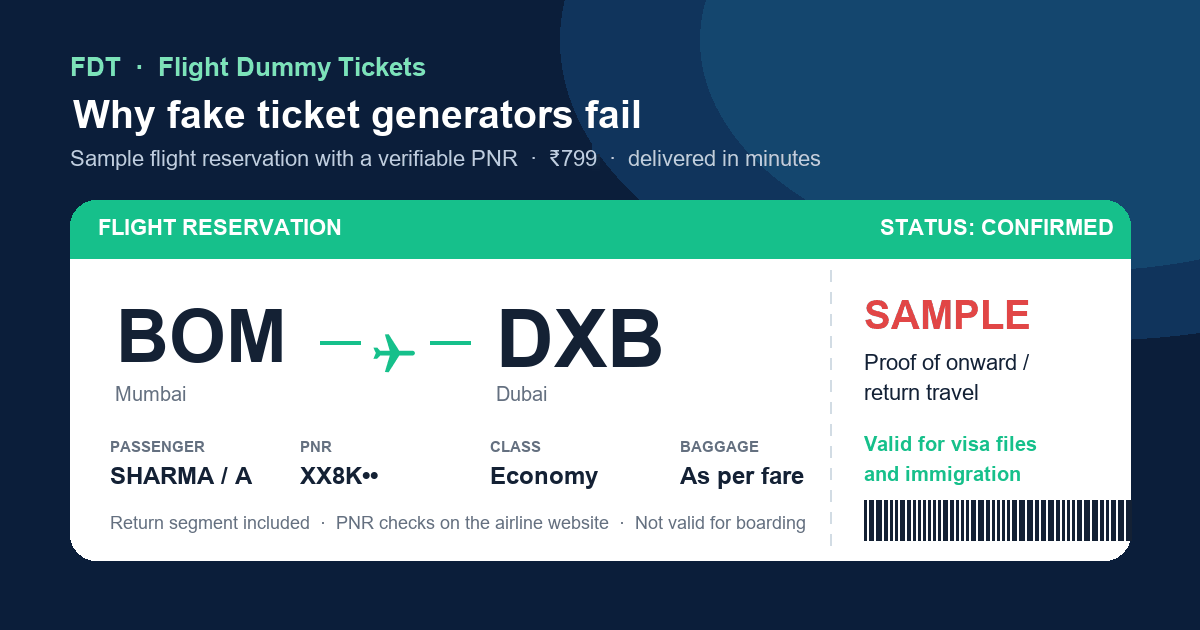
A dummy ticket is different. A dummy ticket is a temporary flight reservation, not a paid ticket, not for boarding, and it does not guarantee a visa. The difference is that a genuine dummy ticket is a real reservation, held for a short time, with a verifiable PNR. A generator PDF is a picture of a reservation that never existed. This guide explains, in practical detail, how generators fail, how embassies and VFS staff spot them, what the pattern of real cases looks like, and what to do instead if you are short of time or money. Always check your own embassy or VFS checklist before you submit. For UK topics, remember this throughout: UK guidance generally says do not routinely submit flight bookings unless transiting, so a generated UK booking is doubly pointless, unwanted and unverifiable.
Flight Dummy Tickets, or FDT, provides genuine temporary reservations at ₹799 / $10 flat per passenger, the same for One-Way, Return and Multi-City. Delivery is about 10 minutes, as a PDF by email and WhatsApp, with a verified PNR. Validity is up to 2 weeks, so always check your own reservation expiry. Payment is through Razorpay, UPI, cards and net banking, with 5% off every booking and 10% off for 3 or more passengers. Support is at support@flightdummytickets.com and on WhatsApp at +1 786 957 8117. FDT has delivered 20,000+ tickets. Those are the only commercial facts used here.
Key facts at a glance
| Question | Short answer |
|---|---|
| What is a fake ticket generator? | A tool that draws a flight PDF with no airline reservation behind it. |
| What is a dummy ticket? | A temporary flight reservation for visa purposes, not a paid ticket and not for boarding. |
| Why do generators fail? | No live PNR, wrong flight details, and template signs an officer can spot. |
| Can an officer tell the difference? | Often yes, in seconds, by checking the PNR or the flight schedule. |
| Does a fake ticket guarantee refusal? | It can lead to refusal, delay, or a credibility problem for future applications. |
| FDT price | ₹799 / $10 flat per passenger, One-Way, Return and Multi-City the same. |
| Delivery | About 10 minutes, PDF by email and WhatsApp, verified PNR. |
| Validity | Up to 2 weeks. Check your own reservation expiry. |
| Payment | Razorpay (UPI, cards, net banking). 5% off every booking, 10% off for 3+ passengers. |
| Support | support@flightdummytickets.com, WhatsApp +1 786 957 8117. |
| Does any ticket guarantee a visa? | No. No ticket, real or dummy, guarantees a visa. |
Why a free generator feels tempting at 11 p.m. the night before VFS
It is worth understanding the temptation honestly, because scolding people who use generators does not stop anyone using them. The temptation usually arrives late at night, the day before a VFS appointment that took weeks to get. The applicant has the passport, the photographs, the bank statements, the hotel bookings, and the insurance. The flight document is the last item. A friend on WhatsApp says, "Just generate one, everyone does it, nobody checks." A search result promises a free ticket in two minutes, no sign-up, no payment. The applicant types in a name, picks Delhi to Paris, picks dates, and a PDF appears that looks, at first glance, exactly like a real itinerary. It has a flight number, a time, a booking reference that looks like a PNR, and a neat layout. The relief is immediate. The problem is invisible, because the PDF does not carry a label that says "no reservation exists".
Money plays a part too. An applicant who has already spent on photographs, VFS fees, insurance, hotel bookings, and a visa fee may look at a ₹799 reservation and think, "Why pay when the free one looks the same?" The answer is that it does not look the same to the person who matters. It looks the same to the applicant, on a phone, at midnight. It does not look the same to an officer who has seen thousands of itineraries, or to a computer system that can check a PNR in seconds. The ₹799 is not paying for a prettier PDF. It is paying for a record in an airline system. A generator cannot sell you that record for free, because making a real reservation costs the seller time and a relationship with a booking system. When something is free and instant and asks for no details, ask yourself what is actually being created. In this case, the answer is a drawing, not a booking.
There is also a social pressure that Indian applicants mention often. A cousin, a colleague, or an agent says they used a generator last year and got the visa, so it must be safe. That story may even be true. Some generated PDFs do slip through, because not every file is checked in depth, and because a visa decision depends on the whole file, not on one document. But "someone got away with it" is not evidence that the document is safe. It is evidence that checking is sometimes light, which is a poor basis for risking your own application. The person who tells the story rarely tells you about the cousin who was refused, or the applicant who was asked for a fresh itinerary and missed the appointment slot, or the student whose credibility was questioned at an interview because a document did not check out. Those stories are less often shared, because they are embarrassing. The failures are real even when they are not posted in a family group.
Time pressure is the third reason, and it is the most sympathetic. VFS slots are scarce, especially in peak season from a city like Mumbai or Delhi. An applicant may have a slot tomorrow morning and no reservation yet. A generator promises a solution in two minutes. A genuine reservation takes about ten minutes with FDT, which is not much longer, but the applicant does not know that at midnight, and the generator's promise of "instant" feels faster than a process the applicant has never tried. The practical fix is to know, before the night before, that a genuine reservation can be made in about ten minutes, and to make it the day before the appointment rather than the night before, with time to check the PNR yourself. That one piece of planning removes the whole reason to reach for a generator.
What a generator actually produces, step by step
Open a typical generator site and the process is always the same, which is itself a clue. You enter a name, a departure city, an arrival city, a date, and sometimes a return date. You pick an airline from a drop-down, or the site picks one for you. You click generate. A PDF downloads. There is no payment page for a reservation, no contact with an airline, no hold placed on a seat, no email from an airline, and no booking reference that the airline recognises. The site has taken your inputs, pasted them into a template, and produced a document.
The template is the giveaway. Generators reuse the same layout for every user. The fonts, the spacing, the position of the flight details, the wording of the footer, and the style of the booking reference are identical from one PDF to the next, except for the name and dates you typed. An officer who sees many files a day learns to recognise that template, in the same way you learn to recognise a particular bank's statement format. The first time you see a generated PDF it looks like a real itinerary. The fiftieth time you see the same layout with a different name, you know what it is before you check the PNR.
The booking reference is the second giveaway. A generator invents a six-character code that looks like a PNR, because a real PNR is six characters. But inventing a code is not the same as creating a record. A real PNR is created by a reservation system when a booking is made. A generated code is a random string. When it is entered on the airline's website, the system returns "booking not found", because there is no booking to find. Some generators are more careful and copy a real PNR from a sample, or reuse the same PNR for many users. That fails in a different way: the PNR may bring up a booking, but for a different person, a different route, or a different date. An officer who checks it sees a mismatch and knows the document does not belong to the applicant.
The flight details are the third giveaway. A generator lets you pick any flight number, any time, and any route, without checking whether the airline operates that flight on that date. A user can generate a direct flight from Delhi to a small European city that has no direct flights from India, or a flight at 3 a.m. on a day the airline does not fly, or a flight number that belongs to a different route entirely. A genuine reservation can only show flights that exist, because it is created from the airline's schedule. A generated PDF can show anything the user types, and users often type something that is not a real flight. The officer does not need to be an aviation expert to spot this. A quick check of the airline's schedule, or of the PNR, is enough.
The fourth giveaway is what is missing. A generated PDF often has no contact details for the airline, no ticketing time limit, no fare note, and no consistent formatting between the outward and return sectors. It may show a ticket number that does not follow the format the airline uses, or a barcode that does not scan to anything. It may show a price that is obviously wrong for the route, or no price at all. Each missing detail on its own might be explained away. Together, they form a pattern that is hard to miss for someone who reads itineraries for a living.
The five ways a generated ticket fails in a real file
Generators do not fail in one way. They fail in at least five distinct ways, and understanding each one helps you see why "it worked for my friend" is not a defence.
The first failure is the PNR check. The officer, or VFS staff, enters the reference on the airline's site and gets nothing. This is the cleanest failure, because it is a fact, not an opinion. There is no booking. The document is not what it claims to be. In a Schengen file, where the flight reservation is a listed requirement, this can lead to a request for a genuine itinerary, which costs time and may mean a new appointment, or it can contribute to a refusal if the officer treats it as a misrepresentation. In a US file, where the interview matters more, a failed PNR may come up in the interview itself, which is a worse place to be caught out than in a paper check.
The second failure is the schedule check. The officer does not check the PNR, but notices that the flight number does not operate on that date, or that the route is not a direct flight, or that the arrival time is impossible given the departure time and the time difference. This failure does not require a computer. It requires a person who knows the route, or who checks the airline's timetable for thirty seconds. Indian applicants often choose popular routes, Delhi to Paris, Mumbai to Frankfurt, Bengaluru to London, which are routes officers know well. A wrong time on a popular route stands out.
The third failure is the consistency check. The generated PDF says one thing, and the rest of the file says another. The flight arrives in Paris on 10 December, but the hotel booking starts on 12 December. The return flight leaves Rome on 22 December, but the insurance ends on 20 December. The cover letter says the applicant is travelling with a spouse, but the flight PDF shows one passenger. These mismatches can happen with a genuine reservation too, if the applicant is careless, but they are more common with generated PDFs, because the generator does not know about the hotel or the insurance. The applicant types dates into the generator from memory, and memory is often a day out. A genuine reservation is usually made with the hotel dates open on the screen, because the seller asks for them. A generator asks for nothing except the flight dates, so the cross-check never happens.
The fourth failure is the template recognition described above. The officer has seen the same generator layout before, perhaps that morning, from a different applicant. The layout is recognised before the PNR is checked. At that point, the officer is not asking "is this reservation real?" but "why did this applicant submit a document from a known generator?" That is a credibility question, and credibility questions are harder to recover from than a simple missing document, because they colour how the officer reads the bank statements, the employment letter, and the cover letter that follow.
The fifth failure is the interview failure. For visas that involve an interview, such as the US B1/B2, the officer may ask a simple question: "Which flight are you taking?" or "What time does your flight leave?" An applicant with a genuine reservation can answer, because they chose the flight, checked the time, and know the route. An applicant with a generated PDF often cannot answer, because they did not choose a real flight. They typed a city and a date into a website and downloaded a PDF. They do not know the flight number, the layover, or the arrival time, because they never looked at a real schedule. The hesitation, or the wrong answer, tells the officer more than the PDF did. A paper check can be passed by luck. An interview check is harder to pass without a real plan.
The pattern of real cases: what actually happens next
No honest guide can quote individual refusal letters it has not seen, and this guide will not invent case numbers or embassy stamps. What it can do is describe the pattern that applicants, agents, and advisers report repeatedly, because the pattern is consistent even when the individual details differ.
The mildest outcome is a request for more documents. The embassy or VFS contacts the applicant and asks for a genuine flight itinerary or reservation. The applicant then has to obtain one quickly, often while the appointment slot has passed, and submit it within a deadline. If the applicant acts fast, the application may still succeed, but time has been lost, and in peak season a delay of a week can mean missing the intended travel dates. The applicant then needs a fresh reservation for new dates, and the hotel and insurance dates may need to change too. A problem that could have been avoided in ten minutes becomes a problem that takes a week to fix.
The next outcome is a delay without a formal request. The file is held while the officer checks other documents more carefully, because one document has raised a doubt. The applicant hears nothing for weeks, and assumes the delay is normal processing time. It may be, but it may also be that the file has been flagged for closer scrutiny. The applicant cannot know, and cannot fix a problem they do not know exists. This is the most frustrating outcome, because there is no letter to respond to and no clear next step.
The next outcome is a refusal in which the flight document is one of several reasons, or is mentioned in general terms such as the purpose of travel not being established, or the documents submitted not being reliable. A refusal letter rarely says "your flight ticket was generated". It says something broader, about the applicant not having demonstrated the purpose and conditions of the intended stay, or about the information submitted not being reliable. The applicant may then focus on the bank statement or the cover letter, and miss that the flight document was the trigger. That is why it is important to treat every document as if it will be checked, rather than assuming a refusal must have been about the most obvious document.
The most serious outcome is a credibility finding that affects future applications. Visa systems keep records. A finding that a document was not genuine can make the next application harder, because the next officer will see the history and will check the next file more carefully. This does not happen in every case, and it should not be exaggerated, but it is a real risk that a free generator does not mention on its homepage. The generator's promise is "free and instant". It does not promise "safe for your next application in two years' time". An applicant who is planning to travel regularly, for business, for family, for study, should think about the second application as well as the first.
There is also a practical cost that is rarely counted. An applicant who is refused, or delayed, may lose the VFS fee, the insurance premium, and the hotel booking deposit, and may have to pay for a fresh appointment. The saving from using a free generator is, at most, the price of a genuine reservation, ₹799 with FDT. The cost of a delay or a refusal is many times that, in money and in missed travel. The arithmetic is not close. It only looks close at midnight, when the generator is free and the genuine reservation feels like an extra expense.
For the genuine alternative, read what is a dummy ticket and dummy ticket vs real ticket. For how to check a real reservation, read how to verify dummy ticket PNR. For the risks of free offers in general, read free dummy ticket generator risks.
How officers and VFS staff actually spot a generated PDF
It helps to picture the desk where your file is opened. The person opening it is not a detective with a magnifying glass. They are a trained staff member who has opened hundreds of similar files, often in the same week, and who has a checklist and a computer. They are not looking for a reason to refuse you. They are looking for consistency, and they have a few quick checks that take seconds.
The first check is visual. Does the itinerary look like the itineraries this airline normally issues? Is the layout familiar? Are the fonts, the spacing, and the position of the PNR where they usually are? A generated PDF often looks slightly too clean, or slightly too generic, because it was designed to look like an itinerary in general, not like a specific airline's itinerary in particular. A real itinerary from a specific airline carries that airline's quirks, a particular way of writing the airport code, a particular footer, a particular order of information. A generic template does not have those quirks. It has the quirks of the generator, which are the same for every user.
The second check is the PNR. The staff member may enter the reference on the airline's website, or may check it in the system VFS or the embassy uses. This takes less than a minute. If it returns a booking, the check passes and the staff member moves on. If it returns nothing, the staff member notes it. They do not need to prove the PDF is fake in a court. They need to decide whether the document can be relied on. A reference that returns nothing cannot be relied on.
The third check is the flight itself. The staff member may know the route, or may look it up. Delhi to Paris is a route many officers know by heart, because so many Indian applicants fly it. They know which airlines fly it direct, what time the flights usually leave, and how long they take. A generated PDF that shows a direct flight at a time no airline flies direct, or a flight number that does not exist, will be noticed. This is not specialist knowledge. It is the knowledge that comes from seeing the same route every day.
The fourth check is the file as a whole. Does the flight match the hotel? Does the hotel match the insurance? Does the insurance match the cover letter? Does the cover letter match the application form? A generated PDF is often the one document that does not match, because it was created in isolation, without reference to the other documents. The mismatch may be a single day, or a single city, but it is enough to prompt a closer look at the rest of the file.
None of these checks requires the officer to be suspicious of you personally. They are routine. The problem with a generated PDF is not that it will definitely be caught. It is that it can be caught by a routine check, in seconds, by a person who is not trying to catch you. That is a poor bet to place on a visa application that matters to you, when a genuine reservation can be made in about ten minutes and checked by you before you submit it.
Schengen, the United States and the United Kingdom: where generators fail most
The risk of a generated PDF is not the same for every destination, because the role of the flight document is not the same. Knowing the difference helps you decide where the risk is highest and where a flight document is not needed at all.
For Schengen, the risk is highest, because the flight reservation is a standard, listed requirement. The checklist asks for it, the officer expects it, and the file is reviewed as a set of documents. A generated PDF in a Schengen file is a direct failure to meet a listed requirement with a genuine document. The Schengen hub guide, dummy ticket for Schengen visa, explains what the checklist asks for, and the country guides for dummy ticket for France visa, dummy ticket for Germany visa and dummy ticket for Italy visa show how the same requirement is worded for the countries most Indians visit first. If you are applying for Schengen, do not use a generator. Use a genuine reservation, time it close to your appointment, and check the PNR yourself.
For the United States, the risk is different but still real. A B1/B2 application is centred on the interview, and applicants are generally advised not to buy a full ticket before approval. Some applicants include a flight reservation to show a plan, and that can be helpful if it is genuine and consistent. A generated PDF in a US file is less likely to be the sole reason for a refusal, because the interview matters more, but it is more likely to cause a problem in the interview itself, when the officer asks about the flight and the applicant cannot answer. Read dummy ticket for USA B1/B2 visa before you decide what to include, and do not include a generated document in the hope that the interview will not touch on it. The interview is exactly where a paper shortcut is most likely to be exposed.
For the United Kingdom, the position is the clearest of all, and it is the opposite of what many applicants assume. UK guidance generally says do not routinely submit flight bookings unless transiting. That means for a standard UK visitor visa, you should not be submitting a flight booking at all, genuine or generated. A generated UK booking is therefore not just unverifiable, it is unnecessary. Check the current guidance on gov.uk and your own checklist, and read dummy ticket for UK visa for the full explanation. If you are transiting through the UK, and a booking is requested for that transit, then it must be a genuine, verifiable reservation, not a generated one. The same verification rules apply.
For Canada, Australia, Dubai and Thailand, the pattern is closer to Schengen. A flight itinerary is commonly requested or helpful, and a generated PDF fails in the same ways: no PNR, wrong schedule, template recognition, and inconsistency with hotel and insurance. The guides for dummy ticket for Canada visa, dummy ticket for Australia visa and dummy ticket for Dubai visa set out what each destination expects. In every case, check your own embassy or VFS checklist on vfsglobal.com where VFS handles the application, and follow that checklist.
What to do if you have already used a generator
If you are reading this after already generating a PDF, do not panic, and do not submit it in the hope that it will pass. You have time to fix this, provided your appointment has not yet happened. The fix is simple, even if it feels annoying after you have already spent time on the generator.
First, delete the generated PDF from the folder you will upload from, so you do not pick it by mistake later. Rename it, move it to a different folder, or delete it entirely. The risk of submitting the wrong file by accident is real, especially when you have several PDFs with similar names. Remove the temptation.
Second, make a genuine reservation for the same travel dates, with the names exactly as in the passport, and check the PNR yourself on the airline's website before you do anything else. With FDT, this takes about 10 minutes, the price is ₹799 / $10 flat per passenger, and the PDF arrives by email and WhatsApp. Time it close to your appointment, because validity is up to 2 weeks and you should check your own reservation expiry.
Third, check the genuine reservation against your hotel bookings, insurance, and cover letter, night by night and date by date, and correct any mismatches before you submit. The generator may have used dates that were a day out, or a return city that does not match your hotel. Do not copy the generator's dates into the genuine reservation without checking them. Start from the hotel and insurance dates, which are the fixed points, and make the flight match them.
Fourth, if you have already submitted a generated PDF, do not try to fix it by editing the PDF or by sending a second, different PDF without being asked. Contact the embassy or VFS through the proper channel, explain that you wish to provide a corrected flight itinerary, and ask how to submit it. Keep the correspondence. If you are asked to attend an interview, be honest about what happened. An applicant who says, "I used a free generator, I realised it was not a real reservation, and I have now provided a genuine one," is in a better position than an applicant who defends a document that does not check out. Honesty does not guarantee success, but dishonesty, once spotted, makes success much harder.
Fifth, if an agent or a friend generated the PDF for you, tell them you need a genuine reservation instead, and do not use that agent for the flight document again if they insist a generator is fine. An agent who is comfortable submitting a fabricated document for you will be comfortable doing it for the next client too, and that is not an agent you want handling your file.
The honest alternative, and how to get it in ten minutes
The alternative to a generator is not a paid ticket for ₹60,000. It is a temporary reservation, made for visa purposes, with a real PNR, for a small flat fee. That is what a dummy ticket is, when it is genuine. A dummy ticket is a temporary flight reservation, not a paid ticket, not for boarding, and it does not guarantee a visa. It is a reservation held for a short time, issued as a PDF that looks like a normal itinerary, with your name, the flight sectors, the dates and a PNR you can check.
Booking with FDT works like this. Choose your route and dates, enter passenger names exactly as in the passport, pay via Razorpay with UPI, a card, or net banking, and receive the PDF by email and WhatsApp in about 10 minutes. The price is ₹799 / $10 flat per passenger, the same for One-Way, Return and Multi-City, with 5% off every booking and 10% off for 3 or more passengers. Validity is up to 2 weeks, so check your own reservation expiry and book close to your appointment. Support is at support@flightdummytickets.com and on WhatsApp at +1 786 957 8117. FDT has delivered 20,000+ tickets.
When the PDF arrives, do the check that a generator PDF cannot pass. Go to the operating airline's website, enter the PNR and your surname, and see your booking. Check the name, the dates, the airports, and the expiry. Check the dates against your hotel and insurance. Then, and only then, upload or print the PDF. That ten-minute check is the difference between a document you can defend and a document you have to hope nobody checks.
For the booking steps, read how to book dummy ticket online. For the price in Indian terms, read dummy ticket price in India. For how long the reservation lasts, read dummy ticket validity how long. For what to check in the PDF before you upload it, read dummy ticket PDF check before upload. For the wider mistakes that lead to refusals, read dummy ticket mistakes visa rejection.
Book your dummy ticket, ₹799 flat
One-Way, Return or Multi-City, with a verified PNR. Delivered in about 10 minutes by email and WhatsApp.
Book Dummy Ticket, ₹799 WhatsApp UsWhy "everyone does it" is the worst reason to use a generator
The phrase "everyone does it" is heard often in visa preparation, and it is worth examining, because it is used to justify shortcuts in many areas, not just flight tickets. The logic is that if many people do something and some of them get visas, the thing must be safe. The logic is flawed, because it confuses "not always caught" with "safe", and it ignores the people who were caught and did not tell you.
Consider a different example. Many people cross a road without looking, and most of them reach the other side. That does not make crossing without looking safe. It makes it lucky. A visa application is not a road you cross every day. It is a formal application, with a fee, a record, and a decision that affects your travel plans and, potentially, your future applications. The standard should not be "did someone else get away with it?" The standard should be "can I defend this document if it is checked?" A genuine reservation passes that test. A generated PDF does not.
Finally, there is a personal point. A visa application is a statement about you. It says: I am a person who plans a trip, who can afford it, who has a reason to return, and who submits documents that can be checked. A generated PDF says the opposite, even if you did not intend it to. It says: I was willing to submit a document that looked real but was not, to save a small fee or a few minutes. An officer who spots that will wonder what else in the file was produced the same way. That wonder is the real cost of a generator, and it is not measured in rupees. It is measured in trust, and trust, once lost in a visa file, is very hard to win back in the same application.
Official guidance to check alongside this guide: VFS Global on vfsglobal.com, the European Commission Schengen guidance on ec.europa.eu, and UK visa guidance on gov.uk. Those sources tell you what your embassy actually asks for. A generator site tells you what it wants to sell you, which is nothing, and that is the problem, it is selling you nothing, dressed up as a ticket.
A side-by-side comparison you can do on your own phone
The clearest way to understand the difference between a generated PDF and a genuine reservation is to compare them side by side, using the same route and the same dates. You do not need to buy anything to do the first half of this comparison. Generate a PDF from a free generator for a Delhi to Paris trip on a date of your choice, and look at it carefully. Then look at a genuine itinerary you have received in the past for a real paid flight, or at the sample structure described in the guides linked in this article, and compare the two. The differences will be visible even before you check a PNR.
Start with the header. A genuine itinerary usually names the airline clearly, shows its contact details, and uses the airline's own formatting for the booking reference. A generated PDF often names the airline in a generic way, or shows a logo that is slightly blurred or stretched, because the generator has copied it from the internet rather than receiving it from the airline's system. The difference is subtle on a phone screen, but it is there if you zoom in. A blurred logo on a document that claims to be from an airline is a sign the document was not issued by that airline.
Next, look at the flight line. A genuine itinerary shows the flight number, the departure and arrival airports by code and by city name, the date, the departure time, the arrival time, and the duration. It shows the aircraft type sometimes, and the class of travel. A generated PDF often shows the flight number and the times, but not the duration, or shows a duration that does not match the times. For example, a flight that leaves Delhi at 2 a.m. and arrives in Paris at 7 a.m. should take about eight to nine hours, allowing for the time difference. If the PDF says the duration is four hours, the numbers do not add up. A genuine system calculates the duration from the schedule. A generator calculates nothing. It pastes the numbers the user typed, or the numbers its template contains, without checking whether they agree with each other.
Next, look at the passenger section. A genuine itinerary shows the full name, often with a title, and sometimes the frequent flyer number or the passport number if it was provided. A generated PDF shows the name you typed, and nothing else, because the generator has no other information about you. That on its own is not proof of fakery, because a temporary reservation may also show only the name. But combined with other signs, it adds to the pattern. A document that knows nothing about you except the name you typed into a web form is a document that was created by that web form, not by an airline.
Next, look at the footer. A genuine itinerary often has a footer with a ticketing time limit, a fare basis, or a note about changes and cancellations. A generated PDF often has a footer that says nothing, or that contains a generic line such as "Have a nice trip" with no contact details. A real booking system always gives you a way to contact the airline or the agent. A generator gives you no way to contact anyone, because there is no one to contact. If you have a question about the booking, the generator site has no answer, because there is no booking to ask about.
Finally, do the PNR test on both. Enter the generated reference on the airline's site and note the result. Then, if you have a genuine reservation, enter its PNR and note the result. The contrast is the lesson. One returns a booking. The other returns an error. That error is not a technical glitch. It is the system telling you the truth about the document. Once you have seen that contrast for yourself, you will not need to take anyone's word for it again, and you will be able to spot a generated PDF in future without needing to check every detail.
What agents and friends will not tell you about generators
Agents who use generators rarely describe them as generators. They describe them as "dummy tickets", "flight reservations", or "itineraries", using the same words that are used for genuine products. That is part of the problem. The language is the same, so the applicant cannot tell from the words alone whether the product is genuine. The applicant has to ask the right questions, and the agent's answers will tell the story.
Ask the agent: "What is the PNR, and which airline's website can I check it on?" A genuine agent will give you the PNR, the airline, and the website, and will encourage you to check it. An agent using a generator will hesitate, or will say the PNR can only be checked on their own website, or will say checking is not necessary. That hesitation is your answer. A real reservation can be checked on the airline's site. A generated one cannot, so the agent has to discourage you from trying.
Ask the agent: "What is the validity, and what is the expiry date?" A genuine agent will give you a date, usually up to two weeks from booking, and will tell you to time the booking close to your appointment. An agent using a generator will say the ticket is valid for a long time, or will not give a date at all, because a generated PDF has no expiry. It is a drawing, and drawings do not expire. The absence of an expiry is not a benefit. It is a sign there is no hold to expire.
Ask the agent: "Can I see the booking on the airline's app?" A genuine agent will say yes. An agent using a generator will say the app is not needed, or that the PDF is enough. The PDF is never enough on its own. The PDF is a representation of a booking. The booking is the thing that matters, and it lives in the airline's system, not in the PDF.
Friends who recommend generators are usually trying to help, and they may genuinely believe the generator worked for them. Ask them a different question: "Did anyone check the PNR?" Most of them will say they do not know, or that nobody checked. That is the point. The generator worked for them in the sense that nobody checked. It did not work in the sense that it was a genuine document. The next time, someone may check, and the friend's advice will not protect you then. Thank the friend for trying to help, and make a genuine reservation instead. The price is small, the time is short, and the peace of mind is real.
There is also a question to ask yourself. If an agent offers you a flight document for free, or for a price far below the normal range, and promises instant delivery with no questions about your passport name or travel dates, what is the agent actually selling? A genuine reservation requires your correct name, your correct dates, and a hold in a booking system. A seller who does not ask for those details is not making a reservation. They are running a template. Walk away, and find a seller who asks you for the details that matter, because those questions are a sign the seller is doing the job properly.
How to explain a genuine dummy ticket if an officer asks
Some applicants worry that even a genuine dummy ticket will be treated as fake, because the word "dummy" sounds suspicious. That worry is understandable, but it is misplaced if the document is genuine and you describe it honestly. Officers know what a flight reservation for visa purposes is. They see them every day. The word "dummy" is used by applicants and agents, but in a cover letter you should use the more formal language the embassy itself uses: "flight reservation", "flight itinerary", or "provisional flight booking for visa purposes". That language is accurate, and it avoids the impression that you are trying to hide what the document is.
If an officer asks, "Is this a paid ticket?" the honest answer is no, it is a temporary reservation made for visa purposes, with a verifiable PNR, and you will buy a paid ticket after the visa is approved. That answer is not a weakness. It is the correct answer, and it shows you understand the process. If you instead say, "Yes, this is my ticket," when it is not a paid ticket, you have misdescribed the document, and that misdescription will cause a problem if the officer checks and finds no ticket number. Honesty about a temporary reservation is stronger than a false claim about a paid ticket.
If an officer asks, "Why did you not buy a full ticket?" the honest answer is that embassies generally ask for a reservation, not a paid ticket, and that buying a full ticket before approval would risk a large non-refundable fare. That is a reasonable answer, and it is one officers hear often. It is not an excuse. It is the reason the reservation system exists. A genuine dummy ticket is not a way of cheating the system. It is a way of using the system as it was designed to be used, with a reservation instead of a paid fare.
Keep your language consistent across the file. Your cover letter, your application form, and your conversation at the interview, if there is one, should all describe the flight document in the same way. If the cover letter says "flight reservation", the interview answer should not be "my ticket is confirmed and paid". That inconsistency, even if innocent, will create doubt. Write the cover letter from the PDF, using the words on the PDF, and rehearse the answer you will give if asked. That rehearsal takes five minutes, and it prevents a moment of panic in the interview when a simple question is asked and the applicant, who has a genuine document, answers as if they have something to hide.
The cost of getting this wrong, counted properly
It is worth counting the cost of a failed generator properly, because the generator's appeal is that it is free, and the genuine alternative's cost is visible, while the cost of failure is hidden until it happens. Count it now, before you decide.
A genuine reservation with FDT costs ₹799 / $10 per passenger, with 5% off every booking and 10% off for 3 or more passengers. That is the visible cost. It is a small fraction of the total cost of a Europe trip, which includes the visa fee, VFS charges, insurance, hotel bookings, and the eventual paid flight, which will cost many times more. It is also a small fraction of the cost of a single night in a Paris hotel. In the context of the trip, it is not a significant expense. It is a paperwork cost, like the photographs or the travel insurance, and it should be budgeted in the same way.
The cost of a generator that fails is harder to count, but it is larger. A request for a fresh itinerary costs time, and time in peak season can cost an appointment slot. A delay can cost the travel dates themselves, if the visa is not decided before the intended departure. A refusal costs the visa fee, the VFS fee, and the insurance premium, and it costs the applicant the need to apply again, with a fresh fee, and with a history that will be seen by the next officer. A credibility finding costs more than money. It costs trust, and trust is the currency of a visa application. None of those costs are certain if you use a generator. They are possible, and they are large enough that the saving of ₹799 is not worth the risk.
If money is genuinely tight, and ₹799 feels like a lot, consider the timing. A reservation is valid for up to 2 weeks, so you do not need to buy it weeks before the appointment. Buy it a few days before, when you know the appointment is confirmed, and you will not need to buy it twice. If you are travelling as a family, the 10% discount for 3 or more passengers reduces the per-person cost. If you are travelling alone, the 5% discount on every booking helps a little. Those discounts do not make the reservation free, but they make it cheaper than the cost of a single meal in the city you are planning to visit, and they are a reminder that the genuine product is priced for applicants, not for airlines. The generator is free, but it is free because it provides nothing. The genuine reservation is inexpensive because it provides a real hold for a short time, not a paid ticket for a large fare. That is a fair price for what it is, and it is worth paying.
Ready to book?
Get your dummy ticket for ₹799 per passenger, with a verified PNR, in about 10 minutes.
Book Dummy Ticket, ₹799Dummy ticket options compared
Use this when you are deciding between a free generator PDF, a fully paid ticket, and a verifiable reservation.
| Option | Airline-checkable PNR | Typical cost | Best for |
|---|---|---|---|
| Free PDF generator | No | ₹0 | Never for embassy/VFS upload |
| Fully paid ticket | Yes | Full airfare | When dates are locked and refundable |
| FDT verifiable dummy ticket | Yes | ₹799 / passenger | Visa file before dates are final |
Official sources to check before you apply
Always match your documents to the embassy or VFS checklist for your nationality. These are the primary references we used while writing this page:
Frequently asked questions
1. What is a fake flight ticket generator? A tool that draws a flight PDF with no airline reservation behind it.
2. Why do generator tickets fail? No live PNR exists, so an airline check returns nothing.
3. Can an officer spot a generated ticket? Often yes, by PNR check, schedule check, or template recognition.
4. Is a dummy ticket the same as a generated ticket? No. A genuine dummy ticket is a real temporary reservation with a verifiable PNR.
5. Can I board a flight with a dummy ticket? No. It is not a paid ticket and cannot be used for boarding.
6. Does a dummy ticket guarantee a visa? No. No ticket guarantees a visa.
7. How much is a genuine FDT reservation? ₹799 / $10 flat per passenger, One-Way, Return and Multi-City the same.
8. How fast is FDT delivery? About 10 minutes, PDF by email and WhatsApp.
9. How long is an FDT reservation valid? Up to 2 weeks. Check your own reservation expiry.
10. Should I submit a flight booking for a UK visa? UK guidance generally says do not routinely submit flight bookings unless transiting.
11. What if I already used a generator? Do not submit it. Get a genuine, verifiable reservation instead.
12. How do I verify a genuine reservation? Enter the PNR and surname on the airline's Manage Booking page.