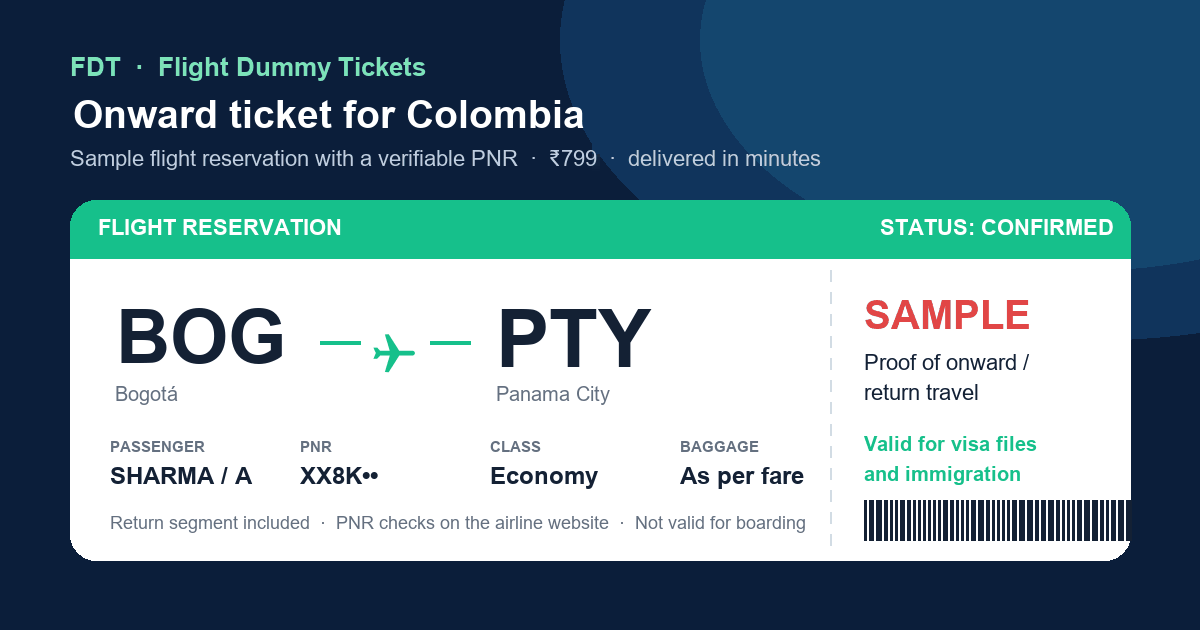
The short answer first
Colombia is a country that Indian travellers often discover late, and then love, Bogotá, Medellín, Cartagena, the coffee region, and the Caribbean coast are all worth the long flight. But Colombia is also a country that checks entry documents carefully, and the onward ticket is part of that check. Indian passport holders need a visa for Colombia in most cases, unless they hold a valid visa for the United States or the Schengen area, which can change the entry route, so check the current rule for your situation before you travel. In every case, you need a ticket out of Colombia, in your name, for a date inside your permitted stay, with a verifiable booking reference, and you need to complete the Check-Mig form before arrival. The airline will check your onward ticket at departure, and immigration at Bogotá's El Dorado Airport may ask to see it. A dummy ticket is a temporary flight reservation for visa purposes. It is not a paid ticket, it is not for boarding, and it does not guarantee a visa or entry. With FDT it costs ₹799 / $10 flat per passenger, the same for One-Way, Return and Multi-City, delivered in about 10 minutes as a PDF by email and WhatsApp with a verified PNR, valid for up to 2 weeks. Payment is through Razorpay, UPI, cards and net banking, with 5% off every booking and 10% off for 3 or more passengers. Support is at support@flightdummytickets.com and on WhatsApp at +1 786 957 8117. FDT has delivered 20,000+ tickets. Always check your own embassy checklist before you submit; if this guide and your checklist disagree, follow the checklist.
Key facts at a glance
| Question | Short answer |
|---|---|
| Do Indians need a visa for Colombia? | Yes, in most cases. A valid US or Schengen visa may change the route, check the current rule. |
| Is an onward ticket required? | Yes, in practice. Airlines check it, and Bogotá immigration may ask for it. |
| What is Check-Mig? | Colombia's online immigration form, completed before arrival and before departure. |
| Does it have to be a paid ticket? | No. A flight reservation with a verifiable PNR is normally accepted for the visa. |
| What must it show? | Your name as in your passport, departure date from Colombia, destination outside it, flight number and PNR. |
| FDT price | ₹799 / $10 flat per passenger, same for One-Way, Return and Multi-City. |
| FDT delivery | About 10 minutes, PDF by email and WhatsApp, verified PNR. |
| FDT validity | Up to 2 weeks. Check your own reservation expiry. |
| FDT payment | Razorpay (UPI, cards, net banking). 5% off every booking, 10% off for 3+ passengers. |
| FDT support | support@flightdummytickets.com, WhatsApp +1 786 957 8117. 20,000+ tickets delivered. |
| Does it guarantee entry? | No. No ticket guarantees a visa or entry. |
Contents
- Why Colombia checks your exit, and why Bogotá is the place it happens
- Check-Mig: the form that records your departure before you land
- Visa routes for Indians: direct visa, and the US / Schengen visa route
- The airline check on the long journey to Colombia
- El Dorado immigration: the questions, and the documents that answer them
- What your Colombia onward reservation must show, line by line
- Return to India, onward to Panama, or onward to the United States?
- The 90-day stay, and why your flight must sit inside it
- Bogotá, Medellín, Cartagena: the multi-city file
- Hotels, money and the rest of the entry file
- Families, first-timers and business travellers
- When your dates change, and how to fix a file quickly
- Frequently asked questions
1. Why Colombia checks your exit, and why Bogotá is the place it happens
Colombia's main international gateway is El Dorado International Airport in Bogotá, and it is there that most Indian travellers will meet Colombian immigration for the first time. The airport is large, modern, and busy, and the immigration hall is built for volume. You will land after a long flight, usually via Europe, the Middle East, or Panama, walk to immigration, join a queue, and present your passport and visa. The officer will look at your passport, your visa, your Check-Mig form, and your documents, and they will ask a few questions. One of them will be about when you are leaving, and how.
The reason Colombia asks is the same reason most countries ask: it wants to know you will leave before your permitted stay ends. Colombia commonly allows visitors to stay for up to 90 days, but the exact period is stamped in your passport on arrival, and it is that stamp that matters. A return flight is the simplest evidence that you have thought about the end of the trip, not just the beginning. A traveller who arrives with a hotel in Bogotá for three nights, a plan to see Medellín and Cartagena, and no flight out of Colombia has a file with no end. The officer has to ask where the trip ends. Does it end in Cartagena? Does the traveller fly home from Cartagena? Do they go on to Panama and then home? Or do they have no plan at all? A reservation answers that in one line. Without it, the conversation becomes longer, and longer conversations at immigration are rarely good news.
There is a second reason, specific to Colombia. Colombia has worked hard to build its tourism industry, and it wants visitors who come, spend money, and leave on time. It does not want visitors who arrive with no plan to leave, overstay, or work without permission. The onward-ticket rule is one of the tools it uses to manage that, and it is applied consistently. It does not mean Colombia distrusts Indian travellers specifically. It means the rule is applied to everyone, and Indian travellers should expect it to be applied to them. Being polite, well-dressed and well-prepared helps, but it does not replace the document. The document is the proof. Your manner is the supporting evidence.
Priya from Bengaluru learned this on her first trip to Colombia. She was planning a 16-day trip: Bogotá for four nights, Medellín for four nights, the coffee region for three nights, and Cartagena for four nights, before flying home. Her first draft of the file had a one-way reservation to Bogotá and a note in her cover letter saying she would book the return later, once her leave was confirmed. Her agent pointed out the problem in one sentence: the embassy would read that as a trip with no end. She changed the reservation to a return, Delhi to Bogotá on 10 April, Cartagena to Delhi on 26 April, via Bogotá, and the file suddenly made sense. Hotels, insurance and cover letter all ended on 26 April. The visa was granted without a query. The lesson is not that a one-way ticket is forbidden. It is that a tourist trip without a visible end looks unfinished, and unfinished files get questions. Our guide on onward travel proof explained explains the general idea, and what is a dummy ticket explains the reservation itself.
2. Check-Mig: the form that records your departure before you land
Check-Mig is Colombia's online immigration form, and it is one of the most important documents for a Colombia trip, because it records your departure date before you land. You complete it online before arrival, usually within 72 hours before your flight, and also before departure from Colombia, and you show the confirmation on arrival. The form asks for your personal details, your passport details, your flight into Colombia, your address in Colombia, and your date of departure from Colombia. That last field is where the onward ticket meets the arrival form, and it is where travellers make mistakes.
Fill in Check-Mig from your reservation, not from memory. Open the PDF, copy the departure date, the flight number, and the departure airport, and type them into the form. Check the spelling of your name against your passport. If your passport says "Arjun Mehta" and you usually write "Arjun", write "Arjun Mehta" on the form. The form is an official immigration record, and it should match your passport and your reservation. If you write 26 April on Check-Mig and your flight is on 28 April, the immigration officer sees a mismatch. If you write 28 April and your hotel ends on 26 April, the officer sees two nights with no accommodation. If you write a departure airport that is different from the airport on your reservation, the officer will ask which one is correct.
There is a timing point as well. Check-Mig is usually completed within 72 hours before arrival, which means you complete it after you have booked your flight, not before. Do not complete Check-Mig with a guessed departure date and then book a flight for a different date. Book the flight first, then complete Check-Mig from the flight. If your flight changes after you have completed Check-Mig, update the form if the system allows it, or be ready to explain the change at the counter with the new reservation in hand. A changed flight with an updated Check-Mig is a normal situation. A changed flight with an old Check-Mig that says something different is a question.
Families should complete a Check-Mig form for each traveller, and each traveller's departure date should be the same, unless someone is genuinely leaving on a different date. If a family of four arrives together and the forms show three different departure dates, the officer will ask why. Keep the family on the same flight out, or explain clearly why one person is leaving earlier or later. Children need their own form, and their departure date should match the family's flight. Save the Check-Mig confirmation as a PDF or a screenshot, and keep it with your return flight PDF. Do not rely on airport Wi-Fi to open it. El Dorado has Wi-Fi, but it can be slow at peak hours, and the immigration queue is not the place to wait for a page to load. Have both documents ready before you land, in the same folder, so you can show them in seconds. Our guide on dummy ticket for family group booking explains family bookings in more detail.
3. Visa routes for Indians: direct visa, and the US / Schengen visa route
Indian passport holders should check the current Colombia visa rule for their situation before they book anything, because there are two routes, and the route changes the file. The first route is a direct Colombia visa, applied for through the Colombian embassy or consulate. That visa requires a full file: passport, application form, photographs, bank statements, employment proof, hotel bookings, itinerary, and flight reservation. The flight reservation should show a return or onward flight out of Colombia, for a date inside the permitted stay. That is the route most first-time Indian travellers take, and it is the route this guide assumes unless stated otherwise.
The second route applies to travellers who already hold a valid visa for the United States or the Schengen area. Colombia has, at various times, allowed holders of those visas to enter without a separate Colombia visa, subject to conditions on the validity and type of the visa they hold. The conditions change, and they are specific, for example, the visa may need to be valid for a minimum period, or to be a multiple-entry visa. Do not assume you qualify. Check the current rule on the official Colombia immigration website or with the embassy, and check it again close to your travel date. If you qualify, you still need an onward ticket. The visa exemption, where it applies, exempts you from the visa. It does not exempt you from the onward-ticket rule, the Check-Mig requirement, the hotel requirement, or the proof-of-funds requirement.
Whichever route you take, the flight file is the same. Show a return or onward reservation, in your name, with a verifiable PNR, for a date inside your permitted stay. If you are travelling on the US-visa route, show the US visa as well, and make sure it is valid for the whole trip and for the return journey if you are transiting through the United States. Transiting through the United States on the way to Colombia is common, because many flights from India to Bogotá go via the US, Europe, or Panama. Each transit has its own rules. A transit through the US requires a US visa, which Indian passport holders do not generally have for transit alone, so most Indian travellers transit via Europe, the Middle East, or Panama instead. Check your transit route carefully, and make sure you can legally transit through each airport on your itinerary. A flight that transits through a country you cannot enter is not a usable flight, even if the ticket is real. The guide on dummy ticket for USA B1 B2 visa explains the US visa file, and dummy ticket for Schengen visa explains the Schengen file.
4. The airline check on the long journey to Colombia
Colombia is a long way from India, and the journey usually involves one or two changes of plane, via Dubai, Doha, Madrid, Amsterdam, Paris, Frankfurt, or Panama City. Each change is a place where your documents may be checked, and the onward ticket will be checked at least once, often twice. The first check happens at check-in in India. The airline will ask for your passport, your visa, your Check-Mig confirmation, and your ticket out of Colombia. If you have a clear reservation, the conversation takes thirty seconds. If you do not, it can take thirty minutes, and it can end with you not being allowed to board.
The reason the airline is careful is the same as in other countries: if you are refused entry in Bogotá, the airline must fly you back, and it may be fined. So check-in staff are trained to ask for a return or onward ticket when the destination requires one. Have the PDF ready, with the PNR visible, and make sure the name matches your passport exactly. A middle name missing, a surname spelled differently, or a first name and surname swapped can turn a valid reservation into a question. Check the spelling before you leave home, not at the airport. The guide on dummy ticket PDF check before upload explains the line-by-line check to do before you travel.
The second check happens at the transit airport. If you fly Delhi to Bogotá via Panama City, the airline in Panama will check your documents for Colombia before you board the Panama to Bogotá flight. If you fly via Madrid, the airline in Madrid will do the same. Your reservation should show the whole journey, or at least the leg into Colombia and the leg out of Colombia, so that each check is answered by the same document. Keep the PDF saved offline on your phone, and keep a printed copy in your hand luggage, so you can show it at each airport without searching for Wi-Fi.
There is a third point that catches Colombia travellers specifically: the return journey. Your return flight from Colombia to India will also involve a transit, and the transit airport on the way home may check that you have a ticket onwards from the transit point. If you fly Cartagena to Delhi via Panama City, the airline in Cartagena will check your Panama to Delhi flight. Show the whole return chain, not just the first leg. A reservation that shows only Cartagena to Panama City, with no Panama City to Delhi flight, is a partial chain. Show the complete chain, or be ready to explain it with the second reservation in hand.
Book your dummy ticket, ₹799 flat
One-Way, Return or Multi-City, with a verified PNR. Delivered in about 10 minutes by email and WhatsApp.
Book Dummy Ticket, ₹799 WhatsApp Us5. El Dorado immigration: the questions, and the documents that answer them
El Dorado International Airport in Bogotá is Colombia's main gateway, and its immigration hall is where the onward-ticket rule is enforced most visibly. You will land, walk to immigration, join a queue, and present your passport, your visa, and your Check-Mig confirmation. The officer will look at your passport, your visa, and your documents, and they will ask a few questions. The questions are usually simple, and they are best answered with documents, not just words.
The first question is usually "How long are you staying?" Answer with the number of days, and show the return flight that proves it. "Sixteen days. I arrive on 10 April and I leave on 26 April." Show the PDF. The officer can see the date, the flight, and the PNR. That is a complete answer. "About two weeks, I think" is not a complete answer, and it invites a follow-up question.
The second question is usually "Where are you staying?" Answer with the first hotel, and show the booking. "Hotel in Bogotá for the first four nights, then Medellín, then the coffee region, then Cartagena." Show the first hotel confirmation. The officer is not expecting you to list every hotel. They are expecting the first hotel to be real, and the rest of the trip to be explainable.
The third question is usually "How much money do you have?" Answer with a bank statement, a credit card, or cash. The amount should be plausible for the length of your stay. Colombia is not the most expensive destination in South America, but a 16-day trip with hotels, transport and activities costs money. Show that you can afford it. A traveller with a reasonable balance and a credit card will not be asked twice. A traveller with no money and no card will be asked how they intend to pay for 16 days in Colombia, and that is a difficult question to answer well at an immigration counter.
The fourth question, if it comes, is "What is the purpose of your visit?" Answer plainly: tourism, honeymoon, visiting family, or business. Do not over-explain. A short, honest answer with documents to back it up is more credible than a long story with no documents. If you are a tourist, say you are a tourist, and show the itinerary. If you are visiting family, say so, and show the family member's details. The officer wants to see a trip with a shape, not a story with no shape.
One practical point: have your documents in one folder, printed or saved offline, in the order the officer is likely to ask for them. Passport first, then visa, then Check-Mig, then return flight, then first hotel, then proof of funds. Do not wait until you are at the counter to search for a PDF. The officer will not wait while you scroll through six months of email. Have the PDF ready before you land. The guide on flight itinerary for visa application explains the itinerary document, and how to verify dummy ticket PNR explains how to check your PNR before you travel.
6. What your Colombia onward reservation must show, line by line
A Colombia onward reservation is judged by whether it contains the right information, in the right form, and whether that information can be checked. Go through this list before you submit a visa file or board a flight, and fix anything that is missing.
First, your full name, spelled exactly as in your passport. That means the same order and the same spelling, including any double letters or extra vowels that Indian names often have. If your passport says "Ananya Sharma" and your reservation says "Ananya Sharmma", that is a mismatch. If your passport has a middle name and your reservation has a different middle name, that is a mismatch. Check every letter.
Second, the departure date and the departure airport. The date must be inside your permitted stay in Colombia, and it must be the date your itinerary says you leave. The airport must be a real airport in Colombia, Bogotá El Dorado (BOG), Medellín José María Córdova (MDE), Cartagena Rafael Núñez (CTG), Cali (CLO) or another international airport, and it must match the city where your trip ends. If your last hotel night is in Cartagena and your flight leaves from Bogotá the next morning, you need to explain the journey between them, or change one of the two.
Third, the destination outside Colombia. This is usually Delhi, Mumbai, Bengaluru or Chennai, but it can be a third country if your trip genuinely continues there. If you are flying Bogotá to Panama City, the destination is Panama City, and you should be able to show that you can enter Panama. An onward ticket to a country you cannot enter is not onward proof. If you are flying home to India, the destination is straightforward, and the officer knows you can enter your own country. That is one reason a return to India is the simplest onward proof for most Indian travellers.
Fourth, the flight number and the airline. The reservation should show the operating airline and the flight number, not just a route and a date. A document that says "Bogotá to Delhi, 26 April" without a flight number looks like a plan, not a booking. A document that says "Avianca AV 123, Bogotá to Delhi via Panama City, 26 April, PNR XXXXXX" looks like a booking, because it is one. If your flight is a codeshare, the PDF should make clear which airline to check the PNR with.
Fifth, the PNR itself. This is the six-character booking reference, and it is the single most important line on the document. An officer or airline staff member can enter the PNR with your surname on the airline's website and see the booking. If the PNR does not work, the reservation does not work. Check it yourself on the day you receive the PDF, and check it again the day before your flight.
Sixth, the status. The reservation should show as confirmed or held, not as waitlisted, cancelled or expired. A waitlisted booking is not a booking. A cancelled booking is worse than no booking. An expired reservation is the most common problem with dummy tickets, because a reservation is valid for up to 2 weeks with FDT, and a visa appointment that is delayed by a month can easily outlast it. Check your own reservation expiry, and get a fresh reservation if the old one has expired before your appointment.
Seventh, the passenger count and the names of everyone travelling. If you are travelling as a couple or a family, every traveller should be named. If only one name is on the reservation, the other travellers have no onward proof. That is a common mistake for honeymoon couples, who book one reservation in one name and assume it covers both. It does not. Each person needs to be named, or each person needs their own reservation.
Eighth, the document should look like a real airline document, not like a Word file with a flight typed into it. A proper PDF from a booking system, with the airline's header, the PNR, and the flight details in a table, is what officers expect. A home-made itinerary with no PNR is not what they expect. The guide on dummy ticket vs real ticket explains why a reservation is the right document.
7. Return to India, onward to Panama, or onward to the United States?
For most Indian travellers, a return to India is the simplest onward proof for Colombia. It is easy to understand, easy to check, and it matches the story of a tourist who lives in India and is visiting Colombia for a holiday. The embassy knows you can enter India. The airline knows you can enter India. The immigration officer in Bogotá knows you can enter India. There is no second visa to check, no second country's rules to consider, and no question about whether you will be allowed into the next destination. That simplicity is valuable, and most first-time applicants should choose a return to India.
An onward ticket to Panama is the most common third-country option from Colombia, because Panama is next door, flights are frequent, and many travellers combine the two countries in one trip. If that is your plan, show the Bogotá to Panama City flight, show that you can enter Panama, Indian passport holders need a visa for Panama in most cases, or may enter on a US visa, so check the rule, and show the Panama City to Delhi flight. If you show only the Bogotá to Panama City flight, the officer sees you leaving Colombia, but they do not see you going home. That is better than nothing, but it is not as strong as a complete chain.
An onward ticket to the United States is a different case. If you are flying Bogotá to the US, and then home to India, you need a US visa, and you need to show the US to India flight as well. The US visa is the key document, and without it, the onward ticket to the US is not valid proof, because you cannot enter the US. Do not book a flight to a country you cannot enter. It is not onward proof. It is a ticket to a refusal.
There is a pattern to avoid. Do not book an onward ticket to a third country you have no intention of visiting, just because it is cheaper than a return to India. Officers see this often, and they know the signs: a flight to a country with no hotel booking, no visa, and no mention in the cover letter. A cheap onward ticket that does not fit the rest of the file is not a clever saving. It is a mismatch, and mismatches are what get files questioned. Book the flight that matches your real itinerary, even if it costs more. The visa and the entry are worth more than the saving.
The return airport also matters. Most Indian travellers fly into Bogotá and out of Bogotá, or into Bogotá and out of Cartagena. Either is fine, as long as the departure airport matches the city where your trip ends. If your last night is in Cartagena and your flight leaves from Bogotá the next morning, you need to explain the journey between them, usually an internal flight the night before, or early on the departure day. If you cannot explain it, change one of the two. A flight from an airport you cannot plausibly reach in time is a problem, and it is a problem the airline will see before the immigration officer does.
8. The 90-day stay, and why your flight must sit inside it
Colombia commonly allows visitors to stay for up to 90 days, but the exact period is stamped in your passport on arrival, and it is that stamp that matters, not what you read online before you travel. Your flight out must fall inside the period stamped in your passport. If the stamp allows you to stay until 20 July and your flight leaves on 25 July, you are planning to overstay by five days, even if you have no intention of doing so. The officer will read the flight date as your planned departure, and they will compare it with the stamp. If it is outside, they will ask.
The practical rule is to book your return flight well inside the permitted stay, not on the last possible day. If you are allowed 90 days, do not book a flight for day 90. Book it for day 16 or day 20, when your trip actually ends. A flight on the last day of a 90-day stay, with hotels for only 16 nights, looks odd. It suggests you have 74 days with no plan. A flight that matches your hotels and your itinerary is credible. A flight that is far later than your hotels is a question. Make the flight, the hotels and the itinerary end on the same day.
There is also a point about the visa itself. If your visa is granted for a shorter period than the maximum, for example, 30 days instead of 90, your flight must fall inside the visa period, not the maximum. Check the visa sticker when you receive it, and make sure your flight date is before the last day it allows. If your visa is granted for a shorter period than you expected, change the flight. Do not keep a flight that is outside your visa. That is a plan to overstay, even if you have no intention of doing so.
Check the stamp when you receive it on arrival. Look at the date, and compare it with your flight date. If the stamp gives you fewer days than you expected, change the flight while you are still in Colombia, and keep the new confirmation. If the stamp gives you more days than you expected, you do not need to change anything, as long as your flight is inside the stamp. Keep a photograph of the stamp on your phone, so you can check it later without opening your passport. And keep the return flight PDF with it, so you can compare the two dates in seconds. The guide on dummy ticket validity explains how reservation validity works, and why a fresh reservation is sometimes needed.
9. Bogotá, Medellín, Cartagena: the multi-city file
Colombia invites multi-city trips. Bogotá for four nights, Medellín for four nights, the coffee region for three nights, and Cartagena for four nights, before flying home. That is a good trip, and it is a common one. But the file must show it, and the showing is where travellers make mistakes.
The trap is the internal journey. Many travellers book the international return, Bogotá to Delhi on 26 April, and forget that the last internal flight, from Cartagena to Bogotá, must arrive before that international flight leaves. If the Cartagena to Bogotá flight is on 26 April at 4 pm, and the Bogotá to Delhi flight is on 26 April at 2 pm, the plan is impossible. You cannot fly out of Bogotá two hours before you arrive there from Cartagena. Check the times, not just the dates. Leave a generous gap between the last internal flight and the international departure, ideally a night in Bogotá before you fly home. A night in Bogotá before departure is cheap insurance against a missed connection, and it gives you a buffer if the internal flight is delayed.
A second trap is the hotel in the wrong city. If your itinerary says you are in Medellín on 14 April, but your hotel booking for 14 April is in Bogotá, the file disagrees with itself. The officer will ask which one is true. Book hotels in the city where the itinerary says you will be, on the dates the itinerary says you will be there. If you change the itinerary, change the hotels. If you change the hotels, change the itinerary. Keep them together.
A third trap is the return from a different city. Some travellers fly into Bogotá and out of Cartagena, because their trip ends in Cartagena and they do not want to fly back to Bogotá. That is fine, as long as the reservation shows the flight out of Cartagena, and the itinerary ends in Cartagena. What is not fine is flying into Bogotá, spending the last four nights in Cartagena, and showing a return flight from Bogotá with no internal flight from Cartagena to Bogotá. That file has a gap. Fill it, or change the departure airport to Cartagena. Our guide on proof of accommodation and onward travel explains how hotel and flight documents work together, and dummy ticket and hotel booking matching dates works through the matching in detail.
10. Hotels, money and the rest of the entry file
The onward ticket is one part of the entry file, not the whole file. The rest of the file is hotels, money, and a clear itinerary, and each part should agree with the others. A return flight on 26 April, hotels until 25 April, and funds to cover 16 days in Colombia is a coherent file. A return flight on 26 April, hotels until 15 April, and funds for 3 days is not. The officer reads the file as a whole, and they notice when the parts do not fit together.
Hotels should cover every night from arrival to the night before departure. If you arrive on 10 April and leave on 26 April, you need hotels for the nights of 10 to 25 April, sixteen nights. If you have hotels for fifteen nights, one night is missing. If you have hotels for seventeen nights, one night is extra. Book hotels that cover the whole trip, in the places your itinerary mentions. A hotel in a place you never visit, or on dates that do not match the itinerary, suggests the itinerary is not real.
Money is the part travellers underestimate most. Colombia is not the most expensive destination in South America, but a 16-day trip with hotels, transport and activities costs money. Show a bank statement with a reasonable balance, or a credit card with a reasonable limit, or cash. The amount is not fixed, but it should be plausible for the length of your stay. A traveller staying for 16 days with ₹30,000 in the bank and no credit card will be asked how they are paying for hotels and food. A traveller with a reasonable balance and a credit card will not be asked. If a sponsor is paying, show the sponsor's documents and explain the sponsorship in the cover letter.
The itinerary should be day by day, even for a trip that does not require a formal itinerary submission. You should be able to explain it if asked: Bogotá on 10 April, arrival and hotel; Bogotá sightseeing on 11 April; travel to Medellín on 14 April; Medellín on 15 April; travel to the coffee region on 18 April; coffee region on 19 April; travel to Cartagena on 21 April; Cartagena on 22 April; departure on 26 April. Each day should have a place and a hotel. The flight dates should be the first and last days of that itinerary. If the itinerary ends on 26 April and the flight leaves on 28 April, there are two days with no plan. If the itinerary ends on 28 April and the flight leaves on 26 April, the plan is impossible. Both are problems. Make the itinerary and the flight end on the same day.
11. Families, first-timers and business travellers
Families need one reservation that names everyone, with each name spelled as in each passport. Children need their own names on the booking, even if they are infants, and each child needs a visa. Honeymoon couples should not submit a reservation in one name only; both partners need to be named, and the hotel bookings should be in both names where possible. Groups travelling together should each have their own reservation, or a group reservation that names every traveller. A group reservation in the leader's name only does not cover the rest of the group.
First-time visitors to Colombia should add extra clarity: a day-by-day itinerary, hotel confirmations for every night, and a cover letter that explains the trip in plain language. A first trip to South America is exciting, but it is also the trip most likely to be questioned, because there is no travel history to support it. Make the file do the work that history cannot. If you have travelled to the United States, Europe, Thailand or Singapore before, mention it in the cover letter and show the old visa stamps if you have them. Travel history helps, but it does not replace the onward ticket. You still need the ticket, even if you have travelled widely before.
Business travellers have a different file. They should show an invitation letter from the Colombian company, a letter from their Indian employer, and a return flight that matches the business dates. A business trip of three days with a return flight 20 days later looks odd. A business trip of three days with a return flight on the fourth day, and a hotel for three nights, is coherent. If you are combining business with sightseeing, say so, and show hotels for the sightseeing days as well. The officer wants to see a trip with a shape, not a business letter and a flight that do not match. The guide on dummy ticket for work visa explains work-related files in more detail.
12. When your dates change, and how to fix a file quickly
Dates change. A visa appointment is delayed, a flight is rescheduled, a hotel is changed. When that happens, update the reservation and update the rest of the file to match. Do not submit an old reservation with new hotels, or a new reservation with an old cover letter. A reservation from FDT is valid for up to 2 weeks, so check your own reservation expiry before your appointment. If it has expired, get a fresh one for the new dates. That is normal, and a fresh reservation with a new PNR is a straightforward fix, as long as you notice the expiry before you submit. The guide on how to book dummy ticket online explains the booking steps, and dummy ticket price in India explains the flat price.
If your flight is changed by the airline, keep the new confirmation and check that the PNR still verifies. If your visa is granted for a shorter period than you expected, change the flight to fall inside the new period. Do not keep a flight that is outside your visa. If you are already in Colombia and your plans change, change the flight while you are there, and keep the new confirmation with you for departure, and update your Check-Mig for departure if required. A changed flight with a verified PNR is a normal situation. A changed flight with a PNR that no longer works is a problem to fix before you go to the airport.
Dummy ticket options compared
Use this when you are deciding between a free generator PDF, a fully paid ticket, and a verifiable reservation.
| Option | Airline-checkable PNR | Typical cost | Best for |
|---|---|---|---|
| Free PDF generator | No | ₹0 | Never for embassy/VFS upload |
| Fully paid ticket | Yes | Full airfare | When dates are locked and refundable |
| FDT verifiable dummy ticket | Yes | ₹799 / passenger | Visa file before dates are final |
Official sources to check before you apply
Always match your documents to the embassy or VFS checklist for your nationality. These are the primary references we used while writing this page:
13. Frequently asked questions
1. Do Indians need a visa for Colombia? Yes, in most cases. A valid US or Schengen visa may allow entry without a separate Colombia visa, subject to conditions. Check the current rule on the official immigration website or with the embassy, and check it again close to your travel date.
2. What is Check-Mig, and do I need to complete it? Check-Mig is Colombia's online immigration form, completed before arrival and before departure, usually within 72 hours before your flight. Your departure date on Check-Mig should match your flight reservation exactly. Save the confirmation and keep it with your return flight.
3. Can I use a dummy ticket for a Colombia visa? Yes. A dummy ticket is a temporary flight reservation for visa purposes, not a paid ticket and not for boarding. Embassies generally accept a reservation with a verified PNR. It does not guarantee a visa or entry, and you should always check your own embassy checklist first.
4. Will the airline check my onward ticket before I leave India? Yes. Airlines check onward tickets at departure, and again at transit airports such as Panama City or Madrid. Have the PDF ready with the PNR visible, and make sure the name matches your passport exactly.
5. Can I fly on to Panama instead of returning to India? Yes, if that is your real plan. Show the Bogotá to Panama City flight, show that you can enter Panama, and show the Panama City to Delhi flight. An onward ticket to a country you cannot enter is not valid onward proof.
6. How do I check my PNR before I travel? Enter the PNR with your surname on the airline's Manage Booking page. The system should return your name, flights, dates and status. If it does not work, check the spelling, check you are on the right airline website, and wait an hour if the booking is very fresh.
7. What if my visa is granted for fewer days than I planned? Change your flight to fall inside the visa period. Do not keep a flight that leaves after your visa stay ends. A flight outside your visa is a plan to overstay, even if you have no intention of doing so.
8. Do children need to be named on the onward ticket? Yes. Every traveller, including children and infants, should be named on the reservation, with the name spelled exactly as in each passport. A reservation in one parent's name only does not cover the rest of the family.
9. Is a flight search screenshot enough for Colombia? No. A screenshot or fare quote shows that a flight exists, not that you have reserved a seat. You need a reservation with your name, flight number, dates and a verifiable PNR.
10. What if my internal flight from Cartagena is delayed? Leave a generous gap between your last internal flight and your international departure, ideally a night in Bogotá before you fly home. Internal flights can be delayed, and a missed connection can mean a missed international flight.
11. How long is an FDT reservation valid? Up to 2 weeks. Check your own reservation expiry, and get a fresh reservation if your appointment or flight is delayed beyond it. A fresh reservation for the same dates, with a new PNR, is a normal fix.
12. How much does an FDT reservation cost for Colombia? ₹799 / $10 flat per passenger, the same for One-Way, Return and Multi-City. Delivery is about 10 minutes as a PDF by email and WhatsApp with a verified PNR. Payment is through Razorpay, with 5% off every booking and 10% off for 3 or more passengers.
Official sources to check: colombia.travel, migracioncolombia.gov.co, cancilleria.gov.co
Ready to book?
Get your dummy ticket for ₹799 per passenger, with a verified PNR, in about 10 minutes.
Book Dummy Ticket, ₹799