The short answer first
Brazil expects most Indian visitors to arrive with a visa already in hand, usually an e-visa, and to be able to show that they will leave before their stay ends. The cleanest way to show it is a return flight reservation in your own name, with a PNR that verifies on the airline website. The check happens twice: once when the e-visa is assessed, and again at the airport in São Paulo or Rio de Janeiro, where the immigration officer will want to see a ticket out of Brazil. You do not need to buy a paid, non-refundable ticket before your visa is approved. A temporary flight reservation is the document that is normally expected, and it is the document that turns a promise to return into a plan an officer can check.
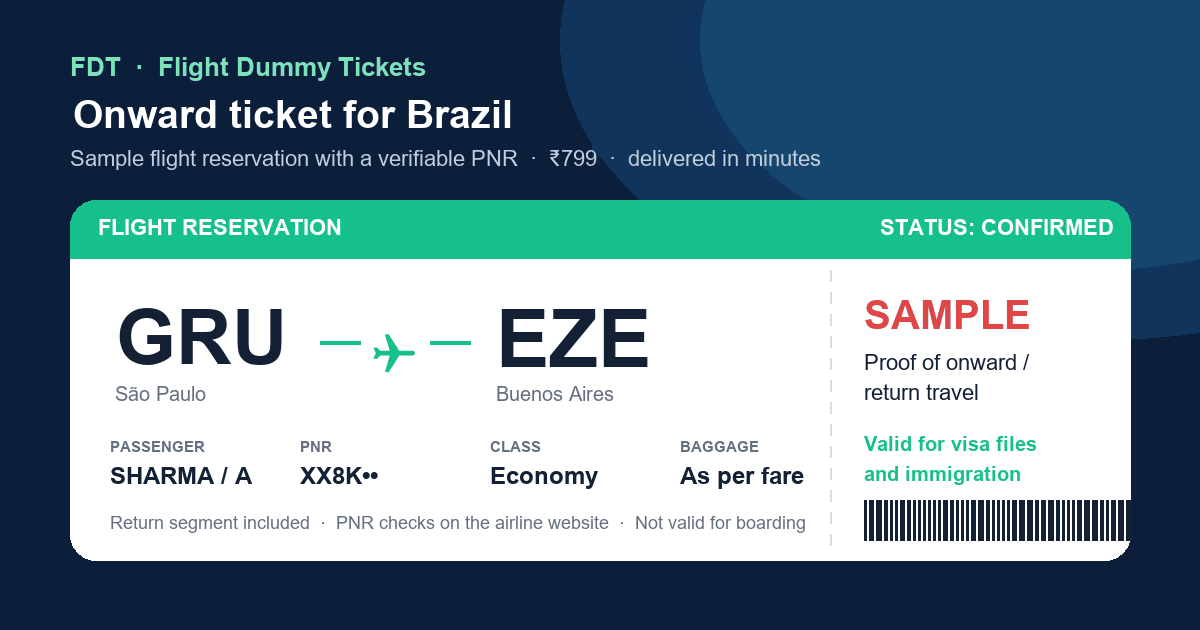
A dummy ticket is a temporary flight reservation for visa purposes. It is not a paid ticket, it is not for boarding, and it does not guarantee a visa. With Flight Dummy Tickets (FDT) that reservation costs ₹799 / $10 flat per passenger, the same for One-Way, Return and Multi-City, delivered in about 10 minutes as a PDF by email and WhatsApp with a verified PNR, valid for up to 2 weeks. Payment is through Razorpay, UPI, cards and net banking, with 5% off every booking and 10% off for 3 or more passengers. Support is at support@flightdummytickets.com and on WhatsApp at +1 786 957 8117. FDT has delivered 20,000+ tickets. Those are the only commercial facts on this page. Everything else is Brazil process, worked examples from Indian applicants, and the errors that actually cause trouble. Always check your own embassy or official e-visa checklist before you submit; if this guide and your checklist disagree, follow the checklist.
Key facts at a glance
| Question | Short answer |
|---|---|
| Do Indian passport holders need a visa for Brazil? | Yes, in almost all cases a visa is required before travel, usually an e-visa. Check the current requirement. |
| What is a Brazil e-visa? | An electronic visa applied for online, usually valid for a short stay of up to 90 days. |
| What onward proof is expected? | A return or onward flight reservation showing your name, departure date from Brazil, destination and a verifiable PNR. |
| Must it be a paid ticket? | No. A flight reservation is the normal document. Do not buy a full ticket before approval. |
| What is a dummy ticket? | A temporary flight reservation for visa purposes, not a paid ticket, not for boarding. |
| FDT price | ₹799 / $10 flat per passenger, same for One-Way, Return and Multi-City. |
| FDT delivery | About 10 minutes, PDF by email and WhatsApp, verified PNR. |
| FDT validity | Up to 2 weeks. Check your own reservation expiry. |
| FDT payment | Razorpay (UPI, cards, net banking). 5% off every booking, 10% off for 3+ passengers. |
| FDT support | support@flightdummytickets.com, WhatsApp +1 786 957 8117. 20,000+ tickets delivered. |
| Does it guarantee a visa? | No. No ticket guarantees a visa. |
Contents
- The Brazil e-visa in plain language
- Arriving in São Paulo and Rio: the port-of-entry conversation
- Why onward proof matters even with an e-visa in hand
- What counts as onward proof, and what officers put aside
- Return, onward and open-jaw: Brazil and its neighbours
- How the PNR is actually checked
- Your reservation, line by line
- Funds to stay: what to show and how to show it
- Hotels that match your flight dates
- A believable Brazil itinerary: cities, falls and coast
- Families, couples and groups travelling together
- When your dates move: rebooking without breaking the file
- Mistakes that delay Brazil trips
- Your pre-submission checklist
- Frequently asked questions
1. The Brazil e-visa in plain language
The Brazil e-visa is the route most Indian travellers use, and it is worth understanding properly before you touch the flight booking. An e-visa is applied for online through the official portal, and it is issued as an electronic document that you print and carry with your passport. It is usually valid for a short stay of up to 90 days, and the dates you enter on the application, your entry date, your exit date, your entry airport and your exit airport, should match the trip you actually plan. Those dates are not a rough plan. They are the dates the visa is assessed against, and your flights, hotels and insurance should match them exactly.
That is the first reason onward proof matters for Brazil. The e-visa application asks for your travel details, and a file that says you will enter on 12 October and leave on 24 October, with no flight document to support the exit date, is a file with a hole in it. The reservation is the evidence behind the dates you typed into the form. If the dates on the form and the dates on the reservation disagree, the application is inconsistent before anyone has read a word of it.
The second reason is the processing time. An e-visa is normally processed in a few working days, but it can take longer at busy times or if the application needs correction. That timing interacts with the reservation, because a temporary reservation is valid for up to 2 weeks. Apply for the e-visa with a reservation that is live, and if the processing drags on and the reservation expires, get a fresh one for the same dates before you travel. Do not let an expired reservation be the document you show at the airport. The guide on dummy ticket validity how long explains the timing in full.
The third reason is the entry and exit airports. Brazil is a very large country, and the e-visa and your itinerary should name the airports you will actually use. São Paulo's Guarulhos and Rio de Janeiro's Galeão are the two most common international gateways for Indian travellers, with Salvador and Brasilia used less often. If your trip starts in São Paulo and ends in Rio, your flights should show exactly that, and your itinerary should explain the journey between the two cities. If your file says you enter and leave through São Paulo, but your return flight leaves from Rio, the file disagrees with itself. Get the airports right on the form first, and let the flights follow the form.
2. Arriving in São Paulo and Rio: the port-of-entry conversation
A visa is permission to travel to Brazil and ask to enter. The final decision is made at the airport by an immigration officer, and that conversation is usually short, polite and straightforward if you are prepared. Most Indian travellers with a valid e-visa, a return ticket and a clear plan are admitted without difficulty. The ones who struggle are the ones who cannot answer three simple questions: where are you staying, what are you doing, and when are you leaving?
Before you land, know your answers. Where are you staying? The name of your first hotel and its area. What are you doing? A one-sentence description of the trip, "Twelve days, São Paulo, Iguazu Falls and Rio, holiday with my family." When are you leaving? The date, the city and the flight. Carry the printouts: passport, e-visa, return flight reservation, first hotel booking, insurance and a copy of your itinerary. Keep them in your hand luggage, not in a checked bag, and keep them in the order you would need them.
The officer may ask to see your return or onward ticket. This is where a verifiable reservation matters for the second time. Show the PDF, and if asked, be ready to show the PNR and the airline. Do not hand over your phone with a dozen open apps. Hand over a printed sheet. Officers deal with paper quickly and phones slowly. If you are travelling as a family, keep one set of documents for the whole family and let one person do the talking, with the others ready to answer if asked.
Be honest about everything. If your plans changed after the e-visa was issued, you swapped a hotel, or you are leaving a day earlier, say so plainly and show the new booking. A changed plan explained honestly is a small matter. A changed plan discovered by the officer is a credibility problem. And never, at any point, offer to work, mention a job search, or suggest you might stay longer. A visitor visa is for visiting. The officer's job is to be satisfied that you will visit and leave, and every answer you give should make that easier to believe.
3. Why onward proof matters even with an e-visa in hand
Some travellers assume that once the e-visa is approved, the onward ticket no longer matters. It does, for three reasons. First, the e-visa itself is issued on the basis of the dates and the exit you declared, so the return flight is part of the approval, not an afterthought. Second, the airline will check it before you board, as described above, and an airline that is not satisfied will not let you fly. Third, the immigration officer at arrival can ask for it, and a traveller who cannot produce it is a traveller whose entry is in doubt, e-visa or not.
Consider two applicants from the same city, both applying for a twelve-day holiday. Sneha from Chennai submits a return reservation, Chennai to São Paulo on 12 October and Rio de Janeiro to Chennai on 24 October, hotels in São Paulo, Foz do Iguaçu and Rio covering 12 to 24 October, insurance for the same dates, and an e-visa application with matching entry and exit dates and airports. Every document agrees. Karthik from the same city submits a one-way reservation to São Paulo on 12 October, three nights in a São Paulo hotel, and an e-visa application that says he will leave on 24 October. Karthik may be telling the truth, but his file does not prove it. The officer has to guess where he will sleep after day three, how he will leave Brazil, and when. Officers do not guess when they can ask for more documents or refuse. Your onward proof should answer, without any further explanation, who is travelling, on what date, from which Brazilian city, to which city, on which flight, under which booking reference, and how that date relates to the last night of your hotel stay.
4. What counts as onward proof, and what officers put aside
Not every document that mentions a flight counts as proof of onward travel. The test is whether the document shows a real, checkable reservation in your name. Here is how the common options score for Brazil.
A flight reservation with a verifiable PNR counts. This is the standard. It shows your name, the flight numbers, the dates, the cities and a booking reference that can be checked on the airline website. A dummy ticket from a legitimate provider is this kind of document. It is a temporary reservation, not a paid ticket, and it is accepted for visa purposes precisely because the booking behind it is real. If you want the full picture of how that works, read dummy ticket vs real ticket, which sets out what changes and what does not when the reservation is temporary, and what is a dummy ticket for the basic idea in plain language.
A paid ticket counts, and counts strongly, but it is not required and it is usually a bad idea before a visa is approved. If you buy a non-refundable ticket to Brazil for ₹80,000 or more and the visa is refused, you have lost the money or you are fighting for a refund. If you buy a fully refundable ticket, you have locked up the money for weeks. The embassy knows this, which is why checklists ask for a reservation, not a paid ticket. Buying early does not make your file stronger. It makes your finances weaker.
A fare quote or a flight search screenshot does not count as proof. It shows that a flight exists and what it costs. It does not show that you have reserved a seat, that your name is held against a booking, or that you intend to be on that flight. Officers see these every day and put them aside. The same goes for a screenshot from a flight comparison site with no passenger name and no booking reference. It is a search result, not a reservation.
An email confirmation from an airline or a travel agent counts, provided it shows the PNR, the passenger name, the flights and the dates. In practice, most applicants submit the PDF version of the same confirmation, which is easier to read and to file. If your confirmation is an email, print it to PDF and check that all the details are legible and complete before you upload it.
A bus or domestic flight booking can count as onward proof when the onward journey is genuinely by land or air, for example, leaving Brazil by flight to Buenos Aires or Lima, which is a real route that some travellers take. But the booking must be real, named and checkable in the same way as an international flight, and it must be consistent with your itinerary. A vague statement that you "plan to fly to Argentina" is not proof. A booked flight with a reference number is. If your exit is to a third country, say so clearly in your cover letter, attach the booking, and attach the visa for the next country if one is needed.
A hotel booking is not onward travel proof. It proves where you will sleep, not how you will leave. Some applicants submit a long hotel booking and think the return is implied. It is not. The officer wants to see the exit, not the stay. You need both documents, and they need to agree on dates, as explained in our guide on proof of accommodation and onward travel and in dummy ticket and hotel booking matching dates.
5. Return, onward and open-jaw: Brazil and its neighbours
Three phrases get used as if they mean the same thing, and for Brazil the difference between them decides which document you should submit.
A return ticket is the most common form of onward proof for Indian tourists visiting Brazil. You fly from India to Brazil and back to India, and both flights appear on one reservation. Chennai to São Paulo on 12 October and Rio de Janeiro to Chennai on 24 October is a return in the sense that you come home, even though you leave from a different Brazilian city from the one you arrived in. That is called an open-jaw return, and it is perfectly normal for a trip that starts in São Paulo, travels to Iguazu Falls, and ends in Rio. Most Brazil visitors should submit this kind, because it matches the way most people actually travel: out, around, and home.
An onward ticket is a flight from Brazil to a third country, rather than back to India. For example, you fly Chennai to São Paulo, spend a week in Brazil, then fly São Paulo to Buenos Aires or Lima, and later home from there. Or you combine Brazil with a visit to Argentina or Peru and your onward flight is the one that takes you out of Brazil. In that case the proof Brazil wants is the flight out of Brazil, not necessarily the flight back to India, although showing the whole chain is always stronger. If you submit an onward ticket, attach the next country's visa or entry permission as well, so the officer can see the chain is real.
An open-jaw return is a return where you leave from a different city from the one you arrived in. For Brazil this usually means flying into São Paulo and home from Rio, or flying into Rio and home from São Paulo. What matters is that the reservation shows both legs, that the e-visa and itinerary name the same entry and exit cities, and that the itinerary explains the journey between the cities. Flying into São Paulo and out of São Paulo, but with hotels that end in Rio and no internal flight shown between the two, is a gap. Fill the gap. Either show the internal flight or change the return to leave from Rio.
A one-way ticket is a single flight with no return or onward flight attached. On its own it is the weakest form of onward proof, and for a tourist visa it is often not enough. A student going to Brazil for a long-term course may legitimately arrive on a one-way ticket, because they do not know when they will come back. But a tourist who submits only a one-way reservation is effectively telling the officer, "I have a plan to arrive, and no plan to leave." That is the opposite of what the document is supposed to prove. If you are a tourist and you submit a one-way reservation, expect a question about it, and expect to need a good answer backed by a return or onward booking. Our guides on dummy ticket for student visa and dummy ticket for work visa explain how long-stay applicants should handle this differently.
The practical rule is simple. Tourists and short-stay visitors should show a return or an onward flight. Long-stay applicants should show whatever their situation genuinely requires and explain it in the cover letter. And if you are not sure which category you fall into, read the checklist for your visa type. A tourist checklist that says "return flight reservation" means a return. Do not guess. Read the words.
6. How the PNR is actually checked
The PNR is the hinge of this whole subject, so it is worth understanding properly. A PNR, or Passenger Name Record, is a six-character code that identifies your booking in the airline's reservation system. When an officer, a visa centre staff member or you yourself enters that code with the passenger's surname on the airline's Manage Booking page, the system returns the booking: the name, the flights, the dates, the cities and the status. That is the check. It takes about two minutes, and it is the difference between a document and a decoration.
Our guide on how to verify dummy ticket PNR walks through the check click by click, but the principle is simple enough to state here. A genuine reservation verifies. A fake one does not. A cancelled one verifies as cancelled, which is just as bad. A reservation in someone else's name verifies under their name, not yours. There is no middle ground, and there is no version of "the PNR will activate later". If the code does not work on the day you receive the PDF, it will not work on the day the embassy checks it either.
There are a few honest reasons why a PNR might not verify on a first attempt, and it is worth knowing them so you do not panic unnecessarily. The most common is a spelling difference: your surname is entered as "Nair" on the booking and "Nayar" in the check, or a middle name is included in one place and not the other. The second is checking the wrong airline's website. A codeshare flight operated by one airline and sold by another can be checked on either, but the booking reference that works on one may be different from the one that works on the other, and the PDF should say which airline to check with. The third is a very fresh booking that has not yet propagated, which usually resolves within an hour. If the PNR still does not verify after an hour, and the spelling is correct and you are on the right airline's site, treat it as a failed check and contact the provider. Do not submit a document you cannot verify yourself. If you cannot verify it, the officer cannot verify it either, and they will not give you the benefit of the doubt.
A worked example helps. Take Sneha from Chennai, applying for a Brazil holiday: Chennai to São Paulo on 12 October via Dubai, Rio de Janeiro to Chennai on 24 October via Dubai. Her flight reservation shows both legs, under the name Sneha Nair, PNR PQR678. She goes to the airline website, enters Nair and PQR678, and sees all the flights, her name, and a status of confirmed. She also checks that the dates match her hotels, São Paulo 12 to 16 October, Foz do Iguaçu 16 to 19 October, Rio 19 to 24 October, and her insurance, 12 to 25 October. Everything agrees. That is a clean file. Now imagine the same trip, but the PNR shows a booking for a different passenger, or for September instead of October, or nothing at all. The hotels and the insurance are still perfect, but the flight document now contradicts them. The officer's question is no longer "is this trip well planned?" It is "which of these documents is wrong?" That is a much harder question to answer, and it is the question a failed PNR creates.
Keep a note of your PNR and the airline, separate from the PDF, so you can re-check it the day before your appointment and again if the embassy asks for anything. A reservation with FDT is valid for up to 2 weeks, so check your own reservation expiry. If your appointment is delayed and the reservation expires before the embassy looks at it, you need a fresh one. That is not a failure. It is normal. Reservations are temporary by design, and a fresh reservation for the same dates, with a new PNR, is a straightforward fix, as long as you notice the expiry before you submit.
Book your dummy ticket, ₹799 flat
One-Way, Return or Multi-City, with a verified PNR. Delivered in about 10 minutes by email and WhatsApp.
Book Dummy Ticket, ₹799 WhatsApp Us7. Your reservation, line by line
A reservation is not proof because it mentions a flight. It is proof because it shows a real, checkable booking in your name. Before you upload anything, check every line against this list.
First, your name, exactly as in your passport and on your e-visa. That means your full name, with the same spelling, including any middle name that appears in the passport. A reservation under "Sneha" when the passport says "Sneha Nair" will still be read, but a reservation under a nickname, a shortened name or a different spelling creates a question that did not need to exist. For a family booking, every traveller's name must appear, with the same spelling as their own passport.
Second, the route, in both directions, including connections. The outbound leg should show the Indian departure city, the transit hub, the Brazilian arrival city and the date. The return leg should show the Brazilian departure city, the transit hub, the arrival in India and the date. The cities matter: São Paulo and Rio are about 430 kilometres apart, a one-hour flight or a six-hour bus ride, and a reservation that says you arrive in São Paulo and leave from Rio is fine, provided your itinerary explains the journey between them. A reservation that says you arrive in São Paulo and leave from São Paulo, while your hotels are all in Rio with no internal flight, is a gap.
Third, the flight numbers and times. A reservation should show the operating airline, the flight numbers and the departure and arrival times for every leg, including connections. This is not decoration. It is how the officer knows the flight is a real service on a real day, and it is how you check the booking yourself. If the PDF shows only city names and dates with no flight numbers, ask the provider for a complete itinerary.
Fourth, the PNR. This is the six-character booking reference, and it is the single most important line on the document. It must be printed clearly, and it must work. A reservation with no PNR, a PNR that belongs to someone else, or a PNR that returns nothing on the airline website is not proof.
Fifth, the status. The booking should show as confirmed in the airline system, not waitlisted, not on request, and not cancelled. A temporary reservation from a legitimate provider shows as a live booking while it is valid. That is normal. A waitlisted booking is not a reservation in any useful sense, and an officer who checks it will see that immediately.
Sixth, the dates, matching everything else. The return date must fall inside your e-visa validity and inside the stay your itinerary describes. The outbound date must match the first night of your hotel booking and the entry date on your e-visa. The return date must match the last night of your hotel booking, the exit date on your e-visa, and the last day of your insurance. A one-day mismatch in any direction is the most common small error, and it is also the easiest to fix before you submit. Our guide on dummy ticket and hotel booking matching dates works through this check in detail, and dummy ticket PDF check before upload gives you a page-by-page check to run on the PDF itself.
Finally, keep the PDF clean and legible. Print it, look at it, and check that no line is cut off, no name is truncated, and no date wraps onto a second line in a confusing way. If the PDF is a screenshot of a phone screen, replace it with a proper PDF from the provider. Officers read dozens of files a day, and a clean document is a small kindness that also happens to be good strategy.
8. Funds to stay: what to show and how to show it
Money is the part of the file that Indian applicants worry about most, and Brazil is an expensive trip from India, so the funds need to match the ambition of the plan. A return flight alone can cost ₹75,000 to ₹1,30,000, and twelve days of hotels, food, internal flights and activities can add another ₹2 lakh to ₹4 lakh. Your bank statements should show that you can afford that total and still have money left over for your life in India. An account that drops to nearly zero after the trip is a warning sign, even if the balance on the day of the application looks adequate.
The form of the evidence matters as much as the amount. Submit the last three to six months of bank statements, stamped or officially generated, showing your salary credits or business income, your regular spending and the balance over time. Salary slips for the last three months support the statements. If you are self-employed, add your income tax returns and a short note explaining your business. If a parent or spouse is sponsoring the trip, add their statements, their ID proof and a signed sponsorship letter that says exactly what they will pay for. Do not submit a single-day balance screenshot. It proves nothing about your financial history, and officers know it.
9. Hotels that match your flight dates
Accommodation proof is the document that most often disagrees with the flight reservation, and the disagreement is usually a single night. It happens like this: the flight home leaves Rio on 24 October, the traveller books hotels until 23 October, thinking that is the last night, and forgets that the night of 23 to 24 October is also a night they need somewhere to sleep. The fix is mechanical. Write down your arrival date and your departure date, count the nights between them, and make sure every one of those nights has a hotel attached to it.
For a twelve-night trip arriving 12 October and leaving 24 October, you need twelve nights of accommodation: 12–13, 13–14, 14–15, 15–16, 16–17, 17–18, 18–19, 19–20, 20–21, 21–22, 22–23 and 23–24 October. If you change cities, split the nights across the hotels accordingly and make sure no night is missing and no night is double-booked in two cities at once. Double-booked nights are a smaller error, but they still make the officer wonder whether you booked at random.
Hotel bookings for visa purposes are normally refundable or pay-at-property bookings, which is sensible: you should not pay in full for hotels before a visa is approved. A booking confirmation showing your name, the hotel name and address, the check-in and check-out dates and the number of guests is enough. It does not need to be prepaid. If you are staying with family or friends in Brazil, a host invitation letter with the host's full name, address, phone number and the dates you will stay is the equivalent document. Attach it, and make sure the dates in the letter match the flight dates and the e-visa dates exactly.
10. A believable Brazil itinerary: cities, falls and coast
Brazil rewards a well-planned itinerary, and the visa officer reads your itinerary as a test of whether you have genuinely thought about the trip. A believable itinerary is specific, geographically sensible and honest about travel times in a country the size of a continent.
A common first trip for Indian families runs twelve to fourteen days. Days one to four in São Paulo: Paulista Avenue, the old centre, the museums and the food markets. Then a flight to Foz do Iguaçu for two nights, covering the Brazilian side of the falls and the bird park. Then a flight to Rio for four or five nights: Copacabana, Sugarloaf, Christ the Redeemer, Santa Teresa and a day trip to Paraty if time allows. That pattern is normal. What matters is that the itinerary is possible in the days you have, that the hotels follow the route, and that the return flight leaves from the city where the trip actually ends.
The most frequent geography mistake is the distance jump. São Paulo and Foz do Iguaçu are about 1,000 kilometres apart, a ninety-minute flight or a fifteen-hour bus ride. Foz do Iguaçu and Rio are about 1,200 kilometres apart, a two-hour flight. An itinerary that says "Day 5: morning in São Paulo, afternoon at the falls, evening in Rio" without flights is impossible, and an officer who knows Brazil will notice. Write the internal flights into the plan, with the day and the route named. If you fly São Paulo to Foz do Iguaçu, say so. If you fly Foz do Iguaçu to Rio, say so. A complete story is a credible story, and a story with a gap is a question waiting to be asked.
Write the itinerary in your cover letter as a short day-by-day table, and keep the same dates and city names in the hotel bookings, the flight reservation and the e-visa. A simple format works best: date, city, main activity, hotel name. Fourteen lines, no adjectives, no long paragraphs about how beautiful the falls are. Officers do not need travel writing. They need a plan they can follow. If you are travelling with children, add their ages and note any child-specific arrangements, such as a family room or a shorter day at the falls, because long travel days with small children are a real constraint and an itinerary that ignores them looks like it was written by someone who has never travelled with children.
11. Families, couples and groups travelling together
Brazil is a popular family destination, and family files have their own pattern of mistakes. The most common is submitting one flight reservation that names only the lead traveller, and one set of hotel bookings in one name, and expecting the officer to assume the rest of the family is included. Officers do not assume. Each traveller needs their own visa file, and each file needs the flight reservation showing that person's name. A family of four needs four names on the reservation, or four separate reservations with the same flights. The same applies to hotels: the booking should list all guests, or each file should carry a copy of the same booking showing the family.
Group bookings with FDT follow the same logic. A reservation for three or more passengers costs ₹799 / $10 per passenger, with 10% off for 3 or more passengers, so a family of four pays for four reservations, not one. That is not a quirk. It is how airline bookings work: each passenger is a separate record, and each record needs its own line on a shared PNR. When you receive the PDF, check that every family member's name appears, with the spelling from their own passport, and that the flights and dates are identical for everyone. If one child's name is missing or misspelt, get it corrected before you submit. A child's file with no flight document is an incomplete file, and it can hold up the whole family's processing.
Couples should be careful about the purpose statement. A honeymoon couple should say so and attach the marriage certificate. A couple travelling together for years should not need to prove the relationship in detail, but the files should still be consistent: the same flights, the same hotels, the same dates, and cover letters that describe the same trip. Two cover letters that describe different itineraries for the same holiday are a red flag, even if both are innocent mistakes.
12. When your dates move: rebooking without breaking the file
Travel plans change. A visa appointment is delayed, a hotel sells out, a school holiday moves, and suddenly the dates on your flight reservation no longer match the dates on your hotels or your e-visa. This is normal, and it is fixable, provided you fix all of the documents and not just one.
The rule is simple: change the flight reservation, then change everything that depends on it. If your return moves from 24 October to 28 October, your hotels must extend to 28 October, your insurance must extend to 28 October or beyond, your e-visa dates must cover the new stay, and your cover letter must describe the new dates. Changing only the flight and leaving the old hotels in the file creates a file that disagrees with itself, and a file that disagrees with itself is a file that gets questioned. Note that if your e-visa dates no longer cover the trip, you may need a fresh e-visa application, so check the e-visa validity before you change anything.
Because a dummy ticket is a temporary reservation valid for up to 2 weeks, timing matters twice over. First, the reservation must be live when the embassy checks it, so do not book the reservation a month before your appointment and assume it will still be valid. Second, the reservation's dates are your trip dates, so if the trip moves, the reservation must move with it. With FDT, a fresh reservation for the new dates costs the same ₹799 / $10 per passenger and arrives in about 10 minutes, so there is no reason to submit an expired or wrong-dated document. Get the fresh one, verify the new PNR, and replace the old PDF in every file that carries it.
There is one timing trap to avoid. Some applicants book their flight reservation, then wait for the visa, then book hotels, and then discover the hotels they wanted are sold out on the new dates. The better order is to plan the whole trip first, flights, hotels, insurance, cover letter, and then book the reservation close to the appointment, when the dates are settled. Our guide on how to book dummy ticket online explains the ordering in detail, and dummy ticket last minute same day appointment covers what to do when the appointment is tomorrow and the dates are only just fixed.
If the embassy asks for a fresh flight reservation during processing, treat it as a routine request, not a bad sign. It usually means the original reservation expired while the file was being processed. Send a fresh reservation for the same dates, with a new PNR, and confirm in a short note that the dates, hotels and insurance are unchanged. Do not change the trip in the same message. One change at a time, clearly explained, is how you keep a file coherent.
13. Mistakes that delay Brazil trips
Most Brazil delays are not about the applicant being unsuitable. They are about the file being careless. Here are the mistakes that come up again and again, in the order an officer is likely to notice them.
First, no return flight at all. A one-way reservation for a tourist, with no explanation, is the single most common gap. Fix it before you submit, not after a refusal.
Second, a PNR that does not verify. A reservation from a free generator, a screenshot, or a provider whose bookings do not exist in the airline system will fail the check. Our guide on free dummy ticket generator risks explains why these documents fail, and dummy ticket vs real ticket explains what a genuine temporary reservation should look like.
Third, e-visa dates that do not match the flights. The e-visa says you enter on 12 October and leave on 24 October, but the flights say 14 October and 26 October. The form and the flights disagree, and the officer does not know which is right. Align them before you submit.
Fourth, names that do not match the passport. A nickname, a missing surname, a transposed first and last name, a child's name missing from a family booking, all of these create work for the officer and doubt about the file. Copy names from the passport, letter by letter, and use the same spelling on the e-visa.
Fifth, dates that disagree. The flight says 24 October, the hotel ends 22 October, the insurance ends 23 October, the cover letter says 26 October. Four documents, four different trips. One of them is wrong, and the officer does not know which. Align them all before you submit.
Sixth, funds that do not support the trip. A luxury itinerary on a thin bank balance, a large unexplained deposit, a single-day screenshot instead of statements, all of these invite a closer look at the money, and a closer look at the money is rarely good news.
Seventh, accommodation with gaps. A night with no hotel, a host letter with no address, a booking in the wrong city for the night in question. Count the nights, match them to the flights, and attach a document for every one.
Eighth, an impossible itinerary. São Paulo in the morning and the falls in the afternoon with no flight, a day trip to Iguazu on the same day as an international departure, a twelve-day trip with four nights of hotels. Write the distances and the hours into the plan, and make sure the plan is possible.
Ninth, submitting a paid non-refundable ticket before approval. This is not a mistake that causes refusal, but it is a mistake that costs money. A refused visa with a ₹80,000 non-refundable ticket is a painful lesson. A reservation costs ₹799 / $10 with FDT, and it is the document the embassy asks for. Buy the real ticket after the visa is in your passport.
Tenth, expired reservations. A reservation booked too early, valid for up to 2 weeks, that expires before the embassy opens the file. Check the expiry, check it again the day before the appointment, and refresh it if needed. The guide on dummy ticket mistakes visa rejection covers these patterns across all destinations, and the Brazil version of each one is exactly the same.
Eleventh, ignoring the checklist. Every visa type has a checklist, and the checklist is the authority. If it asks for a document you have not provided, provide it. If it asks for a document in a particular form, provide it in that form. A guide can explain the general pattern, but only the checklist for your visa type, on the day you apply, tells you what is required.
14. Your pre-submission checklist
Run through this list the day before your appointment, with the actual documents in front of you, not from memory.
- Passport valid for at least six months beyond your intended stay, with at least two blank pages, and copies of the used pages if the checklist asks for them.
- E-visa application completed with entry and exit dates and airports that match your flights, and the printed e-visa carried with your passport.
- Two recent photographs meeting the specification on the checklist, if the visa type requires them.
- Return or onward flight reservation showing your name as in your passport, both directions, flight numbers, dates and a PNR that you have verified yourself on the airline website.
- Hotel bookings or host invitation covering every night from arrival to the night before departure, with names, addresses and dates that match the flights and the e-visa.
- Travel insurance covering the whole trip, with a day of margin, and the policy document in the file.
- Bank statements for the last three to six months, salary slips or income proof, and a sponsorship letter with the sponsor's proof if someone else is paying.
- Cover letter describing the trip day by day, with the same dates and cities as the flights, hotels and e-visa.
- Purpose documents where applicable: marriage certificate for a honeymoon, business invitation for a business trip.
- A copy of the whole file for yourself, and the PNR and airline noted separately so you can re-check the reservation before the appointment.
- The FDT reservation checked for expiry: valid for up to 2 weeks, so confirm it is still live on the day you submit.
If every box is ticked with a real document, submit with confidence. If any box is ticked from memory, go back and find the document. A file is ready when it can be read by a stranger in five minutes and understood without a phone call.
Dummy ticket options compared
Use this when you are deciding between a free generator PDF, a fully paid ticket, and a verifiable reservation.
| Option | Airline-checkable PNR | Typical cost | Best for |
|---|---|---|---|
| Free PDF generator | No | ₹0 | Never for embassy/VFS upload |
| Fully paid ticket | Yes | Full airfare | When dates are locked and refundable |
| FDT verifiable dummy ticket | Yes | ₹799 / passenger | Visa file before dates are final |
Official sources to check before you apply
Always match your documents to the embassy or VFS checklist for your nationality. These are the primary references we used while writing this page:
15. Frequently asked questions
1. Do Indian citizens need a visa for Brazil? Yes, in almost all cases Indian passport holders need a visa before travelling to Brazil, usually an e-visa applied for online. Check the current requirement for your passport and visa type on the official portal, because arrangements change. Do not travel on the assumption that you can get a visa on arrival.
2. Is a return ticket compulsory for a Brazil visa? A return or onward flight reservation is part of the standard visitor visa file, and it is the document that proves you intend to leave before your stay ends. A tourist who submits only a one-way ticket should expect questions. Show a return or onward reservation unless your visa type genuinely requires a one-way arrival.
3. Can I use a dummy ticket for my Brazil visa application? Yes, if it is a genuine temporary reservation with a verifiable PNR. A dummy ticket is a temporary flight reservation for visa purposes, not a paid ticket and not for boarding. It must show your name, dates and a PNR that verifies on the airline website. A screenshot of a flight search or a fare quote is not a substitute.
4. How much does a dummy ticket for Brazil cost with FDT? ₹799 / $10 flat per passenger, the same for One-Way, Return and Multi-City, with 5% off every booking and 10% off for 3 or more passengers. Delivery is about 10 minutes as a PDF by email and WhatsApp, with a verified PNR, valid for up to 2 weeks. Payment is through Razorpay, UPI, cards and net banking.
5. Will the embassy check my PNR? They may, and you should assume they will. Enter the PNR and your surname on the airline's Manage Booking page before you submit. If it does not show your name, flights and dates, do not submit it. Get a corrected reservation first.
6. What is the Brazil e-visa, and how long is it valid? The e-visa is an electronic visa applied for online, usually valid for a short stay of up to 90 days. The entry and exit dates and airports you enter on the application should match your flights, hotels and insurance exactly.
7. My return flight leaves from Rio but I arrive in São Paulo. Is that a problem? No, that is a normal open-jaw trip, provided your itinerary explains the journey between the cities, your e-visa names the same entry and exit cities, and your hotels cover every night. The problem is a gap with no explanation, not the open jaw itself.
8. How much money do I need to show for Brazil? Brazil is an expensive trip from India, so budget honestly: return flights of ₹75,000 to ₹1,30,000, plus hotels, food, internal flights and activities for twelve days often totalling ₹2 lakh to ₹4 lakh. Show bank statements for three to six months that prove you can pay for the trip you describe and still have money left over.
9. Do I need hotel bookings for every night? Yes. Every night from arrival to the night before departure should have a hotel booking or a host invitation with the host's address and dates. A night with no accommodation is a gap the officer will notice. Count the nights and match them to the flight dates and the e-visa dates.
10. What happens at immigration in Brazil? An immigration officer at São Paulo or Rio airport may ask where you are staying, what you are doing and when you are leaving, and may ask to see your return ticket and e-visa. Carry printed copies of your passport, e-visa, return reservation, first hotel booking and insurance in your hand luggage, and answer in short, clear sentences.
11. Can I change my travel dates after my e-visa is approved? You can change hotels and internal plans, but keep the overall trip inside the e-visa validity and the dates on the visa. If your dates change before submission, get a fresh reservation for the new dates and update the hotels, insurance, cover letter and e-visa application to match. If the e-visa no longer covers the trip, you may need a fresh e-visa.
12. Should I buy a real ticket before my visa is approved? No. Do not buy a paid, non-refundable ticket before approval. The embassy asks for a reservation, not a paid ticket, and a refused visa with a non-refundable ticket is an expensive mistake. Book the real ticket after the visa is in your passport.
Official sources: gov.br, brazilianconsulate.org, vfsglobal.com. Always confirm the current checklist and fees there before you submit.
Ready to book?
Get your dummy ticket for ₹799 per passenger, with a verified PNR, in about 10 minutes.
Book Dummy Ticket, ₹799