The short answer first
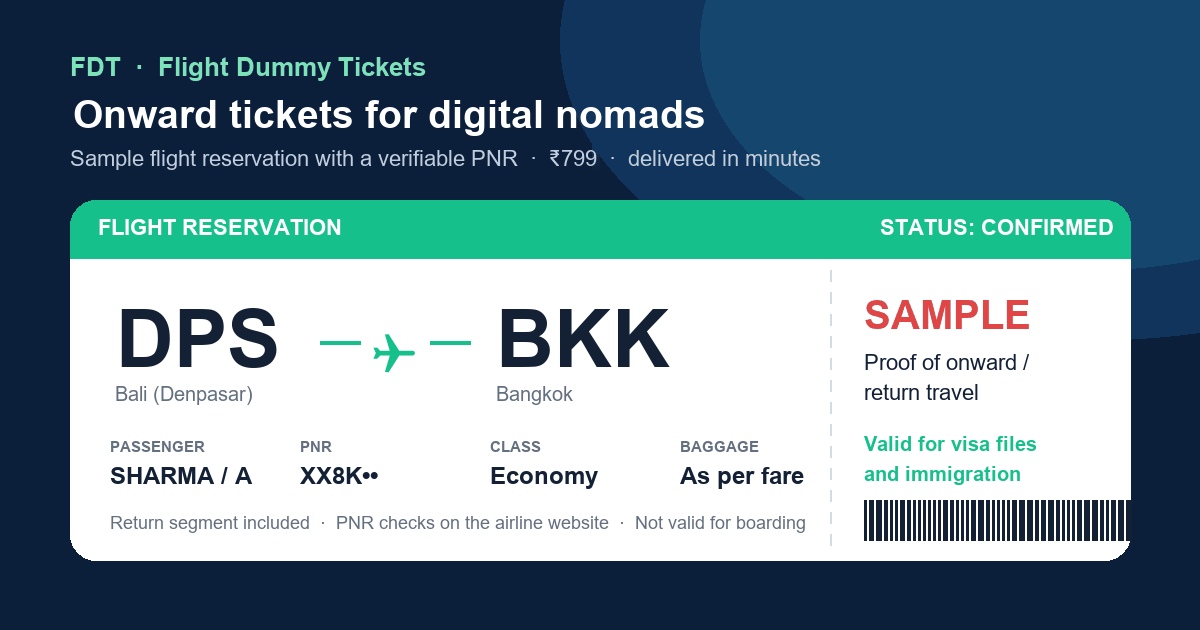
An onward ticket for a digital nomad is proof that you plan to leave the country you are entering before your permitted stay ends. It does not have to be a fully paid, non-refundable flight. For most visa applications and many border crossings, a temporary flight reservation, a dummy ticket, showing your name, your departure date and a verifiable PNR is enough, because embassies and officers are checking for a coherent plan, not a receipt for money already spent. It is not a paid ticket, it cannot be used to board a flight, and it does not guarantee a visa or entry. What it does is answer the single most common question a nomad gets asked: where are you going next, and when?
That question follows nomads everywhere, and it follows them precisely because their lifestyle looks unstructured from the outside. A tourist arrives with a hotel booking and a return flight two weeks later. A nomad arrives with a laptop, a one-way ticket and a shrug. The officer at the desk cannot see your Airbnb history, your client contracts, your bank balance or your plan to spend six weeks in Lisbon and then fly to Tbilisi. All they see is a person with no obvious exit. So they ask for one. If you can show it, a reservation out of the country, dated inside your allowed stay, with your name spelled exactly as it appears in your passport, the conversation usually ends there. If you cannot, the conversation gets longer, and sometimes it ends with a refused entry stamp.
This guide is written for Indian passport holders who work remotely and travel slowly: the designer from Pune working from a coworking space in Bangkok, the developer from Hyderabad spending a season in Lisbon, the content writer from Kochi hopping between Bali, Vietnam and Georgia, the consultant from Delhi who spends three months a year in Europe and the rest in India. You do not need a lecture on what remote work is. You need to know which proof works, where it is asked for, how to keep your plans flexible without looking plan-less, and how to avoid the classic nomad mistakes, the visa run that resets nothing, the one-way ticket with no exit, the reservation whose dates contradict your accommodation booking, the PNR that cannot be verified.
Flight Dummy Tickets, or FDT, provides temporary flight reservations at ₹799 / $10 flat per passenger, the same price for One-Way, Return and Multi-City. Delivery is about 10 minutes, by email and WhatsApp as a PDF, with a verified PNR. Validity is up to 2 weeks, so always check your own reservation expiry. Payment is through Razorpay, UPI, cards and net banking, with 5% off every booking and 10% off for 3 or more passengers. Support is at support@flightdummytickets.com and on WhatsApp at +1 786 957 8117. FDT has delivered 20,000+ tickets. Those are the only commercial facts on this page. Everything else is process, explanation and real examples, so you can judge for yourself what fits your trip.
One honest warning before anything else. Rules change, and they change differently by country. A blog is not your embassy checklist. Always check your own embassy, VFS or official immigration page before you submit or travel, and if this guide and that checklist disagree, follow the checklist. For Schengen trips, remember the 90/180 rule. For the UK, remember that UK guidance generally says you should not routinely submit flight bookings with a visit visa application unless you are transiting. A dummy ticket is a tool for the documents an officer actually asks for, not a substitute for reading the requirement.
Key facts at a glance
| Question | Short answer |
|---|---|
| What is an onward ticket? | Proof of a planned departure from the country you are entering, shown as a flight reservation or itinerary. |
| Does it have to be a paid ticket? | Usually no. A temporary reservation with a verifiable PNR is normally accepted for visa purposes. |
| What does a dummy ticket cost with FDT? | ₹799 / $10 flat per passenger, same for One-Way, Return and Multi-City. |
| How fast is delivery? | About 10 minutes, PDF by email and WhatsApp, verified PNR. |
| How long is it valid? | Up to 2 weeks. Check your own reservation expiry. |
| Can I board with it? | No. It is not a paid ticket and not for boarding. |
| Does it guarantee a visa or entry? | No. No ticket, real or dummy, guarantees either. |
| What else do officers check? | Funds, accommodation, travel history, and whether your story is consistent. |
| Where is onward proof asked most? | Thailand, Indonesia, the Philippines, Mexico, Schengen consulates, and many airlines at check-in. |
| What is a visa run? | Leaving and re-entering to restart a stay. It often does not work the way people think. |
Contents
- Why nomads get asked for onward proof more than tourists
- What counts as onward proof, and what does not
- The one-way ticket problem at check-in
- Flexible travel without looking plan-less
- Visa runs: what actually happens at the border
- Country notes: Thailand, Indonesia, Portugal, Spain, Georgia, Mexico, Vietnam
- Building a coherent itinerary when your dates are genuinely flexible
- Matching flights, stays and funds so the file reads true
- Timing your reservation around applications and travel dates
- Mistakes nomads keep making with onward tickets
- Frequently asked questions
1. Why nomads get asked for onward proof more than tourists
A tourist's file tells a story in one glance. Return flight, hotel for twelve nights, insurance for thirteen days, bank statement with enough money for twelve nights. The officer can see the beginning, the middle and the end. A nomad's file tells a story with the ending missing. That is not a criticism of the lifestyle. It is simply how it reads to someone whose job is to decide, in about ninety seconds, whether you will leave on time.
Consider two Indians arriving at Bangkok airport on the same flight. The first is a couple from Mumbai on a seven-day holiday. They have a return ticket to Mumbai, a hotel booking in Sukhumvit, and 60,000 baht worth of spending money between them. The officer stamps them in without a second question. The second is a solo software engineer from Bengaluru, carrying a laptop bag and a backpack, with a one-way ticket, no hotel beyond the first three nights, and a plan to "see how it goes" for two months. The officer asks: where are you staying, how long, what do you do, and how are you leaving Thailand? None of these questions is hostile. Each one is the officer doing their job. But the engineer who has no answer for the last question is the one who gets taken aside.
The same dynamic repeats at consulates. A Schengen visa officer in Delhi reviewing a tourist file sees a return flight from Paris on day ten and a hotel in Paris for nine nights. A nomad's file shows a flight into Lisbon, a hostel booking for five nights, and nothing after that. The officer's question is the same one the Bangkok officer asked: what happens on day six? The applicant's honest answer, "I will decide when I get there, maybe Porto, maybe Madrid, maybe fly to Athens", is a perfectly reasonable way to travel, and a perfectly unconvincing way to answer a visa form. The form wants dates. It wants a departure. It wants the trip to have a shape.
This is the first thing to accept. Onward proof is not about the ticket. It is about the shape of the trip. The reservation is simply the easiest way to give the trip a shape on paper while keeping your real plans flexible. You are not lying about your plans when you reserve a flight out of Lisbon on a date you may later change. You are showing the officer the plan as it stands today, with a real reservation behind it, and you are free to change your actual travel later, with a real ticket, bought when the visa is in hand or when your plans firm up. What you must not do is show a plan that contradicts your other documents, or show no plan at all and expect the officer to fill in the blanks for you.
There is also a practical reason nomads are asked more often. Immigration systems were built around tourists and business travellers, people with fixed dates. The nomad, the slow traveller, the person working from a beach in Goa for a month and then a flat in Tbilisi for three months, is a newer pattern, and the paperwork has not fully caught up. Some countries have created digital nomad visas, Portugal, Spain, Estonia, Croatia, Georgia and others, precisely because the old tourist framework did not fit. But most nomads still travel on tourist visas and visa-free entries, which means they are judged by tourist rules. A tourist rule applied to a nomad life produces friction, and onward proof is where that friction shows up first.
It helps to think of it from the officer's side for a moment. Their concern is overstay. Every country that asks for onward proof has had the experience of visitors who arrived, found work or a life they liked, and never left. The officer cannot know your intentions. They can only look at evidence. A departure reservation is evidence of an intention to leave. A bank statement is evidence you can afford to leave. A history of previous trips where you left on time is evidence you have left before. None of these proves anything on its own. Together, they form a picture, and the departure reservation is usually the most concrete piece of that picture. That is why it is asked for so often, and why having it ready, before the question is asked, makes the whole interaction smoother.
For a deeper explanation of the basic concept, read what is a dummy ticket and proof of onward travel. Those two pages cover the definitions in detail. This guide builds on them and stays with the nomad-specific decisions: which proof to carry, when to book it, and how to keep your freedom while still looking like a person with a plan.
2. What counts as onward proof, and what does not
Not every document that mentions a flight counts as onward proof. Officers and consulates look for specific things, and knowing the list saves you from the two most common failures: showing something too weak, and paying for something stronger than you needed.
A temporary flight reservation with a verifiable PNR is the standard answer. It shows your full name as in your passport, the departure airport and the arrival airport, the date and time of the flight, the airline and flight number, and a six-character booking reference that an officer can check on the airline's website or through the booking system. That is the document FDT issues as a PDF, delivered in about 10 minutes. It looks like an ordinary itinerary because it is an ordinary itinerary, a held reservation, not a paid ticket. The distinction matters, and it is also the reason the reservation is valid only for up to two weeks: a held seat cannot be held forever, and the airline releases it. Always check your own reservation expiry, and time your booking so the reservation is live when the officer or consulate looks at it.
A fully paid ticket also counts, obviously, and if you already know your dates with certainty and the fare is cheap, buying the real ticket is fine. But for a nomad whose dates are genuinely uncertain, paying ₹25,000 or ₹40,000 for a flight you may not take is a poor trade. A refundable ticket is a middle option: you pay, you hold a real ticket, and you cancel later for a refund minus a fee. In practice the refund takes weeks, the fee is often steep, and the "refundable" fare sometimes refunds only as airline credit. For most nomad visa applications, the temporary reservation does the same job for ₹799 and leaves your money in your account.
What does not count is worth listing plainly, because these are the documents people actually submit. A screenshot of a flight search result, with fares and times but no passenger name and no booking reference, proves you searched for a flight. It does not prove you have a reservation. A fare quote from a travel agent on letterhead, with no PNR, is better than a screenshot but still weak, because there is nothing to verify. An email saying "we will book your flight once your visa is approved" is honest and useless. A ticket in someone else's name, even your spouse's, does not prove your departure. A reservation with your name misspelt, "Rahul" instead of "Rahul Kumar" as in the passport, or a missing surname, creates doubt about whether the booking is even yours. And a reservation for a date after your visa or permitted stay expires proves the opposite of what you intended: it suggests you plan to overstay, or that you have not understood the rules.
If you want to understand how verification works, read how to verify a dummy ticket PNR and checking your dummy ticket PDF before you upload it. Verify your own reservation the same way an officer would, before you submit it or carry it.
The practical rule is simple. Whatever you show, it must have your name, a date inside your allowed stay, a destination outside the country you are entering, and a reference that can be checked. If it has all four, it is onward proof. If it is missing any one of them, it is a piece of paper.
3. The one-way ticket problem at check-in
Many nomads discover the onward-proof problem not at immigration but at the departure airport in India, at the check-in counter, when the airline refuses to board them. This surprises people, and it surprises them because they assume the airline's only job is to fly them. In fact, the airline has a legal and financial reason to care. If a passenger is refused entry at the destination, the airline that brought them is usually responsible for flying them back, and it can be fined. So airlines check onward proof before boarding, especially on routes where refusals are common, and especially for one-way tickets.
The pattern is consistent. You arrive at Delhi or Mumbai airport with a one-way ticket to Bangkok, Denpasar or Manila. The check-in agent asks for your return or onward ticket. You explain that you are a digital nomad, that you will decide later, that you have a laptop and clients and money. The agent is sympathetic and unmoved, because their system has a flag and their supervisor has a rule. You are then given a choice: buy an onward ticket at the counter, at whatever price the system offers, or do not fly. People in this situation have paid ₹15,000 for a throwaway ticket to the nearest country, or missed their flight entirely. The cheapest time to solve this problem is before you reach the airport, not at the counter.
A temporary reservation solves it cleanly. You carry the PDF on your phone and a printed copy in your bag, with the PNR visible, and you show it when asked. The agent checks the reference, sees a live reservation, and checks you in. It is worth printing a copy even though you carry a phone, because a dead battery or a slow airport Wi-Fi connection at the counter is a bad time to discover you cannot open your email. It is also worth making sure the onward date falls inside the visa-free stay you will get, thirty days for Thailand, for example, or sixty days for Indonesia, because an onward flight dated three months out, beyond your permitted stay, raises the same question as having no onward flight at all.
There is a nuance here for Schengen and other visa countries. For a visa application, the reservation is submitted with the file and checked by the consulate. For a visa-free entry, the reservation is shown at check-in and at the border. The same document does both jobs, but the timing differs. For the visa, book the reservation close to your appointment so it is live when the consulate reviews the file. For the flight itself, make sure the reservation is still live on the day you travel, or carry a fresh one. Validity is up to two weeks with FDT, so a reservation booked for a visa appointment three weeks ago will not help you at the airport today. Time it to the moment it will be checked, not to the moment you first think of it.
If you travel with a partner or a family, the same logic applies to each person. A reservation in one name does not cover a spouse or a child. Book for everyone travelling, which is also where the pricing helps: 10% off for 3 or more passengers with FDT, and the same ₹799 / $10 flat rate per person whether you book One-Way, Return or Multi-City. Read dummy ticket for family and group booking before booking a group, because matching names and dates across a family file is where most group mistakes happen.
4. Flexible travel without looking plan-less
The tension at the heart of nomad travel is real. Your life is flexible by design. The paperwork wants fixed dates. The way to resolve it is not to pretend your plans are fixed when they are not, and not to present no plans at all. It is to present a real plan for the first part of the trip and a sensible outline for the rest, with documents that support both.
Start with the first two or three weeks. That is the part of the trip an officer cares about most, because it is the part where you will actually be when you arrive. Book your first stay, an apartment, a hotel, a hostel, for a concrete period, with your name on it. Make your flight reservation into the country match that first stay. Make your onward reservation match the end of a plausible first leg. If you are landing in Lisbon on 3 March and staying in an apartment until 24 March, an onward reservation from Lisbon to Madrid on 25 March reads as a real plan. If your onward reservation is from Porto on 10 March but your Lisbon apartment runs to 24 March, the file contradicts itself, and the officer notices.
For the rest of the trip, a written itinerary in your cover letter does the work. A short paragraph is enough. "After Lisbon I plan to spend two weeks in Porto, then travel to Madrid and Barcelona, returning to India from Barcelona on 28 April." You do not need a hotel booking for every night of a two-month trip, and officers do not expect one from a slow traveller. They expect the shape: where, roughly when, and how you leave. The flight reservation gives the shape a departure date. The cover letter gives it a narrative. Together they are more convincing than either alone, and neither requires you to lock in plans you have not yet made.
Money is the second half of flexibility. A nomad with a thin bank statement and no onward ticket looks like a risk. A nomad with six months of statements showing regular client payments, a healthy balance, and an onward reservation looks like a person who can afford to move on. Keep your statements clean and consistent. If your income arrives through PayPal, Wise or direct bank transfers from clients, make sure the statements show it. If you are employed remotely by a company, carry a letter from your employer confirming that you work remotely, that your job continues while you travel, and that you are expected back or continuing remotely. If you are a freelancer, carry two or three recent invoices or contracts. The point is not to prove you are rich. It is to prove that your life has an income, and that the trip is funded by that income rather than by hope.
Accommodation deserves the same thinking. Nomads often book the first few nights and then find a monthly apartment on arrival. That is fine, and it is also fine to say so. What is not fine is to submit a visa file with three nights of accommodation for a sixty-day trip and no explanation. The officer's arithmetic is simple: where will this person sleep for the other fifty-seven nights? A sentence in the cover letter, "I have booked the first week in Lisbon and will arrange monthly accommodation on arrival, with a budget of €900 per month", plus a bank balance that supports that budget, answers the question. Silence does not.
That is not unfair. It is simply how a first file is read.
5. Visa runs: what actually happens at the border
The phrase "visa run" is part of nomad folklore. You stay in Thailand for thirty days, cross into Laos or Malaysia for a night, come back, and get a fresh thirty days. It sounds like a system, and for many years, in some countries, it worked often enough that people built whole lifestyles around it. It is worth understanding what actually happens now, because the folklore is out of date and the consequences of believing it are real.
First, most countries that offer visa-free entry also have rules about how often you can use it, and officers have discretion to refuse re-entry. Thailand, for example, has at times limited visa-exempt entries by land, and officers routinely question people who have spent most of the last year inside the country on back-to-back entries. The question they ask is the same one you have already met: are you living here without a proper visa? If your passport shows six entries in eight months, each for the maximum stay, the officer does not need a rulebook to see the pattern. They can refuse entry, and they can stamp your passport in a way that makes the next entry harder.
Second, a visa run does not reset the Schengen 90/180 rule, and this is the misunderstanding that causes the most trouble for nomads in Europe. The rule counts days inside the whole Schengen area in any 180-day window. Leaving Schengen for a weekend in London or Istanbul does not restart the count. It only stops the clock while you are outside. If you have spent 80 days in Schengen and you leave for a week, you return with 80 days already counted, and you have 10 days left. People who plan a "visa run" from Portugal to Morocco expecting a fresh 90 days are in for an unpleasant surprise at the border on the way back. Read the Schengen 90/180 rule calculator guide and work your dates before you travel, not after you are standing at passport control with a flight in three hours.
Third, the countries that have noticed the pattern have responded with proper long-stay options. If you want to spend six months in Thailand, the right answer is increasingly a proper visa, a tourist visa with an extension, or a long-term option, not five border crossings. If you want to spend a year in Portugal or Spain, the right answer is a digital nomad visa, with its income requirement and paperwork, not a series of 90-day tourist stays stitched together. The paperwork for a nomad visa is heavier. It is also the difference between living somewhere legally and living there on a technicality that an officer can end at any moment. For an Indian applicant, whose passport already attracts scrutiny, the legal route is worth the effort.
None of this means you cannot travel slowly. It means you should plan your slow travel around the actual rules rather than around rumours. A realistic European plan for an Indian nomad is three months in Schengen, then three months outside it, the UK, Ireland, Georgia, Turkey, the Balkans, Morocco, then back. A realistic Southeast Asian plan is a proper visa where one exists, or a move between countries every few weeks with genuine travel in between, not a same-day turnaround at the same border crossing. Keep your passport stamps varied. Keep your entries honest. And keep an onward reservation for every entry, because the border officer who sees a traveller with a fresh stamp from yesterday and no onward flight is the officer most likely to ask the hardest questions.
Book your dummy ticket, ₹799 flat
One-Way, Return or Multi-City, with a verified PNR. Delivered in about 10 minutes by email and WhatsApp.
Book Dummy Ticket, ₹799 WhatsApp Us6. Country notes: Thailand, Indonesia, Portugal, Spain, Georgia, Mexico, Vietnam
Every country asks the same question differently, so it is worth going through the places Indian nomads actually go, one by one, with the practical detail that matters.
Thailand is the classic first nomad destination, and the one where onward proof is asked most consistently. Indian passport holders get visa-free entry for a short stay, the exact length has changed over the years, so check the current rule before you travel, and airlines check onward tickets rigorously on the India to Bangkok route. Carry a printed onward reservation dated inside your permitted stay, a hotel booking for your first nights, and proof of funds. The funds question is asked more often than people expect; a bank statement or a card with a reasonable balance is usually enough. If you plan to stay longer, apply for a proper tourist visa in India before you travel rather than relying on extensions and border crossings. For the visa file, your flight reservation, hotel booking and insurance must all cover the same dates, and the guidance in dummy ticket for Thailand visa covers the document matching in detail.
Indonesia, and Bali in particular, is the second classic. Visa on arrival or visa-free entry depending on the current rules, and onward proof is asked at check-in in India and sometimes at Ngurah Rai airport. The onward flight is usually to Singapore or Kuala Lumpur, the cheapest hops out of Denpasar, and that is fine, a short hop is believable and useful. Bali has also become stricter about people working on tourist entries, so do not volunteer that you are working remotely unless you are asked, and do not carry client contracts to the immigration desk unless you need them for a visa application. At the border, you are a tourist. At the consulate, for a longer visa, you are a remote worker with a proper application. The two conversations are different, and mixing them up causes trouble.
Portugal is the European nomad favourite, and it offers two different paths. The first is the ordinary Schengen tourist visa: you apply through VFS in India, you show a flight reservation into Lisbon and out of Schengen, hotel bookings, insurance and funds, and you get up to 90 days. The second is the D8 digital nomad visa, which allows a longer stay for remote workers who can show a qualifying monthly income. The D8 is a real application with real requirements, income proof, accommodation, a clean criminal record, and it is worth applying for if Portugal is where you want to be for a year. Do not try to live in Portugal for a year on repeated tourist entries. The 90/180 rule will catch you, and a refusal will follow you to every future Schengen application. For the tourist route, read dummy ticket for Schengen visa and Schengen visa from India: the VFS process before you start.
Spain has followed Portugal with its own digital nomad visa, and it is a serious option for Indians with a steady remote income. The income threshold is higher than Portugal's, and the paperwork is detailed, but the visa is real and it leads somewhere, a year initially, renewable, with a path to longer residence. For a short trip, the ordinary Schengen tourist visa applies, with the same flight reservation and document matching as any other Schengen country. Barcelona and Madrid are common entry points, and a multi-city itinerary, into Barcelona, out of Madrid, or into Lisbon and out of Barcelona, is normal for nomads. A Multi-City reservation costs the same ₹799 with FDT as a simple return, so there is no reason to force a trip into a return shape it does not have.
Georgia is the quiet favourite that more Indian nomads should know about. Indian passport holders can enter visa-free for a long stay, check the current length, as it has been generous, and Tbilisi has a large remote-working community, cheap monthly apartments and fast internet. Onward proof is asked less often than in Southeast Asia, but it is still wise to carry it, because a traveller with no exit plan and a one-way ticket is a question waiting to be asked anywhere. Georgia also sits outside Schengen, which makes it a genuinely useful non-Schengen base for the three months you must spend outside the area under the 90/180 rule. A plan that reads "90 days in Schengen, 90 days in Georgia and Turkey, then back to Schengen" is a plan that respects the rules, and officers can see that.
The official sources worth bookmarking for all of this are vfsglobal.com for Schengen applications from India, gov.uk for UK rules, and europa.eu for Schengen information.
7. Building a coherent itinerary when your dates are genuinely flexible
The practical skill of this whole guide is building a file that looks like a plan when your life is deliberately unplanned. It is a skill, and it can be learned. The method is to separate the trip into three layers and to document each one honestly.
The first layer is fixed. These are the things you actually know: your arrival date, your first city, your first stay, your departure from the region at the end of the trip. Document these with reservations that match each other. Flight into Lisbon on 3 March. Apartment in Lisbon from 3 March to 24 March. Travel insurance from 3 March to 28 April. Flight out of Barcelona on 28 April. These four dates are the skeleton of the file, and they must agree with each other. If the insurance ends before the flight out, the file is wrong. If the hotel ends two days before the flight and nothing covers the gap, the file is wrong. Get the skeleton right and most of the file is right.
The second layer is sketched. These are the middle weeks: Porto for two weeks, Madrid for a week, Barcelona for ten days. You do not need a booking for each one. You need a paragraph in your cover letter and a rough sense of the order. Write it as you would tell a friend: "I will take the train from Lisbon to Porto around 25 March, spend about two weeks there, then travel to Madrid and Barcelona before flying home from Barcelona." That is a plan. It is not a promise. Officers understand the difference, and they prefer a sketched plan to a blank space.
The third layer is the safety net. This is the money, the travel history and the ties to India that make the whole thing believable. A return to India is itself a tie, a job, a family, a flat, a business. Mention it. "I am employed as a designer with a Bengaluru company and work remotely. I will return to India at the end of April for a family wedding." That single sentence does more work than three pages of hotel bookings, because it answers the question the officer is actually asking: why will this person go home?
Two worked examples make this concrete. The first is Ananya, a content writer from Kochi, planning two months in Southeast Asia. She books a flight into Bangkok on 10 January, a hotel for five nights, and an onward reservation from Bangkok to Singapore on 9 February, inside her permitted stay. Her cover letter explains that she will spend three weeks in Thailand, then two weeks in Vietnam, then fly to Singapore for a week before returning to India. Her bank statement shows regular payments from two clients. Her travel history shows a previous Thailand trip where she left on time. The file reads as a real trip, because it is one.
8. Matching flights, stays and funds so the file reads true
A visa file is read as a whole, and the officer's eye goes to mismatches the way a reader's eye goes to a spelling mistake. The most common mismatches are also the most avoidable, and they are worth checking one by one before you submit anything.
The first check is dates. Your flight in, your hotel start, your insurance start and your cover letter's first date should all be the same day. Your flight out, your hotel end, your insurance end and your cover letter's last date should all line up as well, with the flight out on or just after the last hotel night. If your insurance runs from 3 March to 28 April but your flight out is 30 April, you have two uncovered days, and the officer will wonder what you plan to do in them. If your hotel ends on 24 March and your next document starts on 28 March, there is a gap, and the officer will wonder where you are sleeping. These are small errors with large consequences, because they suggest the trip was assembled carelessly, and a carelessly assembled trip is a trip the officer trusts less. Read dummy ticket and hotel booking: matching dates and proof of accommodation and onward travel together for the full matching checklist.
The second check is names. Your name on the flight reservation, the hotel booking, the insurance policy and the bank statement must all match your passport, in the same spelling and the same order. Indian names cause particular trouble here: a passport that says "Kumar, Rahul" and a booking that says "Rahul Kumar" is fine, but a booking that says "Rahul" with no surname, or "Rahul K." instead of the full surname, is not. When you book a dummy ticket, enter your name exactly as it appears in the machine-readable zone of your passport. The same applies to every other document. One spelling, everywhere.
The third check is funds against the trip you have described. A two-month trip through Western Europe costs real money, and your bank statement must show that you can afford it. Officers do not expect a fortune, but they do expect the numbers to make sense. If your statement shows a balance of ₹80,000 for a 60-day trip across four countries, the arithmetic fails, and no flight reservation will save the file. If it shows regular income, a balance that covers the trip with room to spare, and no sudden large deposit in the week before the application, the arithmetic works. A sudden deposit, a loan from a relative, transferred in to inflate the balance, is one of the oldest tricks in the book, and officers recognise it instantly. If family money is genuinely part of your funding, show it honestly, with a sponsorship letter and the sponsor's own statements, rather than as a mysterious credit.
The fourth check is the story. Your cover letter, your itinerary, your bookings and your employment proof should all tell the same story about who you are and why you are travelling. A freelancer who says they are a tourist and then submits client contracts is telling two stories. A person who says they are visiting family and then submits a hotel booking for the whole trip is telling two stories. Pick the true story, tell it once, and make every document support it. For a nomad, the true story is usually: "I work remotely, I earn a steady income, I am travelling slowly for two months, and I will return to India on this date." That story is believable, it is legal, and it is supported by exactly the documents you already have.
9. Timing your reservation around applications and travel dates
Timing is the part of this process that most people get wrong, and it is the part where a little planning saves the most trouble. A temporary reservation is valid for up to two weeks, so the question is always: when will someone actually look at it?
For a visa application, the answer is your appointment date and the days immediately after it, when the consulate reviews the file. Book your reservation a day or two before the appointment, so it is fresh and live when the file is opened. If your appointment is on a Monday, book on the Saturday or Sunday before. If the consulate asks for additional documents a week later, the reservation may have lapsed by then, and you may need a fresh one, which is a small cost and a normal part of the process, not a failure. Do not book the reservation a month before the appointment and assume it will still be live. It will not be.
For a flight, the answer is the day you travel, at check-in and at the border. If you booked a reservation for a visa appointment three weeks ago, book a fresh one for the travel date. The same ₹799 buys a fresh reservation with a new validity window. Think of the reservation as a perishable document, like a carton of milk, not a permanent one, like a passport. Its job is to be live at the moment it is checked, and the way to guarantee that is to book it close to that moment.
Keep the two timelines separate in your head: the application timeline is long, the reservation timeline is short.
If your dates change after the visa is issued, that is simpler still: the visa is issued, the reservation has done its job, and you buy your real ticket for the new dates.
For last-minute travel, the same logic applies in reverse. If your appointment is tomorrow, a reservation delivered in about 10 minutes is fast enough, and you can book it the morning of the appointment. Read dummy ticket for a last-minute or same-day appointment for the urgent-timing checklist, and how long is a dummy ticket valid for the full explanation of validity and timing.
10. Mistakes nomads keep making with onward tickets
The same mistakes appear in nomad files again and again, and they are worth naming plainly so you can check your own file against them.
The first is the one-way ticket with no onward proof at all. It is the most common, and the most avoidable. The traveller assumes that because they are a genuine remote worker with money and a laptop, nobody will question them. Sometimes nobody does. But the one time someone does, at check-in in Mumbai or at the border in Bangkok, the cost is a missed flight or a refused entry, and both are far more expensive than a ₹799 reservation.
The second is the onward ticket dated after the permitted stay ends. A traveller enters Thailand for thirty days and shows an onward flight dated forty-five days later. The officer's conclusion is not that the traveller is flexible. It is that the traveller does not know the rules, or plans to overstay. Always check how many days you are allowed, and date your onward flight inside that window.
The third is the fake or unverifiable PNR. A reservation from a website that generates a code that does not exist in any airline system will fail the moment it is checked, and the failure damages the whole file. Always verify your own PNR on the airline's website before you submit or travel, and use a provider whose reservations are real. The check takes a minute.
The fourth is the mismatch: flight dates that contradict the hotel booking, the insurance, or the cover letter. This is the mistake that turns a good file into a doubtful one, because it suggests the trip was not really planned. Check the dates against each other before you submit, line by line, the way an officer will.
The fifth is the visa run as a lifestyle. Spending a year in a country on back-to-back tourist entries, crossing the border for a night and coming back, is not a plan. It is a pattern, and officers can see patterns. If you want to stay long-term, apply for the long-term visa. It is more paperwork, and it is the only paperwork that actually protects you.
The sixth is treating the dummy ticket as a real ticket. A temporary reservation cannot be used to board a flight, to check in online, or to enter a country as proof of a flight you have already taken. Once your visa is issued, buy a real ticket. The reservation's job ends when the visa is stamped. Read dummy ticket vs real ticket if the distinction is ever unclear, and read dummy ticket mistakes that weaken or delay a visa file for the full list of errors and how to fix each one before you submit.
Dummy ticket options compared
Use this when you are deciding between a free generator PDF, a fully paid ticket, and a verifiable reservation.
| Option | Airline-checkable PNR | Typical cost | Best for |
|---|---|---|---|
| Free PDF generator | No | ₹0 | Never for embassy/VFS upload |
| Fully paid ticket | Yes | Full airfare | When dates are locked and refundable |
| FDT verifiable dummy ticket | Yes | ₹799 / passenger | Visa file before dates are final |
Official sources to check before you apply
Always match your documents to the embassy or VFS checklist for your nationality. These are the primary references we used while writing this page:
11. Frequently asked questions
Do digital nomads need an onward ticket?
In most cases, yes, or at least it is very wise to carry one. Airlines can refuse to board you without it, and immigration officers can refuse entry. A temporary reservation with a verifiable PNR satisfies the requirement in most situations, for visa applications and for border crossings. It is not a paid ticket and it does not guarantee entry, but it answers the question officers ask most often: when and how are you leaving?
Can I use a dummy ticket as onward proof at the airport?
Yes, provided the reservation is live and the PNR can be verified on the airline's website. Carry a printed copy as well as the PDF on your phone, and make sure the onward date falls inside the stay you will be given. A reservation that expired last week will not help you at the counter, so book it close to your travel date.
What if my plans change after I book the reservation?
That is normal for a nomad. The reservation is temporary and costs ₹799, so book a fresh one with the new dates. If you have already submitted a visa application, inform the consulate if the dates change materially. Once the visa is issued, buy your real ticket for the dates you actually want.
Is a one-way ticket a problem for a Schengen visa?
For a Schengen tourist visa, you generally need to show a return or onward reservation out of the Schengen area, so a one-way ticket into Schengen with nothing after it will weaken your file. A Multi-City reservation, into one Schengen city and out of another, is often the most honest shape for a nomad trip, and it costs the same ₹799 / $10 with FDT.
Do I need a return ticket to India, or is an onward ticket to another country enough?
An onward ticket to another country is usually enough, provided it is a genuine next step in your trip and it falls inside your permitted stay. Bangkok to Singapore, Lisbon to Madrid, Bali to Kuala Lumpur, these are all normal nomad hops. What matters is that you are leaving the country you are entering, on a date you are allowed to be there until.
What is a visa run, and does it work?
A visa run is leaving a country and re-entering quickly to get a fresh period of stay. It sometimes works once, and it often stops working when officers see a pattern of repeated entries. It does not reset the Schengen 90/180 rule at all. For a long stay, apply for the proper long-stay or digital nomad visa instead of relying on border crossings.
Can I work remotely while travelling on a tourist visa?
This depends on the country, and the rules are genuinely different in different places. Some countries now have digital nomad visas specifically for remote work. Others tolerate remote work for a foreign employer on a tourist entry, and others do not allow any work at all. Check the official rules for the country you are entering, and if you want to work there long-term, apply for the visa designed for it.
How much money should I show for a nomad trip?
Enough to cover the trip you have described, with room to spare. There is no single figure, because a month in Georgia costs far less than a month in Switzerland. Show regular income over several months, a balance that matches the length and cost of your trip, and no sudden large deposit just before the application. If family money supports you, show it honestly with a sponsorship letter.
Will a dummy ticket help me get a digital nomad visa for Portugal or Spain?
It helps with the travel part of the application, because those visas still ask for flight reservations. But a nomad visa is mainly decided on income, accommodation, insurance and background checks, not on the flight document. The ticket is one line in a longer file. Make sure the rest of the file is strong.
What should I do if the airline refuses to board me without an onward ticket?
Stay calm, show the reservation you have, and if you do not have one, buy one before the flight closes, at the counter, online on your phone, or through a provider that delivers in about 10 minutes. Do not argue with the check-in agent. Their rule comes from the airline's liability for refused passengers, and it is not personal.
Can I use the same dummy ticket for my visa application and for my flight?
You can, if the reservation is still live on the travel date and the dates still match your plans. In practice the visa appointment is often weeks before the flight, so the reservation will have expired by travel day. Book a fresh one for the flight. It costs the same ₹799, and it guarantees the PNR is live when the airline checks it.
Is it safe to book a dummy ticket from FDT?
FDT issues real temporary reservations with verifiable PNRs, delivered as a PDF by email and WhatsApp in about 10 minutes, at ₹799 / $10 flat per passenger. Verify the PNR yourself on the airline's website before you submit or travel. Never use a provider whose reference cannot be checked, because an unverifiable reference is worse than no reference at all.
Ready to book?
Get your dummy ticket for ₹799 per passenger, with a verified PNR, in about 10 minutes.
Book Dummy Ticket, ₹799