The short answer first
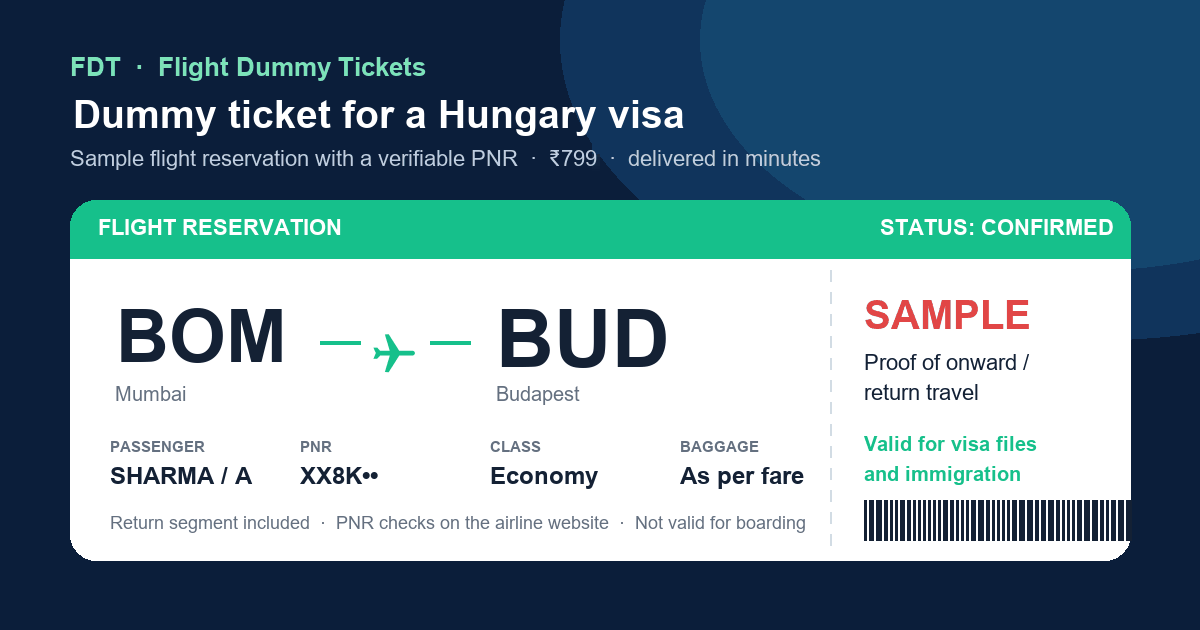
A dummy ticket for a Hungary visa is a temporary flight reservation that shows the Hungarian embassy, through VFS Hungary, that you plan to fly to Hungary on a stated date and leave the Schengen area on a stated date, without buying a full-priced ticket before your visa is approved. It is not a paid ticket, it is not for boarding, and it does not guarantee a visa. What it does is meet the flight-reservation line on the VFS Hungary checklist in a form an officer can verify: your name exactly as in your passport, your flights in and out, your travel dates, and a PNR that checks out on the airline's own website. Hungary is one of the best-value Schengen countries for Indian travellers, and that value is part of its appeal, Budapest is beautiful, affordable by European standards, and easy to explore on foot, but a good-value trip still needs a clean file. A dead PNR, a hotel that starts a day late, or a trip that should have been filed through another country will slow the file down, and in peak season a slow file is a missed trip.
Budapest is the heart of almost every Hungary trip from India, and it is a city that suits a short, focused visit. The Danube divides it into Buda, on the west bank, with its castle hill, fisherman's bastion and quiet streets, and Pest, on the east bank, with its parliament building, its boulevards, its cafés and its ruin bars. The thermal baths, Széchenyi, Gellért, Rudas, are a part of life in Budapest, not a tourist extra, and a visit to one is a normal afternoon. Beyond Budapest there is Lake Balaton, the largest lake in Central Europe, Eger, with its wine cellars and castle, and Pécs, in the south, but most first trips are Budapest plus one other place, or Budapest alone. That focus is a strength in a visa file. A five-night trip that is four nights in Budapest and one night at Lake Balaton is easy to read. A five-night trip that claims Budapest, Eger, Pécs, Debrecen and Szeged is a list, not a trip, and it will be read as one.
This guide is written for an Indian applicant planning a trip to Hungary, a first visit to Budapest, a visit to family or friends living in Hungary, a business trip, or a Hungary-plus-neighbours trip that is genuinely centred on Hungary. It covers the Hungary-specific detail a general Schengen guide cannot: the VFS Hungary process in India, the Budapest entry, the main-destination rule as it applies when Hungary is combined with Austria or the Czech Republic, Hungarian processing timelines, and the mistakes that Hungary applications make most often. For the general Schengen rules, read our dummy ticket for Schengen visa guide. For what a dummy ticket actually is, read what is a dummy ticket. For the VFS process in full, read our Schengen visa from India VFS process guide.
A dummy ticket is a temporary flight reservation for visa purposes. It is not a paid ticket, it is not for boarding, and it does not guarantee a visa. With FDT, a reservation costs ₹799 / $10 flat per passenger, the same for One-Way, Return and Multi-City, delivered in about 10 minutes as a PDF by email and WhatsApp with a verified PNR, valid for up to 2 weeks. Payment is through Razorpay, UPI, cards and net banking, with 5% off every booking and 10% off for 3 or more passengers. Support is at support@flightdummytickets.com and on WhatsApp at +1 786 957 8117. FDT has delivered 20,000+ tickets. Those are the only commercial facts on this page. Always check your own VFS Hungary checklist before you submit; if this guide and your checklist disagree, follow the checklist.
Key facts at a glance
| Question | Short answer |
|---|---|
| Where do I apply for Hungary? | Through VFS Hungary, at a VFS centre in your region in India. |
| What is a dummy ticket? | A temporary flight reservation for visa purposes, not a paid ticket, not for boarding. |
| How long does Hungary take? | About 15 working days is typical, longer in peak summer. |
| What is the main-destination rule? | Apply to Hungary if you spend the most nights there; if equal, the country you enter first. |
| FDT price | ₹799 / $10 flat per passenger, same for One-Way, Return and Multi-City. |
| FDT delivery | About 10 minutes, PDF by email and WhatsApp, verified PNR. |
| FDT validity | Up to 2 weeks. Check your own reservation expiry. |
| FDT payment | Razorpay (UPI, cards, net banking). 5% off every booking, 10% off for 3+ passengers. |
| FDT support | support@flightdummytickets.com, WhatsApp +1 786 957 8117. 20,000+ tickets delivered. |
| Does it guarantee a visa? | No. No ticket guarantees a visa. |
Contents
- Budapest in four days: a trip that fits the city
- The Budapest entry: Liszt Ferenc, flights from India and the first night
- Beyond Budapest: Lake Balaton, Eger and the Danube Bend
- VFS Hungary in India: centres, appointments and regions
- Which country to apply to: Hungary and the main-destination rule
- The Hungary checklist, document by document
- Money, work and ties to India in a Hungary file
- The flight reservation: what VFS Hungary expects to see
- Hotels in Hungary: Budapest, Balaton and the night-by-night check
- Timelines: when to apply, and how long Hungary takes
- Summer, winter and the thermal baths
- Families, friends and first-time travellers to Hungary
- The mistakes that Hungary applications make most often
- After approval: booking real flights and arriving in Budapest
- Frequently asked questions
1. Budapest in four days: a trip that fits the city
Budapest is a city that rewards a short, unhurried visit, and the best Hungary files are the ones that show that understanding. The Parliament Building, on the Pest bank of the Danube, is the postcard, and it is worth a morning, with a tour inside if you book in advance. The Castle Hill, on the Buda bank, holds the Royal Palace, the Fisherman's Bastion, with its view over the Danube and Pest, and Matthias Church, and it deserves a full afternoon. The Széchenyi Thermal Bath, in City Park, is a vast, yellow, outdoor bath complex, and it deserves a slow morning or afternoon. The Great Market Hall, near the river, sells paprika, sausages, cheese and pastries, and it deserves a lunch. A four-day Budapest trip that names these places, in this order, is a real itinerary. A four-day trip that says "sightseeing in Budapest" is a formality.
A practical four-night Budapest plan looks like this. Arrive on a Thursday, settle into a hotel in Pest, near the centre, and spend the evening walking along the Danube, looking across at Buda. Friday, the Parliament Building in the morning, the Great Market Hall for lunch, and the Jewish Quarter in the afternoon, with its ruin bars and street food. Saturday, the Castle Hill in the morning, the Fisherman's Bastion and Matthias Church, and a Danube cruise in the evening, when the Parliament and the bridges are lit. Sunday, the Széchenyi Thermal Bath in the morning, a slow afternoon in City Park, and dinner in Pest. Monday, a slow morning, a final coffee, and a flight home, or a day trip to the Danube Bend. That is four nights, one base, and a file that an officer can read in thirty seconds. The thermal bath matters: it is a normal Budapest activity, and naming it in the itinerary, "morning at Széchenyi Thermal Bath", is a small detail that shows you have looked at Budapest, not just at a list of European capitals.
The point of this section is not to tell you what to see. It is to show you how a Budapest trip should be written. Name the places. Name the days. Keep the base the same. A file that names the Parliament, Castle Hill, Széchenyi and the Great Market Hall is a file that was written by a person who has looked at Budapest. A file that lists five cities in five nights is a file that was written by a person who has looked at a map of Europe and picked names. The officer can tell the difference, and it matters, because the itinerary is the only part of the file that shows the purpose of the trip. The bank statements show you can afford it. The employment letter shows you will return. The itinerary shows why you are going at all. Our guide on dummy ticket for Schengen visa explains the wider Schengen rules.
2. The Budapest entry: Liszt Ferenc, flights from India and the first night
Budapest Ferenc Liszt International Airport, code BUD, is the main international airport for Hungary, and it is where almost every flight from India arrives. There are direct flights from Delhi to Budapest in season, and one-stop flights through the Gulf, through Frankfurt, through Vienna or through Istanbul for the rest of the year. Your flight reservation will show the airport code, and your itinerary should be consistent with it. If your flight arrives at Liszt Ferenc, your hotel should be in Budapest, and your first night should be the night of your arrival date. If your flight arrives late at night, your hotel should still start on the arrival date, because the hotel is booked for the night, not for the day. This is the single most common first-night error in Hungary files, and it is easy to avoid once you see it.
Getting from Liszt Ferenc into central Budapest takes about thirty to forty minutes by bus or taxi, or about forty-five minutes by the airport bus and metro. None of this needs to be in your visa file in detail, but knowing it helps you write an itinerary that is realistic. A flight that lands at Liszt Ferenc at 8 in the morning and a hotel check-in at 3 in the afternoon is normal. You will leave your bags at reception and walk to the Danube, which is a short walk from most central hotels. That is not a visa problem. What is a visa problem is a hotel that starts a day late because you thought check-in time meant something about the date. It does not. The date is the date. If you arrive on 10 June, the hotel starts on 10 June, even if you land at 11 at night. If your flight leaves Delhi at 11 at night on 9 June and arrives in Budapest on 10 June in the morning, your first hotel night is still 10 June, and the night of 9 June is spent on the plane. Say so in your cover letter if you want to be thorough: "I depart Delhi on 9 June and arrive in Budapest on 10 June, and my hotel booking starts on 10 June." That sentence prevents a question.
There is a related point about the return. If you fly out of Budapest, your last hotel night is the night before your departure, and your hotel should be in Budapest on that night. If you fly out of Vienna, your last hotel night should be in Vienna. If you fly out of Budapest but your last hotel is at Lake Balaton, the file needs to explain how you get from Balaton to Budapest on the departure day. A sentence in the cover letter is enough: "I take the morning train from Balaton to Budapest on 20 June and fly home that evening." Without it, the officer has to guess. Do not make them guess. For a multi-city trip that starts in Budapest and ends in Vienna, the reservation should show Delhi to Budapest and Vienna to Delhi, which is an open-jaw return. That is normal, and it is not a problem, as long as the hotels show the journey between Budapest and Vienna and the cover letter explains it. For a trip that is only Budapest, the reservation should show Delhi to Budapest and Budapest to Delhi. For a trip that includes London as well as Budapest, remember that the UK is not in Schengen, and the flight to London is a separate journey with a separate visa, as explained in our dummy ticket for UK visa guide.
3. Beyond Budapest: Lake Balaton, Eger and the Danube Bend
Lake Balaton is Hungary's summer lake, the largest in Central Europe, and it is the place most Hungary trips add after Budapest. It is a shallow, warm lake, with beaches, sailing, cycling and small towns along its shores, and it deserves two nights: one to arrive, one to see the lake. A day trip to Balaton from Budapest is possible, but it is a long day, and a file that claims a day trip to Balaton and also shows a hotel night at Balaton on the same night is a double-booked night. Decide whether Balaton is a day trip or a stay, and write the file to match. Our flight itinerary for visa application guide explains how an itinerary is read, and the dummy ticket and hotel booking matching dates guide explains the night-by-night check.
Eger, in the north-east, is a smaller city with a castle, a historic centre, and wine cellars in the Valley of the Beautiful Woman, where local red wine is served in small cellars. Eger is about two hours by train or bus from Budapest, and it can be a day trip or a single night. A trip that is Budapest for four nights, Eger for one night, and Balaton for two nights is a real journey across Hungary, with journeys that are short and pleasant. A trip that adds Eger, Pécs, Debrecen and Szeged in four nights is a list. The difference is the nights, and the nights are what the embassy checks. Pécs, in the south, is a university city with a Roman history, a mosque turned church, and a quiet, Mediterranean feel, and it deserves a night or two on its own. The Danube Bend, north of Budapest, is a curve in the river with small towns, Szentendre, Visegrád, Esztergom, and it is best as a day trip from Budapest, returning the same evening. Say so in the cover letter, "day trip to Szentendre, returning to Budapest the same evening", so the officer does not read it as a missing hotel night.
4. VFS Hungary in India: centres, appointments and regions
VFS Hungary is the channel through which almost all short-stay Hungary visa applications from India are submitted. VFS does not decide your visa. The Hungarian embassy does. VFS receives the application, checks that the documents are present, collects your biometrics, and returns your passport. Understanding that distinction helps you know what to expect at the appointment and what not to expect. VFS staff can tell you that a document is missing. They cannot tell you whether your visa will be approved, how long the decision will take, or whether your itinerary is convincing. Those are embassy decisions, and they are made after you leave the centre. Do not argue with VFS staff about a decision they did not make. Bring a complete file, in order, and let the embassy decide.
The VFS Hungary centres in India are organised by region, and the centre you use depends on where you live. The major centres are in New Delhi, Mumbai, Bengaluru, Chennai, Hyderabad, Kolkata, Pune, Ahmedabad, Kochi, Chandigarh and Jaipur, with smaller centres in other cities, and the VFS Hungary page for India lists the centres and the services each one offers. Check that page before you book, and book the centre that serves your region. Applying at a centre that does not serve your region can lead to the application not being accepted, and that is a wasted appointment and a wasted trip. The official domain is vfsglobal.com, and you should reach it by typing the address yourself rather than clicking a link in a message from an unknown agent. Our Schengen visa from India VFS process guide explains the appointment process in full, including what to bring and what happens at the counter.
Booking a VFS Hungary appointment is usually less frantic than booking a France or Italy appointment in peak season, because Hungary receives fewer Indian applicants, but it is not a step to leave to the last minute. Slots are released in batches, and in May and June, when summer travel peaks, and in December, when Christmas travel peaks, the nearer slots go quickly. Check the booking page regularly, morning and evening, and be ready to book the moment a slot appears. Have your passport details ready, because the booking form will ask for them, and have a rough travel date in mind, because the appointment should be early enough to leave time for the decision and for a fresh flight reservation if the first one expires. If you cannot find a slot in your city, check other centres in your region. A slot in Pune may be available when Mumbai is full. A slot in Chandigarh may be available when Delhi is full. Travelling to another city for an appointment is inconvenient, but it is better than waiting for a slot that never appears.
A word about appointment sellers applies to Hungary as it does to every Schengen country. In peak season, agents charge a premium to secure a VFS slot, and some of them are legitimate, monitoring the booking page on your behalf. Others sell slots that do not exist, or charge for a slot and disappear. If you use an agent, check that the appointment confirmation is in your name, for Hungary, at the right centre, on the right date. Never pay for a slot by a direct transfer to a personal number without a receipt, and never share your VFS account password. Your VFS account contains your passport details. Treat it like a bank account. At the appointment itself, the process is orderly. You arrive with your documents in the order the checklist asks for them, you hand them over at the counter, your photograph and fingerprints are taken, and you pay the visa fee and the VFS service fee. Keep the receipt. It is your proof of submission and your reference if you need to follow up. You will be told roughly when to expect a decision, but that is an estimate, not a promise. Do not book a non-refundable flight for the day after the estimated decision date.
5. Which country to apply to: Hungary and the main-destination rule
The main-destination rule is the first decision in a Hungary application, and it is the one that most first-time applicants get wrong, because it feels like a choice and it is actually a rule. You apply to the country where you will spend the most nights. If you spend the same number of nights in two or more countries, you apply to the country you will enter first. Work out the nights first, choose the country second, and let the flight follow the itinerary, not the other way round. That is the whole rule, and every multi-country trip on this page is judged against it.
Take a trip that is five nights in Hungary, three in Austria and three in the Czech Republic. The main destination is Hungary. You apply through VFS Hungary, even if you fly out of Vienna. Take a trip that is four nights in Hungary and four nights in Austria. The nights are equal, so you apply to the country you enter first. If you fly into Budapest, you apply through Hungary. If you fly into Vienna, you apply through Austria. Take a trip that is two nights in Hungary and eight nights in Germany. The main destination is Germany, even though you enter through Budapest. Applying through Hungary in that case is a mistake, and it can lead to a delay or a refusal. Our guide on dummy ticket for Germany visa shows the Germany side of the same decision, and the dummy ticket for Schengen visa guide explains the rule in full.
The rule matters for your flight reservation as well. Your flight should arrive in the country you enter first and leave from the country where your trip ends, and your hotels should show the nights that justify your choice. If your hotels say five nights in Hungary and your flight says you arrive in Vienna and never go to Budapest, the file is inconsistent. The night-by-night method from our dummy ticket and hotel booking matching dates guide is the way to catch these problems: write one line per night, from arrival to departure, and next to each night write the country and the city. If the lines do not add up to the trip, fix the itinerary before you fix anything else. Day trips do not count as nights. A day trip from Budapest to the Danube Bend is a day in Hungary, not a new country. A day trip from Budapest to Vienna is a day in Austria, not a night in Austria. Only the nights count, because only the nights need accommodation, and accommodation is what the checklist checks. If your itinerary lists a day trip, say so clearly, "day trip to Szentendre, returning to Budapest the same evening", so the officer does not read it as a missing hotel night. Our flight itinerary for visa application guide explains how an itinerary is read, and the onward travel proof explained guide explains the return flight in detail.
6. The Hungary checklist, document by document
The VFS Hungary checklist is the authority for your application, and it is broadly the same as the checklist for any Schengen country, with small differences that the checklist will state. The list below is the standard set. Use it as a guide, and use the checklist for Hungary as the authority. If the two disagree, follow the checklist. Your passport, valid for at least three months after your intended departure from Schengen, with at least two blank pages, and with any old passports that show previous travel. Your photographs, in the size and format the checklist specifies, usually 35 by 45 millimetres, white background, recent, with your face clearly visible. Your visa application form, completed online, printed and signed. Your flight reservation, showing your name, your flights, your dates and a PNR that verifies on the airline website. Your hotel bookings, covering every night of your trip, in order, with no gaps, including every night in Hungary and every night in any other Schengen country you visit. Your travel insurance, covering the whole trip, with the medical cover the checklist specifies. Your cover letter, stating your purpose, your dates, your itinerary in Hungary and any other countries, and your intention to return to India. Your financial documents: bank statements for the last three to six months, stamped and signed by the bank, showing a balance that supports the trip, and, if you are employed, salary slips for the last three months and an employment letter or a no-objection certificate from your employer, on company letterhead, stating your position, your salary, your date of joining, and that you are on leave for the trip and will return to work afterwards. If you are self-employed, your business registration, your income tax returns and your business bank statements. If you are a student, your admission letter, your student ID and your sponsor's financial documents.
Each document has its own traps, and the Hungarian checklist is applied carefully. Bank statements must be originals, stamped by the bank, not screenshots from a banking app. A bank statement with a large deposit the week before the application, with no explanation, looks like borrowed money. Salary slips must be for the last three months. An employment letter must be on company letterhead, with the company's address and phone number. Hotel bookings must cover every night, as explained in our dummy ticket and hotel booking matching dates guide. Flight reservations must have a verifiable PNR, as explained in our how to verify dummy ticket PNR guide. Insurance must cover the whole trip. Photographs must be the right size and recent. A photograph that is two years old, or that was taken for a different visa, may be rejected. Arrange the documents in the order the checklist asks for them, and put them in a folder in that order. VFS Hungary staff work through the checklist in order, and a file that is in order is faster to process. Make a photocopy of every document for yourself, and keep the copies at home. Check the documents the night before the appointment, using the checklists in our guides on dummy ticket pdf check before upload for the flight, and on proof of accommodation and onward travel for the accommodation. The night before is the last chance to catch an error while there is still time to fix it.
If you are visiting family or friends in Hungary, the checklist may ask for an invitation letter from your host, stating the host's name and address, your name, the dates, and the host's relationship to you, with the host's ID or proof of address where the checklist asks for it. A vague statement that you will stay with a friend, with no letter, no address and no dates, is not accommodation proof. It is a gap. Treat a host stay with the same care as a hotel booking: the dates must match the flight, night by night, and the host's details must be complete. If you are staying partly with a host and partly in hotels, the two must join up without a missing night. The night-by-night list finds the gap in under a minute, and it is worth doing even when the trip feels simple.
7. Money, work and ties to India in a Hungary file
Money is where many Hungary applications are decided, not because Hungary is unusually strict, but because the officer needs to be satisfied that you can afford the trip you have planned. Hungary is cheaper than France or Norway, and that helps, but a seven-day trip to Budapest and Lake Balaton, with hotels, food, local travel and activities, still costs a real amount, and the bank balance needs to reflect that. There is no published minimum balance that guarantees approval, and any agent who quotes one is guessing. What the officer looks for is a balance that is stable over three to six months, that is consistent with your income, and that leaves enough after the trip for your life in India to continue. A balance that jumps by a large amount the week before the application, with no explanation, looks like borrowed money. A balance that has been steady for months, with regular salary credits and regular spending, looks like a real financial life.
If you are employed, the file should show salary slips for the last three months, an employment letter or a no-objection certificate on company letterhead stating your position, your salary, your date of joining, and that you are on leave for the trip and will return to work afterwards. The letter should be recent, signed, and on letterhead with the company's address and phone number. A letter that is undated, or that does not state your return to work, is weaker than it should be. If you are self-employed, the file should show your business registration, your income tax returns for the last two or three years, and your business bank statements, with a cover letter that explains the business in plain language. If you are a student, the file should show your admission letter, your student ID, and your sponsor's financial documents, with a letter from the sponsor stating the relationship and the support. In every case, the financial documents should tell the same story as the cover letter. If the cover letter says you earn a certain salary and the salary slips say something different, the file has a problem that is easy to fix before submission and hard to fix after a refusal.
Ties to India are the other half of the decision. The officer needs to be satisfied that you intend to return to India after the trip, and the evidence for that is ordinary life: a job to return to, a business to run, a course to complete, family in India, a home, a history of travel and return. Previous travel helps, especially previous Schengen travel where you returned on time, but a first-time traveller with a stable job and a clear reason to return is not at a disadvantage. What hurts is a file that shows no reason to return: no job, no business, no course, no family, and a trip that looks like a one-way plan rather than a holiday. If you are between jobs, say so honestly and show what you are returning to, a new job starting on a stated date, a business, a family responsibility. Honesty is stronger than a gap. Our dummy ticket mistakes visa rejection guide explains the mistakes that weaken a file, and our dummy ticket for tourist visa family visit guide explains the family-visit side of the same question.
8. The flight reservation: what VFS Hungary expects to see
VFS Hungary expects to see a flight reservation, not a paid ticket, and not a screenshot. The reservation should show your name exactly as in your passport, your outbound flight into Hungary or into the Schengen area, your return flight out of the Schengen area, your dates, and a PNR that verifies on the airline's website. That is the whole requirement, and it is worth stating plainly for Hungary, because so many applicants make the same two mistakes: they buy a full ticket before the visa is approved, or they submit a screenshot from a flight search site. Neither is what the checklist asks for, and both create problems that a reservation would have avoided.
Do not buy a full ticket before your visa is approved. A non-refundable ticket for ₹50,000 or more, bought for a trip that depends on a visa, is a financial risk that the embassy does not ask you to take. The checklist asks for a reservation, not a paid ticket, and a temporary reservation is what the checklist means. A dummy ticket is a temporary flight reservation for visa purposes, not a paid ticket, not for boarding, and it does not guarantee a visa. With FDT, that reservation costs ₹799 / $10 flat per passenger, the same for One-Way, Return and Multi-City, delivered in about 10 minutes as a PDF by email and WhatsApp with a verified PNR, valid for up to 2 weeks. That is the document VFS Hungary expects to see, and it is the document you should submit. Our dummy ticket vs real ticket guide explains the difference in full, and our how to book dummy ticket online guide walks through the booking step by step.
Check the PNR yourself before you submit, on the airline's own website, with your surname. If the PNR does not verify, do not submit the PDF. Contact the provider and get a fresh reservation with a new PNR that does verify. Our guide on how to verify dummy ticket PNR walks through the check, and our guide on free dummy ticket generator risks explains why a free-generator PDF, with a fake or dead PNR, is the most damaging error you can make in a Hungary application. Check the dates as well. Your outbound flight should arrive on the date your first hotel night starts, and your return flight should leave on the day after your last hotel night, or late on check-out day. Your insurance should cover the whole trip. Your cover letter should state the same dates. If any of those disagree, fix the document that is wrong, not the one that is easiest to change. Usually the flight is the easiest to fix, because a fresh reservation takes about 10 minutes. Our dummy ticket validity how long guide explains how the two-week validity interacts with your appointment date. If your appointment is delayed and the reservation expires, get a fresh one for the same dates with a new PNR, and check the new PNR yourself before you submit.
For a multi-city trip that starts in Budapest and ends in Vienna, the reservation should show Delhi to Budapest and Vienna to Delhi, which is an open-jaw return. That is normal, and it is not a problem, as long as the hotels show the journey between Budapest and Vienna and the cover letter explains it. For a trip that is only Budapest, the reservation should show Delhi to Budapest and Budapest to Delhi. For a trip that includes London as well as Budapest, remember that the UK is not in Schengen, and the flight to London is a separate journey with a separate visa, as explained in our dummy ticket for UK visa guide. Do not mix a UK itinerary into a Hungary application without explaining it.
Book your dummy ticket, ₹799 flat
One-Way, Return or Multi-City, with a verified PNR. Delivered in about 10 minutes by email and WhatsApp.
Book Dummy Ticket, ₹799 WhatsApp Us9. Hotels in Hungary: Budapest, Balaton and the night-by-night check
Hotels in Hungary are where the date-matching work is most visible, because a Hungary trip is often a multi-city trip within Hungary itself: Budapest for four nights, Lake Balaton for two nights, and then a flight home from Budapest. Each change of city is a chance to drop a night, and the night-by-night method from our hotel-matching guide is the way to catch it. Write one line per night, from arrival to departure, and next to each night write the city and the hotel. For a trip arriving in Budapest on 10 June and leaving on 17 June, the lines are the nights of 10 to 16 June, which is 7 nights. If the trip is Budapest 10 to 14 June and Balaton 14 to 17 June, the hotels should be Budapest 10 to 14 June and Balaton 14 to 17 June, which is four plus three, which is 7 nights. The end date of one hotel is the start date of the next. If the Budapest hotel ends on 13 June and the Balaton hotel starts on 15 June, the night of 14 June is missing. If the Budapest hotel ends on 15 June and the Balaton hotel starts on 14 June, the night of 14 June is double-booked. Either way, the file has a problem, and the night-by-night list finds it in under a minute.
Budapest hotels deserve a special note, because they are good value by European standards, and because applicants often book a hotel for fewer nights than the trip, planning to stay with a friend for the rest, without documenting the friend's stay. If you are staying with a friend or a relative in Budapest for part of the trip, you need a host invitation letter for those nights, stating the host's name and address, your name, the dates, and the host's relationship to you, with the host's ID or proof of address where the checklist asks for it. A vague statement that you will stay with a friend, with no letter, no address and no dates, is not accommodation proof. It is a gap. Treat a host stay with the same care as a hotel booking: the dates must match the flight, night by night. Our proof of accommodation and onward travel guide explains how accommodation and onward travel are read together. Balaton hotels in summer sell out early, and a file that shows a hotel booking made the week before the appointment, for a peak-season date, is a file that may not be believed. Book refundable hotels early, and keep the confirmation.
10. Timelines: when to apply, and how long Hungary takes
Hungary, like other Schengen countries, typically takes about 15 working days for a decision, counting from the day the application reaches the embassy, not from the day you book the appointment. In practice, that means you should allow at least six weeks between your VFS appointment and your travel date, and eight to twelve weeks in peak season, to allow time for the appointment itself, for the decision, and for the passport to come back. Applying too early is also a problem: you can usually apply up to six months before travel, but applying five months early with a flight reservation that is only valid for two weeks is a timing problem, because the reservation may expire long before the officer reads it. The reservation needs to be valid at the time the file is read, not just at the time it is submitted, and the safest approach is to get the reservation close to the appointment, so that it is fresh when the file is submitted and still valid while it is being read.
A practical timeline for a summer trip to Hungary looks like this. In February or March, decide the dates, count the nights, choose the main destination, and check the VFS Hungary page for appointment availability. In March or April, book the VFS appointment, gather the bank statements and employment letter, and book refundable hotels. A week before the appointment, get the flight reservation, check the PNR yourself, check the dates against the hotels, and print the PDF. The night before the appointment, check every document against the checklist, in order, and put the file in a folder in that order. After the appointment, wait. Do not book a non-refundable flight, do not pay for a non-refundable hotel, and do not make an irreversible plan until the passport is back. That discipline is the difference between a trip that is delayed and a trip that is financially painful. Our dummy ticket last minute same day appointment guide explains what can and cannot be rushed when the appointment is close, and our dummy ticket price in India guide explains the flight cost in context.
11. Summer, winter and the thermal baths
Budapest changes with the season, and the season should shape the itinerary you submit. Summer, from June to August, is the peak season, with long days, warm weather, outdoor cafés, Danube cruises and the thermal baths at their busiest. A summer trip can be built around walking, cruises, day trips and long evenings, and the file should reflect that. Winter, from December to February, is cold, but Budapest in December is also a Christmas city, with markets at Vörösmarty Square and the Basilica, lights in the streets, and the thermal baths steaming in the cold air, a visit to Széchenyi in winter, with snow on the roofs and steam rising from the water, is one of the most memorable experiences in Europe. A winter trip should show that you understand the cold: a hotel in the centre, indoor museums, and a return flight that leaves margin for weather delays. A winter trip that lists Danube cruises and outdoor dining in January is a plan copied from a summer brochure. Spring and autumn are the shoulder seasons, with milder weather, smaller crowds and easier appointments. April and May bring blossom and longer days. September and October bring autumn colours and quieter streets, and Lake Balaton is at its best in early autumn, when the crowds have gone and the water is still warm.
12. Families, friends and first-time travellers to Hungary
A family trip to Hungary works best when every member's documents tell the same story. Children need their own passports and their own flight names on the reservation, and the hotel bookings should show a family room or enough beds for everyone. With FDT, each passenger costs ₹799 / $10, with 10% off for 3 or more passengers, so a family of four pays less per person than a solo traveller. A first-time traveller should keep the trip simple: Budapest and one other place, and a cover letter that says plainly why Hungary and what will happen each day. Visiting friends is similar: name the friend, give the address and dates, and attach the invitation letter the checklist asks for. Do not leave the host's details vague. Our dummy ticket for family group booking guide explains the family side in detail.
13. The mistakes that Hungary applications make most often
The most common Hungary mistakes are small and avoidable. Applying through Hungary when another country holds more nights. Submitting a flight screenshot instead of a reservation with a verifiable PNR. A hotel that starts a day after arrival. A day trip to Vienna written as if it were a night in Austria. A bank statement that is a phone screenshot instead of a stamped original. A cover letter that says "Europe" instead of naming Budapest and the places you will visit. Insurance that ends before the return flight. A photograph that is old or the wrong size. Each of these is caught by the night-before check in our dummy ticket pdf check before upload guide, and each is cheaper to fix before submission than after a refusal.
14. After approval: booking real flights and arriving in Budapest
Once the passport is back with the visa, book a real ticket and check the visa details the same day: your name, the dates, the number of entries, and the validity. A single-entry visa means one entry to Schengen, so a trip that leaves Schengen and returns needs a multiple-entry visa. At Liszt Ferenc, keep the passport, the visa and the return ticket accessible, and keep the hotel address handy. After landing, take the bus or taxi to the centre, check in, and enjoy the city you planned so carefully. The dummy ticket has done its job. It is not for boarding, and it should not be shown at the airport as a ticket.
Ready to book?
Get your dummy ticket for ₹799 per passenger, with a verified PNR, in about 10 minutes.
Book Dummy Ticket, ₹799Dummy ticket options compared
Use this when you are deciding between a free generator PDF, a fully paid ticket, and a verifiable reservation.
| Option | Airline-checkable PNR | Typical cost | Best for |
|---|---|---|---|
| Free PDF generator | No | ₹0 | Never for embassy/VFS upload |
| Fully paid ticket | Yes | Full airfare | When dates are locked and refundable |
| FDT verifiable dummy ticket | Yes | ₹799 / passenger | Visa file before dates are final |
Official sources to check before you apply
Always match your documents to the embassy or VFS checklist for your nationality. These are the primary references we used while writing this page:
Frequently asked questions
1. Do I need a dummy ticket for a Hungary visa from India? Yes, a flight reservation is on the VFS Hungary checklist. A temporary reservation with a verifiable PNR meets that requirement.
2. Where do I apply for a Hungary visa in India? Through VFS Hungary, at a VFS centre in your region. VFS receives the application; the Hungarian embassy decides it.
3. How long does a Hungary visa take from India? About 15 working days is typical, longer in peak summer. Allow six weeks or more before travel.
4. How much does a dummy ticket for Hungary cost with FDT? ₹799 / $10 flat per passenger, same for One-Way, Return and Multi-City, with 5% off every booking and 10% off for 3 or more passengers.
5. Should I apply through Hungary if I spend more nights in Austria? No. Apply to the country where you spend the most nights. If Austria holds more nights, apply through Austria.
6. Can I fly into Budapest and out of Vienna? Yes, that is a normal open-jaw trip, as long as Hungary is your main destination by nights and your hotels explain the journey.
7. What if my VFS Hungary appointment is delayed and my dummy ticket expires? A reservation is valid for up to 2 weeks. Get a fresh reservation for the same dates with a new PNR and check it yourself.
8. Do I need hotel bookings for every night in Hungary? Yes. Your bookings must cover every night, in order, with no gaps. A host invitation letter can cover nights with family or friends.
9. Can I use a dummy ticket to board my flight to Budapest? No. A dummy ticket is a temporary reservation, not a paid ticket and not for boarding.
10. What is the 90/180 rule for a Hungary trip? You can spend up to 90 days in the Schengen area in any 180-day period, across all Schengen countries together, including arrival and departure days.
11. Is Hungary cheaper than France or Norway for a first Schengen trip? Yes, Budapest is good value by European standards, with cheaper hotels and food, which helps the budget in your file.
12. Does a dummy ticket guarantee my Hungary visa? No. A dummy ticket is a temporary flight reservation, not a paid ticket and not for boarding, and it does not guarantee a visa.