The short answer first
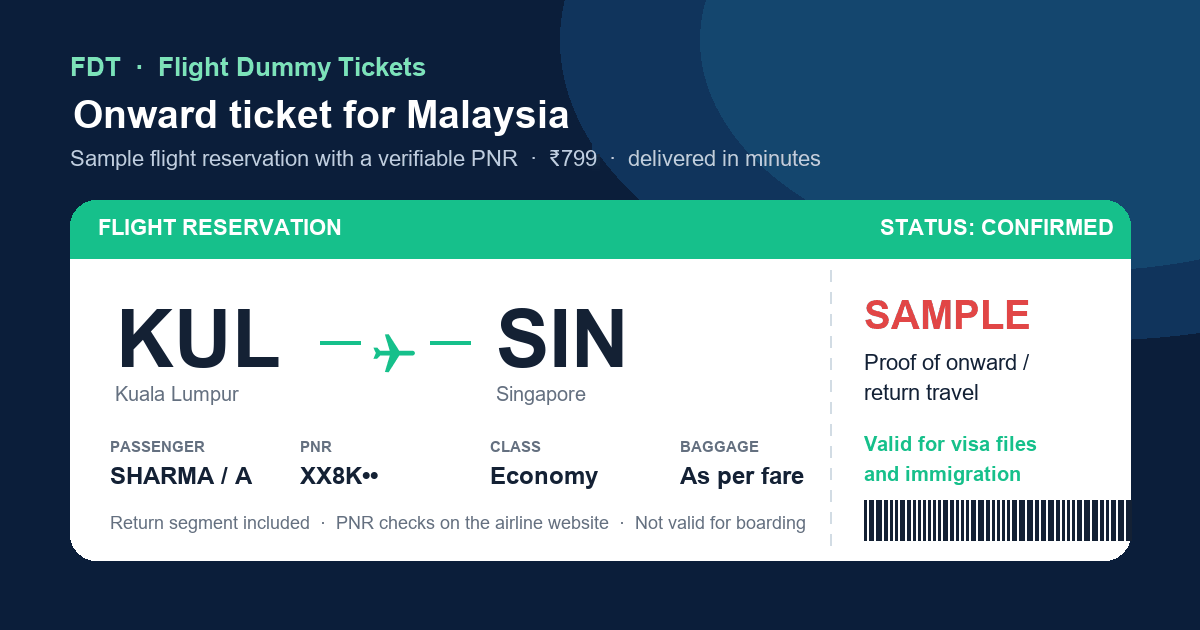
Malaysia is a friendly destination for Indian travellers, and it is also a country that checks onward travel properly. Indian passport holders can often enter Malaysia visa-free for a short stay, or with an eVisa, depending on the current rules, but a visa-free entry does not mean a document-free entry. You still need a passport valid for at least six months, a completed Malaysia Digital Arrival Card (MDAC), proof of funds, hotel bookings, and a return or onward flight ticket out of Malaysia. The airline will usually check the onward ticket at check-in in India, and immigration at Kuala Lumpur International Airport (KLIA) may ask to see it. A dummy ticket is a temporary flight reservation for visa purposes. It is not a paid ticket, it is not for boarding, and it does not guarantee a visa or entry. With FDT it costs ₹799 / $10 flat per passenger, the same for One-Way, Return and Multi-City, delivered in about 10 minutes as a PDF by email and WhatsApp with a verified PNR, valid for up to 2 weeks. Payment is through Razorpay, UPI, cards and net banking, with 5% off every booking and 10% off for 3 or more passengers. Support is at support@flightdummytickets.com and on WhatsApp at +1 786 957 8117. FDT has delivered 20,000+ tickets. Always check your own embassy or official Malaysia immigration guidance before you travel; if this guide and the official guidance disagree, follow the official guidance.
Key facts at a glance
| Question | Short answer |
|---|---|
| Do Indians need a visa for Malaysia? | Often visa-free for a short stay, or eVisa, depending on current rules. Check before you travel. |
| Is an onward ticket required? | Yes, in practice. Airlines check it, and KLIA immigration may ask for it. |
| Does it have to be a paid ticket? | No. A flight reservation with a verifiable PNR is normally accepted. |
| What is MDAC? | Malaysia Digital Arrival Card, completed online before arrival. Your departure date should match your flight. |
| What must the ticket show? | Your name as in your passport, departure date from Malaysia, destination outside it, flight number and PNR. |
| FDT price | ₹799 / $10 flat per passenger, same for One-Way, Return and Multi-City. |
| FDT delivery | About 10 minutes, PDF by email and WhatsApp, verified PNR. |
| FDT validity | Up to 2 weeks. Check your own reservation expiry. |
| FDT payment | Razorpay (UPI, cards, net banking). 5% off every booking, 10% off for 3+ passengers. |
| FDT support | support@flightdummytickets.com, WhatsApp +1 786 957 8117. 20,000+ tickets delivered. |
| Does it guarantee entry? | No. No ticket guarantees a visa or entry. |
Contents
- Visa-free does not mean check-free: the Malaysia misunderstanding
- MDAC: the arrival card that records your departure date
- KLIA immigration: what the officer looks for, and in what order
- The airline check in India, and why it is often the stricter one
- What your Malaysia onward reservation must show
- Return to India or onward to Singapore, Thailand or Indonesia?
- How long can you stay, and why your flight date must sit inside it
- Kuala Lumpur, Penang, Langkawi and the multi-city trap
- Money, hotels and the rest of the entry file
- Families, first-timers and business travellers
- When plans change: extending, rebooking and fresh reservations
- The mistakes that cause the most trouble at KLIA
- Frequently asked questions
1. Visa-free does not mean check-free: the Malaysia misunderstanding
The most common misunderstanding about Malaysia is also the most dangerous one. A traveller hears that Indians can enter Malaysia visa-free for up to 30 days, and they conclude that they need no documents at all. They book a one-way flight, pack a bag, and arrive at KLIA expecting a stamp and a smile. Sometimes they get the stamp. Sometimes they get a long conversation at the immigration counter, and sometimes they do not get past check-in in India at all. The misunderstanding is not about the visa. It is about what "visa-free" means. It means you do not need a visa sticker before you travel. It does not mean you do not need to prove you will leave, that you can afford your stay, or that you have somewhere to sleep.
Malaysia's entry rules for visa-free travellers are clear, even if they are not always explained well. You need a passport valid for at least six months, a return or onward ticket, proof of sufficient funds, and accommodation details. You need to complete the MDAC before arrival. And you need to be able to show those things if asked. Immigration officers do not ask every traveller for every document, every time. They ask when something in your file, your manner, or your travel history gives them a reason to ask. A first-time traveller with a one-way ticket is a reason to ask. A traveller with a return ticket, a hotel booking, and a completed MDAC is not.
Anil from Jaipur learned the difference on his first trip to Malaysia. He had heard about visa-free entry from a friend, and he had booked a one-way flight to Kuala Lumpur with a plan to "see how it goes" and book a return later. At check-in in Delhi, the airline asked for his return ticket. He explained that Malaysia was visa-free. The agent agreed, and then asked again for his return ticket. Visa-free, the agent explained, does not mean ticket-free. Anil booked a return flight from the airport, paid more than he would have paid a week earlier, and made his flight with minutes to spare. On arrival at KLIA, the immigration officer asked to see his return ticket, his hotel booking, and his MDAC. He had all three by then, and he was admitted without further questions. The lesson he took home was simple: visa-free is a privilege, not a free pass. The privilege comes with conditions, and the onward ticket is one of them.
The practical rule is to treat a visa-free trip to Malaysia exactly like a visa trip, as far as documents are concerned. Have a return or onward reservation, a hotel booking for every night, proof of funds, and a completed MDAC. Have them ready to show, printed or saved offline. Do not assume that because you do not need a visa, you do not need the other documents. The officer at KLIA is not checking your visa. They are checking your trip, and the onward ticket is the part of the trip that shows it has an end.
2. MDAC: the arrival card that records your departure date
The Malaysia Digital Arrival Card, or MDAC, is the online arrival form that most foreign visitors must complete before arriving in Malaysia. You fill it in on the official immigration website, usually within three days before arrival, and you show the confirmation on arrival. The form asks for your personal details, your passport details, your flight into Malaysia, your address in Malaysia, and your date of departure from Malaysia. That last field is where the onward ticket meets the arrival form, and it is where travellers make mistakes.
Fill in the MDAC from your reservation, not from memory. Open the PDF, copy the departure date, the flight number, and the departure airport, and type them into the form. Check the spelling of your name against your passport. If your passport says "Kavya Nair" and you usually write "Kavya", write "Kavya Nair" on the form. The form is an official arrival record, and it should match your passport and your reservation. If you write 18 April on the MDAC and your flight is on 20 April, the immigration officer sees a mismatch. If you write 20 April and your hotel ends on 18 April, the officer sees two nights with no accommodation. If you write a departure airport that is different from the airport on your reservation, the officer will ask which one is correct.
There is a timing point as well. The MDAC is usually completed within three days before arrival, which means you complete it after you have booked your flight, not before. Do not complete the MDAC with a guessed departure date and then book a flight for a different date. Book the flight first, then complete the MDAC from the flight. If your flight changes after you have completed the MDAC, update the MDAC if the system allows it, or be ready to explain the change at the counter with the new reservation in hand. A changed flight with an updated MDAC is a normal situation. A changed flight with an old MDAC that says something different is a question.
Families should complete an MDAC for each traveller, and each traveller's departure date should be the same, unless someone is genuinely leaving on a different date. If a family of four arrives together and the forms show three different departure dates, the officer will ask why. Keep the family on the same flight out, or explain clearly why one person is leaving earlier or later. Children need their own MDAC, and their departure date should match the family's flight. Our guide on dummy ticket for family group booking explains family bookings in more detail.
One more practical point: save the MDAC confirmation as a PDF or a screenshot, and keep it with your return flight PDF. Do not rely on airport Wi-Fi to open it. KLIA has Wi-Fi, but it can be slow at peak hours, and the immigration queue is not the place to wait for a page to load. Have both documents ready before you land, in the same folder, so you can show them in seconds.
3. KLIA immigration: what the officer looks for, and in what order
Kuala Lumpur International Airport is one of the busiest airports in Southeast Asia, and its immigration hall is built for volume. You will land, walk to immigration, join a queue, and present your passport, your MDAC confirmation, and your documents when asked. The officer will look at your passport first, then at your MDAC, then at your return or onward ticket if they ask for it, then at your hotel booking and proof of funds if they ask for those. The order matters, because it tells you what to have ready first.
The passport check is about validity and history. Your passport should be valid for at least six months beyond your arrival, with blank pages for the stamp. If your passport is valid for five months, you may be refused entry, even if everything else is perfect. Check the expiry date before you travel, not at the airport. The officer will also look at your travel history. A passport with stamps from Thailand, Singapore, Dubai or Europe helps, because it shows you have travelled and returned. A blank passport does not hurt you on its own, but it means the officer will look more carefully at the rest of your file. First-time travellers should be extra prepared, not extra nervous. Preparation is the answer to a blank passport.
The MDAC check is about consistency. The officer will compare the MDAC with your passport and your flight. The name should match. The arrival flight should match. The departure date should match your onward ticket. If any of those do not match, the officer will ask. The questions are usually simple, "When are you leaving?" "Where are you staying?" "How long are you staying?", and they are best answered with documents, not just words. Show the return flight PDF when you answer the departure question. Show the hotel confirmation when you answer the accommodation question. A document answers the question before the officer has to ask it twice.
The onward ticket check, when it happens, is about the exit. The officer wants to see a flight out of Malaysia, in your name, for a date inside your permitted stay, to a destination outside Malaysia. A return to India is the simplest version. An onward flight to Singapore, Thailand or Indonesia is also fine, if it is part of a real plan and you can enter the next country. A one-way ticket with no onward flight is the version that causes trouble. If you have a return reservation, the conversation is short. If you do not, it is long, and long conversations at immigration are rarely good news.
The hotel and funds checks, when they happen, are about whether you can support yourself. A hotel booking for every night, in the cities your itinerary mentions, is the standard. Proof of funds can be a bank statement, a credit card, or cash. The amount is not fixed, but it should be plausible for the length of your stay. A traveller staying for 10 days with ₹20,000 in the bank and no credit card will be asked how they are paying for hotels and food. A traveller with a reasonable balance and a credit card will not be asked. Our guide on proof of accommodation and onward travel explains how hotel and flight documents work together.
4. The airline check in India, and why it is often the stricter one
Before you reach KLIA, you will meet the airline check in India, and it is often stricter than the immigration check in Malaysia. The reason is the same as in the Philippines and Japan: the airline is responsible for flying you back if you are refused entry, and it may be fined. So check-in staff in Delhi, Mumbai, Bengaluru or Chennai will ask for your return or onward ticket, your MDAC, and your passport validity, before they give you a boarding pass.
The check is simple and quick if you are prepared. The staff member looks at your passport, asks for your return flight, and may type the PNR into their system. They may ask when you are coming back. If you have a clear reservation, the conversation takes thirty seconds. If you do not, it can take thirty minutes, and it can end with you not being allowed to board. Have the PDF ready, with the PNR visible, and make sure the name matches your passport exactly. A middle name missing, a surname spelled differently, or a first name and surname swapped can turn a valid reservation into a question. Check the spelling before you leave home, not at the airport. The guide on dummy ticket PDF check before upload explains the line-by-line check to do before you travel.
There are two other airline checks worth knowing. The first is the transit check. If you fly Delhi to Kuala Lumpur via Singapore or Bangkok, the airline in India checks your documents for Malaysia, and the transit airport may also check that you have a ticket onwards from the transit point. Your reservation should show the whole journey, or at least the leg into Malaysia and the leg out of Malaysia, so that each check is answered by the same document. The second is the check for a different return airport. If you fly into Kuala Lumpur and out of Penang, the check-in staff in India will see a return from a different airport. That is normal, but it is worth pointing it out yourself, "I am flying into Kuala Lumpur and out of Penang", so the staff member does not think the return flight is missing. A short, clear sentence saves a long explanation.
Low-cost airlines, which operate many India–Malaysia flights, check with particular care, because their check-in windows are shorter and their staff have less time to resolve a problem. If you are flying on a low-cost carrier, be at the airport early, have your documents ready, and do not expect the staff to wait while you search your email for a PDF. A printed copy is often faster than a phone at a low-cost check-in counter, because it can be handed over and checked in seconds. Print the return flight, the MDAC confirmation, and the first hotel booking, and keep them in one folder.
Book your dummy ticket, ₹799 flat
One-Way, Return or Multi-City, with a verified PNR. Delivered in about 10 minutes by email and WhatsApp.
Book Dummy Ticket, ₹799 WhatsApp Us5. What your Malaysia onward reservation must show
A Malaysia onward reservation is judged by whether it contains the right information, in the right form, and whether that information can be checked. Go through this list before you travel, and fix anything that is missing.
First, your full name, spelled exactly as in your passport. That means the same order and the same spelling, including any double letters or extra vowels that Indian names often have. If your passport says "Ananya Sharma" and your reservation says "Ananya Sharmma", that is a mismatch. If your passport has a middle name and your reservation has a different middle name, that is a mismatch. Check every letter.
Second, the departure date and the departure airport. The date must be inside your permitted stay in Malaysia, and it must be the date your itinerary says you leave. The airport must be a real airport in Malaysia, Kuala Lumpur International (KUL), Penang (PEN), Langkawi (LGK), Kota Kinabalu (BKI) or another international airport, and it must match the city where your trip ends. If your last hotel night is in Penang and your flight leaves from Kuala Lumpur the next morning, you need to explain the journey between them, or change one of the two.
Third, the destination outside Malaysia. This is usually Delhi, Mumbai, Bengaluru or Chennai, but it can be a third country if your trip genuinely continues there. If you are flying Kuala Lumpur to Singapore, the destination is Singapore, and you should be able to show that you can enter Singapore. An onward ticket to a country you cannot enter is not onward proof. If you are flying home to India, the destination is straightforward, and the officer knows you can enter your own country. That is one reason a return to India is the simplest onward proof for most Indian travellers.
Fourth, the flight number and the airline. The reservation should show the operating airline and the flight number, not just a route and a date. A document that says "Kuala Lumpur to Delhi, 20 April" without a flight number looks like a plan, not a booking. A document that says "AirAsia AK 123, Kuala Lumpur to Delhi, 20 April, PNR XXXXXX" looks like a booking, because it is one. If your flight is a codeshare, the PDF should make clear which airline to check the PNR with.
Fifth, the PNR itself. This is the six-character booking reference, and it is the single most important line on the document. An officer or airline staff member can enter the PNR with your surname on the airline's website and see the booking. If the PNR does not work, the reservation does not work. Check it yourself on the day you receive the PDF, and check it again the day before your flight. Our guide on how to verify dummy ticket PNR explains how to check it, and what is a dummy ticket explains the difference between a reservation and a paid ticket.
Sixth, the status. The reservation should show as confirmed or held, not as waitlisted, cancelled or expired. A waitlisted booking is not a booking. A cancelled booking is worse than no booking. An expired reservation is the most common problem with dummy tickets, because a reservation is valid for up to 2 weeks with FDT, and a trip that is delayed by a month can easily outlast it. Check your own reservation expiry, and get a fresh reservation if the old one has expired before you travel.
Seventh, the passenger count and the names of everyone travelling. If you are travelling as a couple or a family, every traveller should be named. If only one name is on the reservation, the other travellers have no onward proof. That is a common mistake for honeymoon couples, who book one reservation in one name and assume it covers both. It does not. Each person needs to be named, or each person needs their own reservation.
Eighth, the document should look like a real airline document, not like a Word file with a flight typed into it. A proper PDF from a booking system, with the airline's header, the PNR, and the flight details in a table, is what officers expect. A home-made itinerary with no PNR is not what they expect. If you are unsure whether your PDF looks right, compare it with the checklist in flight itinerary for visa application.
6. Return to India or onward to Singapore, Thailand or Indonesia?
For most Indian travellers, a return to India is the cleanest onward proof for Malaysia. It is easy to understand, easy to check, and it matches the story of a tourist who lives in India and is visiting Malaysia for a holiday. The embassy and the immigration officer know you can enter India. There is no second visa to check, no second country's rules to consider, and no question about whether you will be allowed into the next destination. That simplicity is valuable, and most first-time applicants should choose a return to India, even if they are tempted by a more complicated route.
An onward ticket to Singapore is the most common third-country option from Malaysia, because Singapore is an hour's flight from Kuala Lumpur, flights are frequent, and many travellers combine the two countries in one trip. If that is your plan, show the Kuala Lumpur to Singapore flight, show that you can enter Singapore, Indian passport holders need a visa for Singapore in most cases, so show the visa or the visa approval, and show the Singapore to Delhi flight. If you show only the Kuala Lumpur to Singapore flight, the officer sees you leaving Malaysia, but they do not see you going home. That is better than nothing, but it is not as strong as a complete chain. The same logic applies to Thailand and Indonesia. Show the flight out of Malaysia, show that you can enter the next country, and show the flight home from there.
There is a pattern to avoid. Do not book an onward ticket to a third country you have no intention of visiting, just because it is cheaper than a return to India. Officers see this often, and they know the signs: a flight to a country with no hotel booking, no visa, and no mention in your itinerary. A cheap onward ticket that does not fit the rest of the file is not a clever saving. It is a mismatch, and mismatches are what get files questioned. Book the flight that matches your real itinerary, even if it costs more. The trip is worth more than the saving.
The return airport also matters. If your trip ends in Penang, fly home from Penang. If it ends in Kuala Lumpur, fly home from Kuala Lumpur. Do not fly home from an airport that is far from your last hotel night just because the fare is lower, unless you can show how you get there in time. A flight from Kota Kinabalu on the morning after your last night in Kuala Lumpur is not a plan. It is a geography problem. The officer will see it, and so will the airline. Choose the departure that fits the itinerary, and let the fare follow the plan, not the other way round.
7. How long can you stay, and why your flight date must sit inside it
Malaysia's permitted stay for Indian visitors depends on the entry route. Visa-free entry is commonly up to 30 days, and an eVisa may allow a similar period, but the exact period is stamped in your passport on arrival, and it is that stamp that matters, not what you read online before you travel. Your flight out must fall inside the period stamped in your passport. If the stamp allows you to stay until 20 April and your flight leaves on 25 April, you are planning to overstay by five days, even if you have no intention of doing so. The officer will read the flight date as your planned departure, and they will compare it with the stamp. If it is outside, they will ask.
The practical rule is to book your return flight well inside the permitted stay, not on the last possible day. If you are allowed 30 days, do not book a flight for day 30. Book it for day 10 or day 12, when your trip actually ends. A flight on the last day of a 30-day stay, with hotels for only 10 nights, looks odd. It suggests you have 20 days with no plan. A flight that matches your hotels and your itinerary is credible. A flight that is far later than your hotels is a question.
There is also a point about extensions. Malaysia allows extensions in some cases, but an extension is not something to plan for before you arrive. Do not book a flight for 60 days after arrival and say you will extend your visa when you get there. The officer will read that as a plan to stay longer than you are allowed, and they may refuse entry. Book a flight inside your current permitted stay. If you later extend your stay legally, change the flight then. A booked flight that you later change is still proof on the day you travel. A plan to extend with no flight is not proof.
Check the stamp when you receive it. Look at the date, and compare it with your flight date. If the stamp gives you fewer days than you expected, change the flight. If the stamp gives you more days than you expected, you do not need to change anything, as long as your flight is inside the stamp. Keep a photograph of the stamp on your phone, so you can check it later without opening your passport. And keep the return flight PDF with it, so you can compare the two dates in seconds.
8. Kuala Lumpur, Penang, Langkawi and the multi-city trap
Malaysia is a country that invites multi-city trips. Kuala Lumpur for three nights, Penang for three nights, Langkawi for two nights, and then home from Langkawi or back through Kuala Lumpur. That is a good trip, and it is a common one. But the file must show it, and the showing is where travellers make mistakes.
The trap is the internal journey. Many travellers book the international return, Kuala Lumpur to Delhi on 20 April, and forget that the last internal flight, from Langkawi to Kuala Lumpur, must arrive before that international flight leaves. If the Langkawi to Kuala Lumpur flight is on 20 April at 4 pm, and the Kuala Lumpur to Delhi flight is on 20 April at 2 pm, the plan is impossible. You cannot fly out of Kuala Lumpur two hours before you arrive there from Langkawi. Check the times, not just the dates. Leave a generous gap between the last internal flight and the international departure, ideally a night in Kuala Lumpur before you fly home. A night in Kuala Lumpur before departure is cheap insurance against a missed connection.
A second trap is the hotel in the wrong city. If your itinerary says you are in Penang on 14 April, but your hotel booking for 14 April is in Kuala Lumpur, the file disagrees with itself. The officer will ask which one is true. Book hotels in the city where the itinerary says you will be, on the dates the itinerary says you will be there. If you change the itinerary, change the hotels. If you change the hotels, change the itinerary. Keep them together.
A third trap is the return from a different city. Some travellers fly into Kuala Lumpur and out of Penang, because their trip ends in Penang and they do not want to fly back to Kuala Lumpur. That is fine, as long as the reservation shows the flight out of Penang, and the itinerary ends in Penang. What is not fine is flying into Kuala Lumpur, spending the last three nights in Penang, and showing a return flight from Kuala Lumpur with no internal flight from Penang to Kuala Lumpur. That file has a gap. Fill it, or change the departure airport to Penang. Our guide on onward travel proof explained explains the general idea, and dummy ticket vs real ticket explains why a reservation is the right document.
9. Money, hotels and the rest of the entry file
The onward ticket is one part of the entry file, not the whole file. The rest of the file is money, hotels, and a clear itinerary, and each part should agree with the others. A return flight on 20 April, hotels until 19 April, and funds to cover 10 days in Malaysia is a coherent file. A return flight on 20 April, hotels until 15 April, and funds for 3 days is not. The officer reads the file as a whole, and they notice when the parts do not fit together.
Money is the part travellers underestimate most. Malaysia is not expensive by international standards, but a 10-day trip with hotels, food, transport and activities still costs money. Show a bank statement with a reasonable balance, or a credit card with a reasonable limit, or cash. The amount is not fixed, but it should be plausible for the length of your stay. A traveller staying for 10 days with ₹20,000 in the bank and no credit card will be asked how they are paying for hotels and food. A traveller with a reasonable balance and a credit card will not be asked. If a sponsor is paying, show the sponsor's documents and explain the sponsorship. Do not claim a trip is cheap when the flight alone costs more than your balance.
Hotels should cover every night from arrival to the night before departure. If you arrive on 10 April and leave on 20 April, you need hotels for the nights of 10 to 19 April, ten nights. If you have hotels for nine nights, one night is missing. If you have hotels for eleven nights, one night is extra. Book hotels that cover the whole trip, in the cities your itinerary mentions. A hotel in a city you never visit, or on dates that do not match the itinerary, suggests the itinerary is not real. The guide on dummy ticket and hotel booking matching dates works through this matching in detail.
The itinerary should be day by day, even for a visa-free trip. You do not need to submit it formally, but you should be able to explain it if asked: Kuala Lumpur on 10 April, arrival and hotel; Kuala Lumpur sightseeing on 11 April; travel to Penang on 13 April; Penang on 14 April; travel to Langkawi on 16 April; Langkawi on 17 April; return to Kuala Lumpur on 19 April; departure on 20 April. Each day should have a place and a hotel. The flight dates should be the first and last days of that itinerary. If the itinerary ends on 20 April and the flight leaves on 22 April, there are two days with no plan. If the itinerary ends on 22 April and the flight leaves on 20 April, the plan is impossible. Both are problems. Make the itinerary and the flight end on the same day.
10. Families, first-timers and business travellers
Families need one reservation that names everyone, with each name spelled as in each passport. Children need their own names on the booking, even if they are infants. Honeymoon couples should not submit a reservation in one name only; both partners need to be named, and the hotel bookings should be in both names where possible. Groups travelling together should each have their own reservation, or a group reservation that names every traveller. A group reservation in the leader's name only does not cover the rest of the group.
First-time travellers should add extra clarity: a day-by-day itinerary, hotel confirmations for every night, and proof of funds. A first trip to Malaysia is exciting, but it is also the trip most likely to be questioned, because there is no travel history to support it. Make the file do the work that history cannot. If you have travelled to Thailand, Singapore or Dubai before, mention it if asked, and show the old visa stamps if you have them. Travel history helps, but it does not replace the onward ticket. You still need the ticket, even if you have travelled widely before.
Business travellers have a different file. They should show an invitation letter from the Malaysian company, a letter from their Indian employer, and a return flight that matches the business dates. A business trip of three days with a return flight 20 days later looks odd. A business trip of three days with a return flight on the fourth day, and a hotel for three nights, is coherent. If you are combining business with sightseeing, say so, and show hotels for the sightseeing days as well. The officer wants to see a trip with a shape, not a business letter and a flight that do not match.
11. When plans change: extending, rebooking and fresh reservations
Dates change. A flight is rescheduled, a hotel is changed, a trip is extended by a few days. When that happens, update the reservation and update the rest of the file to match. Do not travel on an old reservation with new hotels, or a new reservation with an old MDAC. A reservation from FDT is valid for up to 2 weeks, so check your own reservation expiry before you travel. If it has expired, get a fresh one for the new dates. That is normal, and a fresh reservation with a new PNR is a straightforward fix, as long as you notice the expiry before you travel. The guide on dummy ticket validity explains validity in more detail, and how to book dummy ticket online explains the booking steps.
If you extend your stay in Malaysia, do it legally, through the proper extension process, and change your flight to match the new departure date. Do not overstay and hope no one notices. Overstaying in Malaysia can lead to a fine, detention, and a ban on future entry, and it will be recorded in your passport. A short, legal trip that ends on time is worth far more than a long trip that ends with an overstay stamp. If you are unsure about the extension process, ask at the immigration office before your permitted stay ends, not after. And if your flight is changed by the airline, keep the new confirmation and check that the PNR still verifies. A changed flight with a verified PNR is a normal situation. A changed flight with a PNR that no longer works is a problem to fix before you go to the airport.
12. The mistakes that cause the most trouble at KLIA
The most common mistakes are a one-way ticket with no onward flight, a return date after the permitted stay ends, a PNR that does not verify, a name spelled differently from the passport, a reservation that has expired before the flight, a return flight from an airport you cannot reach in time, and an MDAC departure date that does not match the flight. Each one is easy to avoid with a ten-minute check before you leave home. Print the PDF, check the name, check the dates, check the PNR on the airline website, check the MDAC, and check that the hotels agree. Ten minutes at home saves hours at the airport, and it can save the trip. Also avoid screenshots, fare quotes, and home-made itineraries with no PNR. Officers see them every day, and they put them aside. The guide on dummy ticket price in India explains the flat price, and dummy ticket for Schengen visa shows how a different destination handles the same onward proof, for travellers combining Malaysia with Europe later.
One more practical detail helps many travellers at KLIA: keep a small amount of Malaysian ringgit, or a card that works in Malaysia, ready to show if the officer asks about funds. You do not need to carry a large amount of cash, and you should not, for safety. A bank statement on your phone, a credit card, and a modest amount of cash together are a credible answer to the funds question. A traveller who cannot show any money, any card, and any bank balance will be asked how they intend to pay for ten days of hotels and food, and that is a difficult question to answer well at an immigration counter. Prepare the answer before you travel, in the form of documents you can show in seconds, and the question, if it comes at all, will be short.
Travellers who arrive late at night should also plan for the first hotel. KLIA is far from central Kuala Lumpur, and a late arrival with no hotel booking and no transport plan looks unprepared. Book the first night in advance, save the confirmation, and know how you are getting there, airport taxi, bus, or train. An officer who asks where you are staying tonight wants a hotel name and an address, not a plan to decide after you land. That first night is the easiest part of the trip to get right, and it sets the tone for the whole entry check.
Dummy ticket options compared
Use this when you are deciding between a free generator PDF, a fully paid ticket, and a verifiable reservation.
| Option | Airline-checkable PNR | Typical cost | Best for |
|---|---|---|---|
| Free PDF generator | No | ₹0 | Never for embassy/VFS upload |
| Fully paid ticket | Yes | Full airfare | When dates are locked and refundable |
| FDT verifiable dummy ticket | Yes | ₹799 / passenger | Visa file before dates are final |
Official sources to check before you apply
Always match your documents to the embassy or VFS checklist for your nationality. These are the primary references we used while writing this page:
13. Frequently asked questions
1. Do Indians need a return ticket for Malaysia if entry is visa-free? Yes, in practice. Visa-free means no visa sticker before travel, not no documents. Airlines check the onward ticket at check-in in India, and KLIA immigration may ask for it. Have a return or onward reservation, in your name, with a verifiable PNR.
2. What is MDAC, and do I need to complete it? MDAC is the Malaysia Digital Arrival Card, completed online before arrival, usually within three days before you land. Your departure date on the MDAC should match your flight reservation exactly. Save the confirmation as a PDF and keep it with your return flight.
3. Can I use a dummy ticket for Malaysia? Yes. A dummy ticket is a temporary flight reservation, not a paid ticket and not for boarding. It is normally accepted as onward proof if it shows your name, dates, flight number and a verifiable PNR. It does not guarantee entry, and you should always check official Malaysia immigration guidance first.
4. Will the airline in India check my onward ticket? Yes. Check-in staff check that you can enter Malaysia and leave it again, because the airline must fly you back if you are refused entry. Have the PDF ready with the PNR visible, and make sure the name matches your passport exactly.
5. Can I fly on to Singapore instead of returning to India? Yes, if that is your real plan. Show the Kuala Lumpur to Singapore flight, show that you can enter Singapore, and show the Singapore to Delhi flight. An onward ticket to a country you cannot enter is not valid onward proof.
6. How do I check my PNR before I travel? Enter the PNR with your surname on the airline's Manage Booking page. The system should return your name, flights, dates and status. If it does not work, check the spelling, check you are on the right airline website, and wait an hour if the booking is very fresh.
7. What if my passport is valid for less than six months? Do not travel. Malaysia requires a passport valid for at least six months beyond arrival. Renew your passport first, and then book your flight. A short-validity passport can lead to refusal at check-in or on arrival, even if everything else is perfect.
8. Do children need to be named on the onward ticket? Yes. Every traveller, including children and infants, should be named on the reservation, with the name spelled exactly as in each passport. A reservation in one parent's name only does not cover the rest of the family.
9. Is a flight search screenshot enough for Malaysia? No. A screenshot or fare quote shows that a flight exists, not that you have reserved a seat. You need a reservation with your name, flight number, dates and a verifiable PNR.
10. What if I want to stay longer than 30 days? Do not book a flight outside your permitted stay and plan to extend later. Book a flight inside your current permitted stay. If you later extend your stay legally, change the flight then. Overstaying can lead to a fine, detention and a future entry ban.
11. How long is an FDT reservation valid? Up to 2 weeks. Check your own reservation expiry, and get a fresh reservation if your travel is delayed beyond it. A fresh reservation for the same dates, with a new PNR, is a normal fix.
12. How much does an FDT reservation cost for Malaysia? ₹799 / $10 flat per passenger, the same for One-Way, Return and Multi-City. Delivery is about 10 minutes as a PDF by email and WhatsApp with a verified PNR. Payment is through Razorpay, with 5% off every booking and 10% off for 3 or more passengers.
Official sources to check: malaysia.travel, imi.gov.my, kln.gov.in
Ready to book?
Get your dummy ticket for ₹799 per passenger, with a verified PNR, in about 10 minutes.
Book Dummy Ticket, ₹799