The short answer first
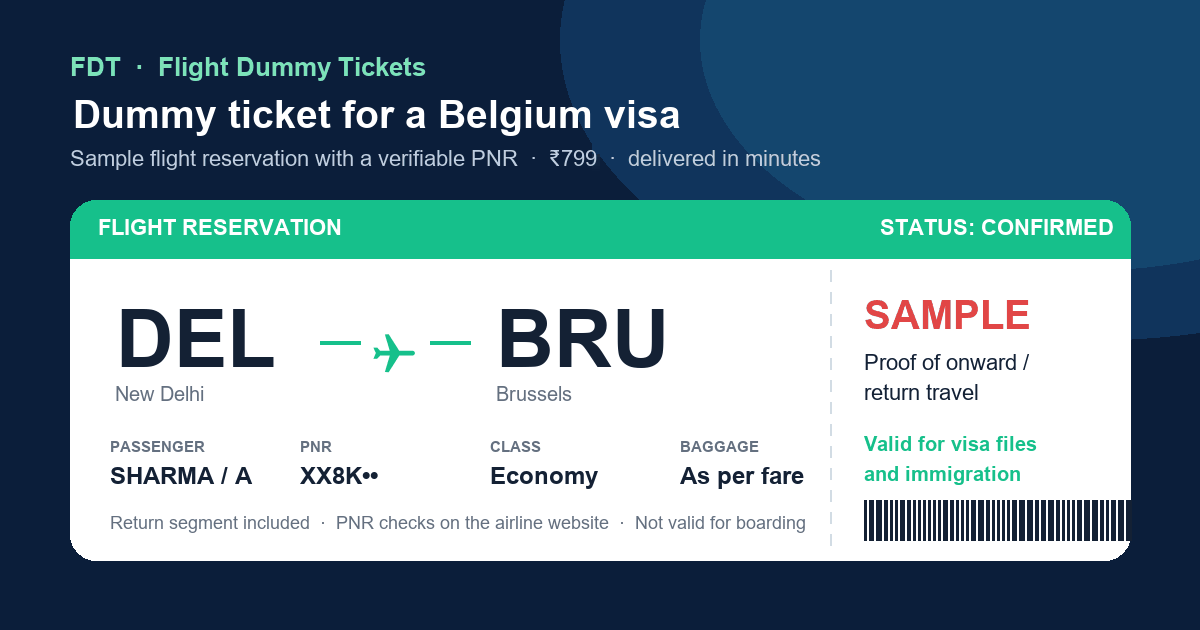
A flight reservation for a Schengen visa Belgium application is a temporary flight reservation, a dummy ticket, that shows the Belgian authorities you have a planned journey into and out of the Schengen area, without you paying for a full ticket before your visa is approved. It is not a paid ticket. You cannot board a flight with it. It does not guarantee a visa. What it does is satisfy the "proof of travel" line on the visa checklist: your name as in your passport, a flight into Belgium or the Schengen area, a flight out again, dates that match your hotel bookings and insurance, and a booking reference, a PNR, that can be verified.
Belgium is the Schengen country where the trip is most often short, and the short trip is where most Belgium files go wrong. A business visitor from Mumbai flies to Brussels for three days of meetings and assumes a three-day trip needs a three-line file. A couple from Delhi spend two nights in Brussels and three in Amsterdam, and they apply through Belgium because Brussels is where they land. A family from Chennai spend three nights in Brussels, two in Bruges and four in Paris, and they apply through Belgium because someone told them Belgium is "easier". In each case the file is missing something, the main destination rule, the business invitation, or the simple fact that a short trip still needs a complete file, and this guide works through all three before anything else, because a short trip with a thin file is the file that gets delayed.
Flight Dummy Tickets, or FDT, provides temporary flight reservations at ₹799 / $10 flat per passenger, the same price for One-Way, Return and Multi-City. Delivery is about 10 minutes, by email and WhatsApp as a PDF, with a verified PNR. Validity is up to 2 weeks, so always check your own reservation expiry. Payment is through Razorpay, UPI, cards and net banking, with 5% off every booking and 10% off for 3 or more passengers. Support is at support@flightdummytickets.com and on WhatsApp at +1 786 957 8117. FDT has delivered 20,000+ tickets. Those are the only commercial facts on this page. Everything else is process, explanation and examples, so you can judge for yourself.
One honest warning before anything else. Always check your own embassy or VFS checklist before you submit. Rules change, checklists differ slightly by country and by visa type, and a blog, even a long one, is not a substitute for the checklist that applies to your appointment. If this guide and your checklist disagree, follow the checklist. Two facts apply to every Schengen application: you may stay up to 90 days in any 180-day period, and a flight reservation is a temporary document, so time it to your appointment, not to the day you first think of it.
Key facts at a glance
| Question | Short answer |
|---|---|
| What is a flight reservation for Belgium? | A temporary flight reservation for your Belgium Schengen visa, not a paid ticket, not for boarding. |
| Do I need a confirmed ticket before the visa? | No. The authorities ask for a flight reservation or itinerary, not a paid ticket. |
| Which country do I apply through? | The main destination, where you spend the most nights. Not necessarily where you land first. |
| Where do Indians apply? | Through VFS Global, for the Belgian embassy. Check vfsglobal.com for your city. |
| FDT price | ₹799 / $10 flat per passenger, same for One-Way, Return and Multi-City. |
| Delivery | About 10 minutes, PDF by email and WhatsApp, verified PNR. |
| Validity | Up to 2 weeks. Check your own reservation expiry. |
| Payment | Razorpay (UPI, cards, net banking). 5% off every booking, 10% off for 3+ passengers. |
| Support | support@flightdummytickets.com, WhatsApp +1 786 957 8117. |
| Does it guarantee a visa? | No. No ticket, real or dummy, guarantees a visa. |
| How long can I stay? | Up to 90 days in any 180-day period on a short-stay Schengen visa. |
Contents
- Brussels entry: the city that is also a capital of Europe
- The short trip problem: why two nights needs the same care as two weeks
- The main destination rule for a Belgium-plus-Netherlands trip
- VFS India: the Belgium process
- Flights: Brussels, and the Amsterdam question
- What your dummy ticket must show
- Hotels, insurance and the date-matching drill
- Business visitors: the file that is not a holiday
- Processing time and the calendar that works
- Mistakes Belgium applicants keep making
- Frequently asked questions
1. Brussels entry: the city that is also a capital of Europe
Most Indian travellers meet Belgium through Brussels, and Brussels is a good place to start because it explains why the country works the way it does. It is a city that is two things at once: the capital of Belgium, with its Grand Place, its chocolate shops and its comic-strip murals, and the capital of Europe, with the European institutions, the embassies and the business meetings that fill its hotels on weekdays. A typical first trip lands in Brussels in the morning, often on a flight from Delhi or Mumbai via a Gulf hub, or via Frankfurt, Paris or London, spends two or three nights near the Grand Place or the European Quarter, and then takes the train to Bruges for a night or two among the canals, or to Ghent for a day among the medieval streets.
That shape, three nights in Brussels, two in Bruges, perhaps one in Ghent, is a normal Belgium trip, and it is also a trip that applies through Belgium without any argument, because Belgium is where every night is spent. The trouble starts when the trip grows. Brussels for two nights, then Amsterdam for three, then Paris for three. Bruges for two nights, then Amsterdam for four. Brussels for three nights, then Cologne for two, then Amsterdam for three. Each of these is a perfectly reasonable holiday, and each of them changes the answer to the question "which embassy do I apply through?" That is the question this guide answers in section 3, because it is the question that decides whether your file is even read.
There is a second thing about Belgium that matters for the paperwork. It is a country people visit for a specific reason, the business meeting, the European institution, the chocolate and the beer, a short city break that wants medieval towns instead of beaches, and a specific reason makes a stronger visa file than a vague one. An officer reading a file that says "Brussels, three nights, Grand Place and the European Quarter, then Bruges, two nights, the canals and the Belfry" understands the trip. An officer reading a file that says "Europe, fifteen days, various cities" does not. Be specific in your cover letter. Name the cities, name the nights, name the reason. The flight reservation then becomes the frame around a picture the officer can already see, rather than the only evidence that a trip exists at all.
The seasons matter less in Belgium than in the island countries, and that is itself useful to know. Brussels and Bruges are year-round cities, the Christmas markets in December, the spring flowers, the summer festivals, the autumn light on the canals, and the visa appointment slots at VFS are steadier across the year. The peaks are still there: summer applications pile up in March, April and May, and business travel is steady all year. If you are travelling in peak season, book your VFS appointment early, slots go, and they go suddenly, but book your flight reservation late, close to the appointment, because a temporary reservation is valid for up to two weeks and you want it live when the embassy looks at the file. The two timelines are different, and keeping them separate is the single most useful habit in this whole process.
For the wider Schengen background, including the 90/180 rule and how the countries fit together, read dummy ticket for Schengen visa and Schengen visa from India: the VFS process. This guide assumes you know the basics and stays with the Belgium-specific decisions: which embassy, which airport, which dates, and how the flight document fits a trip that is often short and often not a holiday at all.
2. The short trip problem: why two nights needs the same care as two weeks
The most dangerous assumption in a Belgium file is that a short trip needs a short file. It does not. A three-day trip to Brussels needs the same documents as a three-week trip across Europe, the passport, the form, the photographs, the insurance, the accommodation, the funds, the employment proof, and the flight reservation, and the officer will check each one with the same care. The trip is shorter. The checklist is not.
Here is the situation that causes the most trouble. A business visitor from Hyderabad is flying to Brussels for three days of meetings. He has the invitation letter from the Belgian company, he has his own company's letter, and he has a flight reservation. What he does not have is a hotel booking for all three nights, because he assumed the Belgian company would arrange it and nobody did. Or he has a hotel booking, but it covers two nights and his flight leaves on the fourth day, with one night unaccounted for. Or he has travel insurance, but it covers only the three days of meetings and not the travel days on either side. Any one of these gaps is enough to delay the file, and the delay is the same delay a tourist would face, the file goes back, more documents are requested, and the meetings are missed.
The fix is to treat the short trip with the same discipline as a long one. Write down the nights: arrive Monday, hotel Monday, Tuesday and Wednesday nights, fly home Thursday. That is three hotel nights for a four-day trip, and the file should show all three. Write down the insurance: from Monday to Thursday, covering the travel days as well as the meeting days. Write down the flight reservation: into Brussels on Monday, out of Brussels on Thursday, matching the hotel and the insurance exactly. A short trip with a complete file is a strong file. A short trip with a thin file is a weak one, and the officer has no way of knowing whether the thinness is carelessness or something worse.
There is a related point about the cover letter for a short trip. A tourist's cover letter describes a holiday. A business visitor's cover letter describes a purpose: who you are meeting, where, when, and why. A two-paragraph letter is enough, the company, the meetings, the dates, the return to work, but it must be specific. "Meetings with our Belgian partner in Brussels from 10 to 12 June, returning to Hyderabad on 13 June" is a complete story. "Business trip to Europe" is not. The flight reservation supports the story, but it cannot replace it. Read dummy ticket for work visa for the business and work file in detail, and dummy ticket for tourist visa and family visit if your trip is a family visit rather than a business one.
3. The main destination rule for a Belgium-plus-Netherlands trip
The main destination rule is the most important sentence in Schengen visa law for an Indian applicant, and it is also the most misunderstood. It says: apply through the country where you will spend the most time. Not the country you land in first. Not the country you like most. Not the country whose appointment slot was available soonest. The country where you spend the most nights. If two countries tie, apply through the one you enter first.
Work it through with real itineraries, because the rule only makes sense in examples. A couple from Bengaluru plan ten days: Brussels three nights, Bruges two nights, Amsterdam four nights. Belgium has five nights, the Netherlands has four, so Belgium is the main destination and they apply through Belgium. The fact that they fly into Brussels and out of Amsterdam does not change it. The fact that Amsterdam has almost as many nights does not change it. Five is more than four, and the application goes to Belgium.
Change one night and the answer flips. Brussels two nights, Bruges two nights, Amsterdam five nights. Now the Netherlands has five nights and Belgium has four, so the Netherlands is the main destination and they apply through the Netherlands. But if they landed in Brussels and spent four nights there first, then five in Amsterdam, the tie-break would not apply, because it is not a tie, the Netherlands has more nights, and the application goes to the Netherlands regardless of where they land. The arrival city only decides a tie. When one country has more nights, that country decides the application. That is why the itinerary matters down to the night, and why a cover letter that lists the nights city by city, with the country totals added up, is worth more than a paragraph of general enthusiasm about Europe.
A third example is the one that causes the most refusals. A family from Delhi plans fourteen days: Brussels two nights, Bruges one night, Amsterdam four nights, Paris four nights, and three nights on trains that they have not really counted. The Netherlands and France have four nights each, Belgium has three. It is a tie between two countries, so the rule says apply through the country of first entry among the tied countries, but the family enters through Brussels, which is not one of the tied countries, so the tie-break points to the first of the tied countries they enter, which is the Netherlands if they go to Amsterdam before Paris. The family applies through Belgium, because Brussels is where they land and because someone told them Belgium is "easier". The application goes to the wrong place, the file is returned or delayed, and the family loses three weeks and misses their appointment slot. The advice they were given was not malicious. It was simply wrong, and it cost them a month.
There is a related mistake that is subtler: counting days instead of nights. A trip that says "Brussels 10th to 13th, Amsterdam 13th to 17th" has three nights in Brussels and four in Amsterdam, not four days and four days. The night of the 13th belongs to Amsterdam, because that is where the traveller sleeps. Officers count nights, because nights are where the traveller actually is. When you write your itinerary, write it in nights, city by city, with dates, add up the nights per country, and apply through the country with the most. If Belgium does not have the most nights, do not apply through Belgium. Read dummy ticket for Netherlands visa or the relevant country guide for the country that does have the most nights, and apply there.
One more point about the rule, because it comes up in almost every Belgium consultation. The main destination rule is about the application, not about the trip. It does not mean you must spend your whole holiday in Belgium. It means the embassy that processes your file is the one for the country where you spend the most time. Once the visa is issued, it is a Schengen visa, and you can travel across the Schengen area as your itinerary describes. The visa does not lock you into Belgium. It simply asks you to be honest, in advance, about where most of the trip happens. Be honest, count the nights, and apply in the right place. Everything else in the file becomes easier after that.
4. VFS India: the Belgium process
The Belgium Schengen visa application from India goes through VFS Global, which collects the file and biometrics on behalf of the Belgian embassy. The process is the same shape as every Schengen application, but the details, which VFS centre serves your city, how far ahead the slots run, what the checklist emphasises for business visitors, are Belgium-specific, and they are worth knowing before you book.
Start with the checklist, published on vfsglobal.com for Belgium. The core documents are the same across Schengen: a passport valid for at least three months beyond your return, with blank pages; the completed and signed application form; two recent photographs meeting the Schengen specification; travel medical insurance covering at least €30,000 for the whole Schengen area and the whole trip; proof of accommodation for every night; proof of funds, usually six months of bank statements; proof of employment or business, such as a leave letter, payslips or GST returns; and proof of travel, the flight reservation. Your cover letter ties it together, explaining the trip in plain language, city by city, night by night. For business visitors, add the invitation letter from the Belgian company and your own company's letter.
Your jurisdiction depends on where you live, so check it before you book the appointment. Delhi, Mumbai, Bengaluru, Chennai, Hyderabad, Kolkata, Pune, Ahmedabad, Kochi and other cities have VFS centres, but not every centre accepts Belgium applications on every day, and the embassy that processes your file may be in Delhi or in another city depending on your region. Book the slot online, choose the centre that serves your state, and arrive early with the originals and one set of photocopies, arranged in the order on the checklist. VFS will take your photograph and fingerprints, collect the visa fee and the VFS service charge, and give you a receipt with a tracking number. The file then goes to the embassy. You will not meet the officer who decides your visa. The file speaks for you, which is why the file has to be complete and consistent.
There are two practical points about VFS that first-time applicants miss. The first is that VFS offers optional paid services, form filling, photocopying, courier return, SMS updates, premium lounge, and none of them improves your chances of getting the visa. They make the appointment more comfortable. They do not make the file stronger. Spend your money on getting the documents right, not on the lounge. The second is that VFS cannot advise you on your application. If you ask the person at the counter whether your bank statements are enough, they will not answer, because it is not their job. Their job is to collect the file. Your job is to make sure the file is right before you hand it over.
The most common VFS-day problem is a missing or mismatched document discovered at the counter: an insurance policy that ends two days before the flight home, a hotel booking in a different name, a bank statement that is three months old. Any of these can be fixed if you catch them before the appointment. Run the checklist the night before, line by line, and check every date against every other date. The guidance in dummy ticket and hotel booking: matching dates and checking your dummy ticket PDF before you upload it covers the matching drill in detail, and it is worth reading before the appointment rather than after a rejection.
5. Flights: Brussels, and the Amsterdam question
Belgium has one international airport that matters for Indian travellers, and one neighbouring airport that matters almost as much. Brussels Airport is the gateway, with connections from India via Gulf hubs and European hubs. Amsterdam Schiphol, across the border in the Netherlands, is the second option, and it is often the cheapest way into Belgium, fly to Amsterdam, take the train to Brussels in under two hours, and start the holiday from there.
Each choice has consequences for the file. A reservation into Brussels and out of Brussels is the simplest shape, and the simplest shape is the strongest, because every document agrees with every other. A reservation into Amsterdam and out of Brussels, or into Brussels and out of Paris, is a Multi-City shape, and it is perfectly normal for a trip that crosses borders, but it must be reflected in the cover letter and the hotel bookings. If your flights say you leave from Paris but your hotels say your last night is in Brussels, the file contradicts itself, and the officer will ask why. A Multi-City reservation costs the same ₹799 / $10 with FDT as a simple return, so there is no reason to force a multi-country trip into a return shape it does not have. Book the shape your trip actually has.
The Amsterdam question comes up often. If you fly into Amsterdam and spend your first nights in Brussels, is the Netherlands your main destination? No, the main destination is where you spend the most nights, not where you land. Landing in Amsterdam for a flight connection and a train to Brussels does not make the Netherlands the main destination, provided your nights are in Belgium. But your cover letter should explain it: "Arrive Amsterdam, train to Brussels same day, three nights Brussels." If the file does not explain the Amsterdam arrival, the officer may wonder why a trip to Belgium starts in the Netherlands. A single sentence removes the doubt.
The same logic applies to the return. Many travellers fly out of Amsterdam after a trip that ends in Bruges or Ghent, taking the train to Amsterdam for the flight home. That is normal, and it is fine, provided the last hotel night is somewhere sensible, a night in Amsterdam before the flight, or a night in Bruges with an early train to Amsterdam on the day of departure. What is not fine is a flight out of Amsterdam on a day when the hotels say you are still in Brussels with no travel planned. The officer reads the file as a journey, and the journey has to be physically possible. Trains take time. Flights leave at specific hours. A file that has you in two cities at once is a file that has not been thought through.
For a first trip, the honest advice is to keep it simple: fly into Brussels, fly out of Brussels, and let the middle of the trip do the travelling. A return reservation is easier to check, easier to match to the hotels, and easier for the officer to understand. Once you have one Schengen visa in your passport, the multi-city trips become easier, because your travel history speaks for you. For the first file, simplicity is a strength.
6. What your dummy ticket must show
A dummy ticket is a temporary flight reservation, and like any document it is judged on whether it contains the right information in the right form. The authorities are not looking for a beautiful document. They are looking for five things, and if any one of them is missing, the document is weak.
First, your name, exactly as it appears in your passport. Not a nickname, not a shortened form, not a surname missing. Indian names cause particular trouble here, because passports often carry the surname first and booking systems often expect the given name first. Enter the name the way the passport shows it, and check the PDF when it arrives. If the name is wrong, get it corrected before the appointment, not after.
Second, the flight sectors: the departure airport, the arrival airport, the date, the time, the airline and the flight number. Delhi to Brussels, Brussels to Delhi. Or Delhi to Brussels, Amsterdam to Delhi, if your trip is multi-city. The sectors must match the itinerary in your cover letter. If the cover letter says you arrive on 10 June and the reservation says 12 June, the file is wrong, and the officer will trust neither document.
Third, the PNR, the six-character booking reference. This is the part that makes the reservation verifiable. An officer, or a VFS staff member, can enter the PNR and your surname on the airline's website and see the booking. A reservation without a PNR is a piece of paper. A reservation with a PNR that does not exist in the airline's system is worse than a piece of paper, because it suggests the document was fabricated. Always verify your own PNR before the appointment. Read how to verify a dummy ticket PNR and follow the steps there. It takes a minute, and it is the difference between a document you can defend and one you cannot.
Fourth, the dates must fall inside the trip you have described, and the return date must fall inside the visa you are asking for. A reservation that shows you leaving Schengen after your insurance ends, or after the 90-day limit, suggests you have not understood the rules. A reservation that shows you leaving before your last hotel night suggests the trip was not planned. Both are avoidable. Check the dates against the hotels and the insurance, line by line, before you submit.
Fifth, the document must be legible and complete. A PDF that is cut off at the edge, a printout where the PNR is smudged, a screenshot instead of the actual itinerary, these are small failures with real consequences, because the file is read by a person who sees hundreds of files a day, and a document they cannot read is a document they set aside. Print the PDF cleanly, check it before the appointment, and carry a spare copy. The guidance in what is a dummy ticket and dummy ticket vs real ticket explains the distinction between a temporary reservation and a paid ticket in full, and it is worth reading if you are unsure what you are actually buying.
One more point, because it is the question everyone asks: should you buy a real ticket instead? If your dates are certain, your visa history is strong, and the fare is cheap and refundable, buying a real ticket is fine. But for most first-time applicants, paying ₹50,000 or more for a flight before the visa is decided is a poor trade. A temporary reservation does the same job in the file for ₹799, and you buy the real ticket once the visa is stamped, at the price that makes sense then. That is the whole point of the product: it removes the financial risk from the application without weakening the file.
Book your dummy ticket, ₹799 flat
One-Way, Return or Multi-City, with a verified PNR. Delivered in about 10 minutes by email and WhatsApp.
Book Dummy Ticket, ₹799 WhatsApp Us7. Hotels, insurance and the date-matching drill
The flight reservation is one document in a set, and the set is judged as a whole. The most common reason a Belgium file is delayed is not the flight document. It is a mismatch between the flight, the hotels and the insurance, and the mismatch is usually a matter of a day or two, the kind of error that feels trivial to the applicant and looks careless to the officer.
Run the drill the night before your appointment. Write down four dates: your arrival date, your departure date, your first hotel night, your last hotel night. They should form a simple pattern. Arrival date equals first hotel night. Departure date equals the day after the last hotel night, or the same day if you are flying out in the evening after checking out. Insurance start equals arrival date. Insurance end equals departure date, or later. If any of these is off by a day, fix it. Insurance that ends before the flight home is the most common error, and it is also the most serious, because it means you are uninsured for part of the trip, and the embassy will not issue a visa for an uninsured trip.
The hotels themselves deserve attention. A booking confirmation must show your name, the hotel's name and address, the check-in and check-out dates, and ideally the fact that it is booked and not merely held. For a multi-city trip, Brussels three nights, Bruges two nights, Amsterdam four nights, you need a booking for each city, and each booking must match the nights in your cover letter. A single booking for Brussels covering the whole trip, when the cover letter says you are in three cities, is a contradiction. The officer will wonder where you are actually sleeping, and the wonder will slow the file down. For the simple Brussels-only trip, the single booking is enough, and it is also the cleanest file of all: one hotel, three nights, matching the flight exactly.
Business visitors have a different accommodation question. The Belgian company may have booked the hotel, or the visitor's own company may have done it. Whatever the arrangement, the file needs a document that shows it: a hotel confirmation in the visitor's name, or a letter from the inviting company stating where the visitor will stay. A business visitor who writes "my host will arrange accommodation" has submitted an incomplete file. The officer's question is the same as for a tourist: where will this person sleep on the night they arrive? If the file does not answer, the file is incomplete.
There is a practical question about refundable bookings. Most tourist applicants book refundable hotels for the visa, and then rebook or change them after the visa is issued. That is normal, and it is accepted, provided the bookings you submit are real and cover the dates you claim. A booking that was cancelled before the appointment, submitted as if it were live, is a problem, because the embassy can check. Book refundable, keep the bookings live until the visa is decided, and change them afterwards if you need to. The same principle applies to the flight reservation: it is temporary, it is valid for up to two weeks, and it must be live when the embassy looks at the file. Read proof of accommodation and onward travel together for the full matching checklist, and dummy ticket for family and group booking before booking a group, because matching names and dates across a family file is where most group mistakes happen.
8. Business visitors: the file that is not a holiday
Belgium receives more Indian business visitors than almost any other small Schengen country, because Brussels is where the European institutions are, and where a large number of international companies have their European offices. A business file is different from a tourist file, and the differences matter for the flight reservation.
A business file is built around the invitation. The letter from the Belgian company should state the visitor's name, the purpose of the visit, the dates of the meetings, who the visitor will meet, and whether the inviting company is covering any costs. The visitor's own company should provide a letter stating the visitor's role, the purpose of the trip, and that the visitor will return to work after the trip. The two letters should agree with each other on the dates, the purpose and the costs. If the invitation says the meetings are from 10 to 12 June and the employer's letter says the trip is from 10 to 20 June, the file contradicts itself, and the officer will ask why.
The flight reservation in a business file has one job: to show that the visitor will arrive in time for the meetings and leave when they end. A reservation that shows arrival the day before the meetings start and departure the day after they end is sensible. A reservation that shows arrival a week before the meetings, with no explanation, raises a question. A reservation that shows departure a week after the meetings end, with no explanation, raises a bigger one. If the visitor is adding a few days of tourism after the meetings, two nights in Bruges, for example, the cover letter should say so, and the hotel bookings should show it. A business trip with a short holiday attached is normal, and it is fine, provided the file describes the whole trip honestly.
There is a specific question about who pays. If the Belgian company is covering the hotel and the visitor's own company is covering the flights, the file should say so, in both letters. If the visitor is paying for everything themselves, the bank statements must show that they can afford it. A business visitor whose file says the trip is fully sponsored, but whose bank statements show no income and no sponsor's statements, has submitted a file that does not add up. The funds question is the same as for a tourist: the money must be real, it must be available, and it must cover the trip. The difference is that in a business file, the money often comes from a company rather than a person, and the file needs the company's documents to show it.
The timing question is also different for business visitors. A tourist books the reservation a day or two before the VFS appointment. A business visitor does the same, the reservation is valid for up to two weeks, and it must be live when the embassy looks at the file. But the business visitor should also think about the meetings: if the meetings are on 10 June and the visa is issued on 5 June, the real ticket should be bought immediately, because flights to Brussels fill up and the meetings cannot move. The reservation buys you time in the application. It does not buy you a seat on the plane. Once the visa is issued, buy the real ticket.
9. Processing time and the calendar that works
Belgium Schengen visa processing from India usually takes around fifteen working days from the day the file reaches the embassy, but "usually" is a word that hides a lot of variation. In peak season, March to June for summer travel, it can take longer. In quiet months it can be faster. The embassy's own guidance and the VFS tracking page are the only reliable sources for current times, and they should be checked before you plan. Do not build a trip around the shortest possible processing time. Build it around the longest plausible one, and be pleasantly surprised if it comes faster.
The practical consequence is about when to apply. Schengen visas can generally be applied for several months before travel, and applying early is wise. If you are travelling in June, apply in March or April. If your business meetings are in September, apply in June or July, as soon as the invitation letter is ready. The appointment slots at VFS fill up in peak season, and a late application is the most common reason a trip is cancelled, not a refusal, but a file that simply did not get processed in time. Apply early, and the processing time becomes a background detail rather than a crisis. For business visitors, there is an extra reason to apply early: meetings cannot be moved, and a visa that arrives the day after the meetings is the same as a refusal.
But applying early does not mean booking the flight reservation early. A temporary reservation is valid for up to two weeks, so the reservation must be live when the embassy looks at the file, which is in the days after your VFS appointment. Book the reservation a day or two before the appointment. If your appointment is on a Monday, book on the Saturday or Sunday before. If the embassy asks for additional documents a week later, the reservation may have lapsed, and you may need a fresh one, a small cost and a normal part of the process, not a failure. Do not book the reservation a month before the appointment and assume it will still be live. It will not be.
Once the file is submitted, you can track it on the VFS website with the receipt number from your appointment. The status will move through a small number of stages, received, forwarded to the embassy, under process, decided, ready for collection or dispatched by courier. Do not read too much into how long any single stage takes. A file can sit at "under process" for ten days and then be decided in a day. If the embassy needs more documents, VFS will contact you, and you should respond quickly, with exactly what was asked for, and nothing extra. When the passport is ready, collect it in person or receive it by courier as you chose at the appointment, and check the visa the same day: your name, the dates, the number of entries, and the number of days granted. A mistake on the visa itself, a wrong date, a single entry when you asked for multiple, is rare, and it is much easier to fix on the day you receive it than at the airport a week later. Read how long is a dummy ticket valid for the full explanation of validity and timing, and dummy ticket for a last-minute or same-day appointment if your appointment is sooner than you planned.
10. Mistakes Belgium applicants keep making
The same mistakes appear in Belgium files again and again, and they are worth naming plainly so you can check your own file against them before the appointment.
The first is applying through the wrong country. A trip with more nights in the Netherlands or France than in Belgium, submitted to Belgium, will be returned or delayed. Count the nights. Apply through the country with the most.
The second is a flight reservation that does not match the itinerary. A reservation into Brussels on 10 June when the cover letter says 12 June, or a return from Amsterdam when the hotels say the last night is in Brussels, is a contradiction that slows the file down. Check the dates against each other, line by line.
The third is an unverifiable PNR. A reservation from a provider whose reference cannot be checked on the airline's website will fail the moment anyone looks at it, and the failure damages the whole file. Verify your own PNR before the appointment.
The fourth is insurance that does not cover the whole trip. A policy that ends two days before the flight home is the most common error in the file, and it is also the most serious, because it means you are uninsured for part of the trip. Check the insurance dates twice.
The fifth is a sudden deposit in the bank statement. A large sum transferred in the week before the application, to inflate the balance, is recognised instantly and damages the file. Show family money honestly, with a sponsorship letter, or do not show it at all.
The sixth is treating the dummy ticket as a real ticket. A temporary reservation cannot be used to board a flight, to check in online, or to enter Belgium as proof of a flight you have already taken. Once the visa is issued, buy a real ticket. Read dummy ticket mistakes that weaken or delay a visa file for the full list, and dummy ticket price in India if you want to understand the cost comparison with a real ticket.
Dummy ticket options compared
Use this when you are deciding between a free generator PDF, a fully paid ticket, and a verifiable reservation.
| Option | Airline-checkable PNR | Typical cost | Best for |
|---|---|---|---|
| Free PDF generator | No | ₹0 | Never for embassy/VFS upload |
| Fully paid ticket | Yes | Full airfare | When dates are locked and refundable |
| FDT verifiable dummy ticket | Yes | ₹799 / passenger | Visa file before dates are final |
Official sources to check before you apply
Always match your documents to the embassy or VFS checklist for your nationality. These are the primary references we used while writing this page:
11. Frequently asked questions
Do I need a dummy ticket for a Belgium visa from India?
You need to show proof of travel, and a temporary flight reservation is the standard way to do it. It shows the embassy your planned journey without you paying for a full ticket before the visa is approved. It is not a paid ticket, it cannot be used to board a flight, and it does not guarantee a visa.
Which country should I apply through if I visit Belgium and the Netherlands?
Apply through the country where you spend the most nights. If Belgium has more nights, apply through Belgium. If the Netherlands has more, apply there. If it is a tie, apply through the country you enter first. Count nights, not days, and count per country, not per city.
Can I fly into Amsterdam for a Belgium trip?
Yes. Fly to Amsterdam and take the train to Brussels. Explain it in your cover letter so the officer understands why a Belgium trip starts in the Netherlands. Landing in Amsterdam does not make the Netherlands your main destination, provided your nights are in Belgium.
How long does a Belgium Schengen visa take from India?
Usually around fifteen working days from when the file reaches the embassy, but it can take longer in peak season. Apply early, several months before travel if you can, and check the current times on vfsglobal.com before you plan.
How much does a dummy ticket for Belgium cost?
With FDT, ₹799 / $10 flat per passenger, the same for One-Way, Return and Multi-City. Delivery is about 10 minutes, PDF by email and WhatsApp, with a verified PNR. Payment is through Razorpay, with 5% off every booking and 10% off for 3 or more passengers.
How long is the dummy ticket valid?
Up to two weeks. Book it a day or two before your VFS appointment so it is live when the embassy reviews the file. If the embassy asks for more documents later, you may need a fresh reservation.
Can I use a dummy ticket to board my flight to Brussels?
No. A dummy ticket is a temporary reservation, not a paid ticket. You cannot check in or board with it. Once your visa is issued, buy a real ticket for the dates you actually want.
What if my Belgium visa is refused?
Read the refusal letter carefully. It will state the reason, usually funds, itinerary, or doubts about returning. Fix the specific issue, gather stronger documents, and reapply. A refusal is not a permanent bar, but a second application that repeats the same mistakes will be refused again.
Do I need travel insurance for Belgium?
Yes. Travel medical insurance covering at least €30,000, for the whole Schengen area and the whole trip, is a requirement. A policy that ends before your flight home, or covers only Belgium, is not enough.
Can I apply for a Belgium visa if I have never travelled abroad?
Yes. First-time travellers are approved every day. Your file has to work harder, clearer itinerary, stronger funds, cleaner documents, because there is no travel history to support it. A consistent, well-prepared file is the best argument a first-timer can make.
Should my flight, hotel and insurance dates all match?
Yes. Your arrival date, first hotel night and insurance start should be the same day. Your departure date, last hotel night and insurance end should line up as well. Mismatched dates are the most common avoidable error in a Schengen file.
What is the 90/180 rule for Belgium?
On a short-stay Schengen visa you may spend up to 90 days in the Schengen area in any 180-day period. The rule counts days across all Schengen countries, not per country. Leaving Belgium for the Netherlands does not restart the count. Plan your total Schengen days, not just your Belgium days.
Ready to book?
Get your dummy ticket for ₹799 per passenger, with a verified PNR, in about 10 minutes.
Book Dummy Ticket, ₹799