The Short Answer First
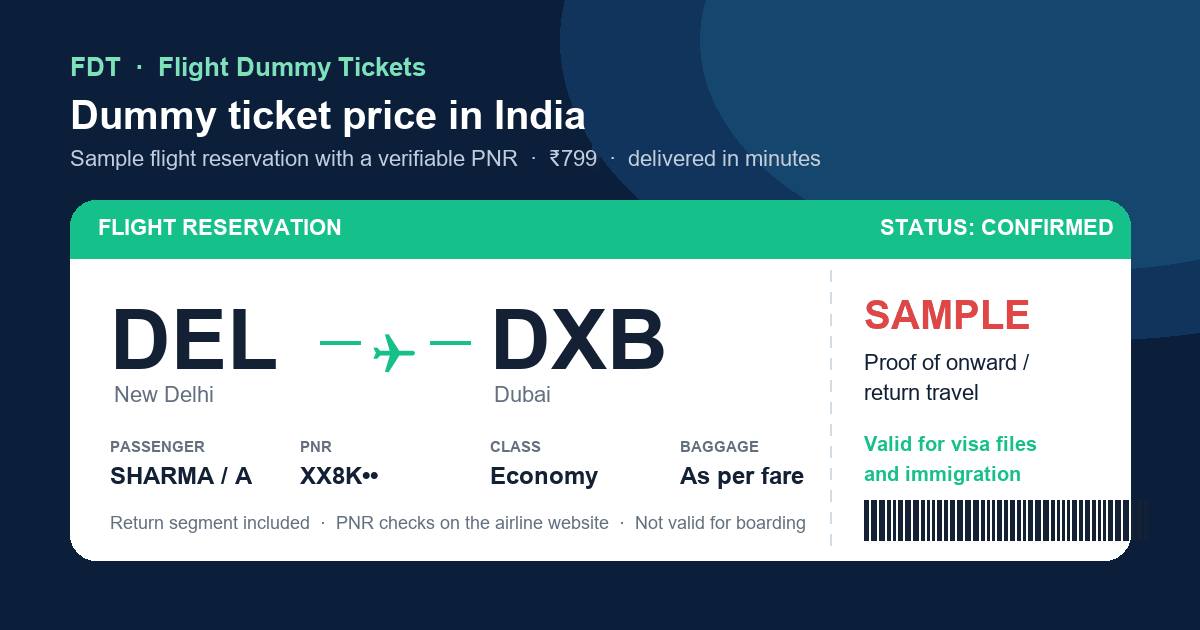
A dummy ticket in India costs ₹799 / $10 flat per passenger at FlightDummyTickets.com, the same price for One-Way, Return and Multi-City, with 5% off every booking and 10% off for three or more passengers. Across the wider Indian market, prices range from about ₹299 from the cheapest online sellers to ₹2,000–₹3,500 from premium agents, and travel agents in cities like Delhi, Mumbai and Chennai typically charge ₹500–₹1,500 as part of a visa-assistance package. The price you pay matters far less than what you get for it: a genuine reservation has a real PNR that verifies on the airline's website, a validity window of up to two weeks, and a provider who will correct errors and reissue if your appointment moves. A cheap PDF with an invented PNR is worthless at any price, and an expensive PDF with no verifiable PNR is worthless too. This guide explains the real price landscape in India, what drives the differences, the hidden charges to check before you pay, and how to judge value rather than price alone.
If you are applying from India, the price question is usually the first one you ask and the easiest one to get wrong, because the market is unregulated, the sellers range from established online platforms to a WhatsApp number with no business name, and the product itself is invisible until you verify it. A clear understanding of what a fair price looks like, and what the price does and does not buy, will save you money, time, and, in the worst case, a refused visa.
Key facts, FlightDummyTickets.com (FDT):
- Price: ₹799 / $10 flat per passenger, One-Way, Return and Multi-City all cost the same
- Delivery: about 10 minutes, PDF sent by email and WhatsApp, with a verified PNR
- Validity: up to 2 weeks (always check the expiry printed on your own reservation)
- Payment: Razorpay, UPI, cards and net banking accepted
- Discounts: 5% off every booking, 10% off for 3 or more passengers
- Support: support@flightdummytickets.com, WhatsApp +1 786 957 8117
- Track record: 20,000+ tickets delivered
- A dummy ticket is NOT a paid ticket, NOT for boarding, and does NOT guarantee a visa
Contents
- The FDT Price: Exactly What You Pay
- The Indian Market: Who Charges What
- City-Wise Rates: Delhi, Mumbai, Chennai, Bengaluru, Hyderabad, Kolkata
- Online Sellers vs Travel Agents vs Visa Consultants
- What Affects the Price: Six Factors
- One-Way vs Return vs Multi-City: Does the Price Change?
- Discounts: Family, Group and Repeat Bookings
- Hidden Charges: The Eight Fees to Check Before You Pay
- Too Cheap to Be True: The ₹299 Trap
- Too Expensive to Be Worth It: The ₹3,000 Trap
- How to Compare Quotes Like a Professional
- Paying Safely: UPI, Cards and What to Avoid
- What the Price Does Not Buy
- Frequently Asked Questions
1. The FDT Price: Exactly What You Pay
The price at FlightDummyTickets.com is deliberately simple: ₹799 / $10 flat per passenger. One-Way, Return and Multi-City all cost the same. There is no surcharge for a complex itinerary, no extra fee for a family booking, and no "express delivery" upsell, delivery in about ten minutes by email and WhatsApp is the standard service for every booking. Two discounts apply automatically: 5% off every booking, and 10% off for three or more passengers. The arithmetic is straightforward. A solo traveller pays ₹799, or about ₹759 after the 5% discount. Two travellers pay ₹1,598, or about ₹1,518 after 5%. Three travellers pay ₹2,397, or about ₹2,157 after the 10% discount. A family of four pays ₹3,196, or about ₹2,876 after the 10% discount. A group of six pays ₹4,794, or about ₹4,315 after discount.
That flatness is worth pausing on, because it is unusual in this market. Most travel pricing varies by route, date, airline and season, a Delhi–Paris flight costs more than a Delhi–Dubai flight, and a December flight costs more than a February one. A dummy ticket's price does not vary that way, because the product is not a seat. It is a reservation service, and the cost of creating a reservation does not depend on the destination. A provider who charges more for a "Europe" dummy ticket than for a "Dubai" one is charging for the label, not for a difference in cost or quality. The flat price is also what makes the product easy to budget: you know the cost before you start, and it does not change when you change the route.
Payment is through Razorpay, which accepts UPI, credit and debit cards, and net banking, the payment methods Indian applicants actually use. UPI is usually the fastest: approve the collect request on your phone and the payment confirms in seconds. Keep the payment confirmation and the order reference until your PDF arrives, so you can quote them to support if anything is delayed. Support is at support@flightdummytickets.com and on WhatsApp at +1 786 957 8117, and the service reports 20,000+ tickets delivered. If you want the step-by-step booking flow, it is in how to book dummy ticket online, and the complete guide to the product is the dummy ticket for visa complete guide blog.
2. The Indian Market: Who Charges What
The Indian dummy ticket market has four kinds of seller, and their prices reflect their costs and their business models rather than the quality of the reservation itself. The first is the online platform, a website that sells reservations directly, with an automated booking flow, online payment, and email and WhatsApp delivery. FDT is in this category, at ₹799 flat. Other online platforms charge anywhere from ₹499 to ₹1,500, with the variation usually reflecting their advertising spend and their support costs rather than the reservation. The second is the travel agent, a shop in a city market, often in Delhi's Connaught Place, Mumbai's Fort or Crawford Market, Chennai's T Nagar, or Bengaluru's Commercial Street, who makes a reservation as part of a wider service. Agents typically charge ₹500–₹1,500 for a standalone reservation, or include it in a visa-assistance package priced at ₹3,000–₹8,000 that also covers form filling, document checking and appointment booking.
The third kind of seller is the visa consultant, a firm that handles the whole application, from the form to the VFS appointment, and includes the dummy ticket in the package. Consultants rarely price the ticket separately; it is buried in a package fee of ₹5,000–₹15,000 or more, and the applicant often does not know what the ticket itself cost. The fourth is the informal seller, a WhatsApp number, a Telegram group, an Instagram page, with prices from ₹299 to ₹999, no business address, no website, and payment by personal UPI. This is where the fake-PNR problem lives, because there is no accountability and no way to verify the seller before you pay.
The price range across all four is wide: ₹299 at the bottom, ₹3,500 at the top for a standalone reservation, and much more when it is bundled into a package. The important insight is that the reservation itself costs the provider roughly the same whatever they charge you. The price differences reflect marketing, overheads, bundling and, in the worst cases, fraud, not the reservation. A ₹799 reservation from a transparent platform with a verifiable PNR is a better product than a ₹2,500 reservation from an agent who cannot explain verification, and a ₹299 reservation that does not verify is not a bargain at any price. Judge the seller on verifiability, validity and support, and use price only to choose between sellers who pass those tests.
3. City-Wise Rates: Delhi, Mumbai, Chennai, Bengaluru, Hyderabad, Kolkata
Prices vary by city, because rents, competition and the local visa market vary. Delhi has the largest and most competitive market: the VFS centres in the capital handle the highest volume of Schengen, UK and USA applications, and the travel agents around Connaught Place, Karol Bagh and Nehru Place compete fiercely. A standalone reservation from a Delhi agent typically costs ₹500–₹1,000, and some agents will make one for ₹400 if you are also buying insurance or a forex card from them. The competition keeps prices low, but it also means the market has more informal sellers, so verification matters more, not less.
Mumbai is slightly more expensive: agents in Fort, Andheri and Borivali typically charge ₹700–₹1,500 for a standalone reservation. The city's large Gujarati and Marathi travelling community generates high demand for Schengen and UK visas, and the agents who serve it often bundle the reservation with insurance and hotel bookings. Chennai's market, centred on T Nagar and Anna Nagar, runs ₹500–₹1,200, with a strong focus on UK and Canada applications and a large student-visa segment. Bengaluru, with its IT workforce travelling for business and conferences, runs ₹600–₹1,500, and agents in Koramangala and Indiranagar often bundle the reservation with a visa-assistance package. Hyderabad's market in Ameerpet and Begumpet runs ₹500–₹1,200, with heavy USA and Canada demand. Kolkata, centred on Park Street and Salt Lake, runs ₹500–₹1,000, and is generally the cheapest of the metros for a standalone reservation.
These are typical ranges, not fixed prices, and they change with demand, prices rise in the summer holiday season (April–June) and before Christmas, when VFS appointments are scarce and agents are busy. The online price of ₹799 does not vary by city or season, which is one reason online platforms are often cheaper than a city agent in a busy month. If an agent quotes you a price far above the local range, ₹2,500 in Kolkata, for example, ask what is included, and compare it with the online price before you agree. If an agent quotes far below the range, ask how the PNR can be verified, because a price below the cost of creating a real reservation is a warning sign. The country guides for the most common destinations, dummy ticket for Schengen visa, dummy ticket for UK visa, dummy ticket for USA B1/B2 visa, explain what the reservation needs to contain for each destination, which is the same whatever the city.
4. Online Sellers vs Travel Agents vs Visa Consultants
Each channel has a genuine advantage, and the right choice depends on what you need beyond the reservation. An online platform is the cheapest and fastest for a standalone reservation: you book in ten minutes, pay by UPI, and receive the PDF by email and WhatsApp. It is the right choice if you are comfortable assembling your own file and you only need the flight document. Its weakness is that there is no one sitting across a desk from you to check the rest of your file, and if you are a first-time applicant who needs help with the form, the insurance and the appointment, the platform alone will not provide it.
A travel agent is the right choice if you want a human being to look at your file. A good agent will check that your names match your passport, that your dates match your hotels, and that your insurance covers the trip, the checks that prevent most refusals. The agent's fee of ₹500–₹1,500 for the reservation is often part of a wider service, and the value is in the checking, not in the reservation itself. The weakness is variability: a good agent is worth the fee, and a careless one is worse than no agent, because a careless agent's confidence can stop you from checking the file yourself. Ask the agent how they verify the PNR, and verify it yourself anyway.
A visa consultant is the right choice if you want the whole application handled, form, documents, appointment, and follow-up, and you are willing to pay ₹5,000–₹15,000 for it. The reservation inside the package is a small part of the fee, and the value is in the end-to-end handling. The weakness is opacity: the package price hides the cost of each component, and you may not know whether the reservation is genuine until you verify it yourself. Always verify the PNR yourself, even when a consultant provides it. The consultant works for you, and the file is yours, the applicant signs the declaration, not the consultant.
The informal seller, the WhatsApp number, the Telegram group, has no genuine advantage beyond price, and the price advantage is usually illusory. A ₹299 reservation that does not verify is not cheaper than a ₹799 reservation that does; it is more expensive, because it costs you the visa. There is no circumstance in which an untraceable seller with no business address and no refund policy is the right choice for a document that goes into a government file. The risks are documented in free dummy ticket generator risks, and the legality of reservations generally is in is a dummy flight ticket legal for immigration understanding the guidelines.
5. What Affects the Price: Six Factors
Six factors explain almost all the price variation in the Indian market. The first is the channel: online platforms have lower overheads than a shop in Connaught Place, and they pass the saving on. The second is bundling: a reservation sold alone is cheaper than the same reservation buried in a ₹8,000 package, because the package price includes form filling, insurance commission and appointment assistance. The third is the validity window: a reservation held for two weeks costs the provider more, in system terms, than one held for 48 hours, because the seat is off the market for longer. Sellers who offer very short validity windows can charge less, but the product is worse, a 48-hour hold may lapse before your appointment. The fourth is the airline and route: some airlines' reservation systems are more expensive for agents to use, and some routes have higher hold costs, although the difference is small and a flat price is the honest way to handle it.
The fifth factor is urgency: a reservation needed today, for an appointment tomorrow, is sometimes priced higher by agents who know you have no time to shop around. The defence is to book three to seven days before the appointment, when you have time to compare and to verify. The sixth is the season: summer and Christmas demand pushes agent prices up, while online flat prices do not move. None of these factors changes what the reservation is, a hold in the airline's system with a real PNR, and none of them justifies a price above ₹1,500 for a standalone reservation, or a price below ₹400 that cannot be explained. If a quote falls outside that range, ask why, and judge the answer on verifiability rather than on the seller's confidence.
A seventh factor is sometimes claimed but is not real: the destination. Sellers who charge more for a "Schengen" dummy ticket than for a "Dubai" one, or more for a "USA" ticket than for a "Thailand" one, are charging for the label. The reservation costs the provider the same whatever the destination, and the PNR verifies the same way. A flat price across destinations is the honest model, and it is the model FDT uses: ₹799 whether you are flying to Paris, London, Toronto or Bangkok.
6. One-Way vs Return vs Multi-City: Does the Price Change?
At FDT, no: One-Way, Return and Multi-City all cost the same ₹799 flat per passenger. That is worth stating clearly, because in the wider market it is not always true. Some agents charge per segment, ₹500 for a one-way, ₹800 for a return, ₹1,200 for a multi-city, on the reasoning that more flights mean more work. The reasoning is weak: a multi-city reservation is a single PNR with several segments, and creating it takes a few minutes more than a return, not twice the effort. Other agents charge per passenger, which is fair, but then add a "multi-city fee" of ₹200–₹500 that has no basis in their costs.
The practical consequence for applicants is that a multi-city trip should not cost more than a simple return, and if a seller quotes you a higher price for a multi-city itinerary, ask why, and compare with the flat price. A Paris–Rome trip with three flights (Mumbai–Paris, Paris–Rome, Rome–Mumbai) is a single reservation and a single PNR, and it should be priced as one reservation. The same applies to a family booking: four passengers on one PNR is one reservation with four names, and the price should be four times the per-passenger rate, minus the group discount, at FDT, ₹3,196 before the 10% discount, or about ₹2,876 after it, not four times the rate plus a "family fee".
There is one case where a higher price is legitimate: a booking that requires two separate PNRs, because the group is too large for one reservation, or because the itinerary combines airlines that cannot be held on a single record. In that case the provider is genuinely creating two reservations, and charging for two is fair. Ask whether your booking is on one PNR or two, and check the PDF: a single PNR at the top means a single reservation, whatever the number of flights. The itinerary guidance for multi-city trips is in flight itinerary for visa application, and the timing rules are in dummy ticket validity how long.
7. Discounts: Family, Group and Repeat Bookings
Discounts in this market are simple, and FDT's are representative of the honest end of it: 5% off every booking, and 10% off for three or more passengers. The 5% is a standing discount on the flat price, ₹799 becomes about ₹759 for a solo traveller. The 10% applies to the whole booking when three or more passengers travel together, and it replaces the 5% rather than stacking on top of it. A family of three pays about ₹2,157 instead of ₹2,397. A family of four pays about ₹2,876 instead of ₹3,196. A group of ten colleagues travelling to a trade fair pays about ₹7,191 instead of ₹7,990.
Agents offer discounts too, usually in the form of a package deal: the reservation is free or discounted if you also buy insurance, forex, or a hotel booking from the same agent. These bundles can be good value, but they can also hide the real price of each component, a "free" reservation inside a ₹8,000 package is not free, it is priced into the package. Ask for the itemised price before you agree, and compare the total with the cost of buying each component separately online. If the bundle is genuinely cheaper, take it. If it is not, buy the components separately.
Repeat bookings are a smaller category: applicants who reapply after a refusal, or who travel twice a year, sometimes get a loyalty discount from an agent they know. Online platforms rarely offer loyalty pricing for a ₹799 product, because the margin is already thin, but they may offer a reissue at a reduced price if the appointment moves, ask before you pay, and get the answer in writing. The question to ask any seller about discounts is not "how much off" but "off what": a 50% discount on an inflated ₹2,000 price is worse than a flat ₹799 with 5% off. Compare the final price you will actually pay, not the size of the discount.
8. Hidden Charges: The Eight Fees to Check Before You Pay
Before you pay any seller, ask about eight potential charges, in writing, and keep the answer. One: a multi-city fee, at FDT there is none, and there should not be one anywhere, because a multi-city reservation is a single PNR. Two: a fee for adding a passenger after booking, a genuine addition requires a new or amended reservation, and the fair charge is the per-passenger rate, not a penalty. Three: a correction fee, if the provider misspelt your name, the correction should be free, because the error was theirs; if you gave the wrong spelling, a small fee may be fair, but it should be stated in advance. Four: an express delivery fee, delivery in about ten minutes is the standard at FDT, and a seller who charges extra for "express" delivery when standard delivery is already fast is selling you speed you already have.
Five: a reissue fee if your appointment moves, ask whether a fresh reservation on the same itinerary costs extra, and how much. Six: a verification fee, no seller should charge you to verify your own PNR, because verification is a two-minute check on the airline's website that you can do yourself; a seller who charges for it is monetising your caution. Seven: a "visa approval" or "embassy" fee, there is no such fee, embassies do not charge agents for verification, and any seller who claims otherwise is inventing a charge. Eight: a payment surcharge, a fee for paying by UPI or card, which at FDT does not exist, because Razorpay's processing is included in the price; some agents add 1–2% for card payments, and you should know about it before you pay, not after.
The pattern across all eight is the same: the honest seller states the price, states what is included, and states the exceptions in advance. The dishonest seller quotes a low headline price and adds fees afterwards, when you have already committed. A ₹499 headline price that becomes ₹1,100 after fees is not cheaper than a ₹799 flat price with no fees. Always ask for the total, in writing, before you pay, and compare totals, not headlines.
Book your dummy ticket, ₹799 flat
One-Way, Return or Multi-City, with a verified PNR. Delivered in about 10 minutes by email and WhatsApp.
Book Dummy Ticket, ₹799 WhatsApp Us9. Too Cheap to Be True: The ₹299 Trap
A reservation sold for ₹299, or given away free by a "generator", is cheap for a reason, and the reason is that the reservation usually does not exist. Creating a real reservation in an airline's system has a cost to the provider, access to the reservation system, the time to create and document the booking, and the risk of holding a seat. A price far below the market cannot cover those costs, so the seller covers them by not creating a reservation at all: they generate a PDF with an invented PNR, or they reuse a PNR from another booking, or they create a reservation and cancel it immediately after sending the PDF. The applicant receives a convincing document, files it, and discovers the problem only when an officer checks it, or never discovers it, and is refused for a reason they do not understand.
The economics are simple. If a genuine reservation costs the provider ₹300–₹500 to create and service, a ₹299 retail price leaves no margin, no support, and no business. A ₹799 price leaves a modest margin that pays for the platform, the payment processing, the support team, and the reissues. A ₹1,500 price leaves a larger margin that may pay for a shop and a human agent. A ₹299 price leaves nothing, and a business that makes nothing on a sale is not a business, it is a trap, or a lead generator for a more expensive service that will be sold to you later. The free generator is the extreme case: the product is free because you are the product, and the cost is paid in your visa record. The full account of the risks is in free dummy ticket generator risks, and the verification walkthrough that catches the trap is in how to verify dummy ticket PNR.
There is one legitimate exception: a reservation given free as part of a larger package, an agent who includes it when you buy insurance and forex, or a consultant who includes it in a full-service fee. In that case the reservation is not really free; its cost is inside the package price, and the provider can afford it because the package is profitable. The test is the same as always: verify the PNR. A free reservation that verifies is a genuine reservation. A ₹299 reservation that does not verify is a fake, whatever the price tag says.
10. Too Expensive to Be Worth It: The ₹3,000 Trap
At the other end of the market, some sellers charge ₹2,000–₹3,500 for a standalone reservation, usually under a label like "premium", "embassy-verified", or "guaranteed". None of those labels means anything. There is no premium reservation, a PNR either exists or it does not, and the airline's system does not have a premium tier for holds. There is no embassy verification service, embassies verify PNRs themselves, and they do not offer a paid verification channel to agents. And there is no guarantee, no document can guarantee a visa, and anyone who promises one is lying.
What the high price usually buys is a bundle of services you did not ask for and may not need: a cover letter template, a "visa consultation" that is a fifteen-minute phone call, a document checklist copied from the VFS website, or "priority support" that is the same email address everyone else uses. Some of those services have value for a first-time applicant, but they should be priced and sold separately, so you can decide whether you want them. A ₹3,000 reservation that includes a cover letter template is a ₹799 reservation plus a ₹2,200 template, and the template is available free from a dozen sources, including the guidance in this blog.
The high-price trap is more subtle than the low-price one, because the product is usually genuine, the PNR verifies, the reservation is real, and the applicant feels they have bought quality. They have bought a genuine reservation at four times the market price, plus services they did not need. The defence is the same as for the low-price trap: compare the final price with the flat ₹799, ask what is included, and verify the PNR yourself. A genuine reservation is a genuine reservation, and paying more for it does not make the embassy accept it more readily. The embassy checks the PNR, not the receipt. The comparison with a paid ticket, where the price difference is real and large, is in dummy ticket vs real ticket.
11. How to Compare Quotes Like a Professional
Comparing quotes is a skill, and it takes five minutes. Get three quotes: one from an online platform, one from a local agent, and one from any other source you are considering. For each, write down six things: the headline price, the total price including all fees, the validity window, whether multi-city costs extra, whether corrections and reissues cost extra, and how the PNR can be verified. Then compare the totals, not the headlines. A ₹499 quote with ₹400 of fees is ₹899. A ₹799 quote with no fees is ₹799. A ₹1,200 quote that includes a document check and a reissue is worth more than a ₹799 quote that charges ₹500 for a reissue, if you think you will need one.
Next, test the verification claim. Ask each seller, in writing: "How do I verify the PNR, and on which website?" A genuine seller will answer in one sentence: "On the airline's website, under Manage Booking, using the PNR and the surname." A seller who cannot answer, or who says verification is not possible, or who says the embassy never checks, has failed the test, whatever the price. Then test the validity claim: "How long is the reservation valid, and where is the expiry printed?" A genuine seller will give a number, up to two weeks at FDT, and point to the reservation itself. A seller who is vague about validity is selling a hold they cannot guarantee.
Finally, test the support claim. Email the seller a question before you pay, and see how quickly and how clearly they answer. A seller who answers in an hour with a specific answer is a seller who will answer when you have a problem the day before your appointment. A seller who does not answer, or who answers with a generic script, is a seller who will not be there when you need them. The price of the reservation is ₹799. The price of a seller who disappears the day before your VFS appointment is a missed appointment, a new VFS fee, and weeks of delay. Pay attention to support, because it is the part of the price you only notice when it is missing.
12. Paying Safely: UPI, Cards and What to Avoid
Pay by a traceable method, and keep the record. At FDT, payment is through Razorpay, which accepts UPI, credit and debit cards, and net banking, and which gives you a payment confirmation with a transaction reference. That reference is your proof of payment, and it is also your route to a dispute if the product is not delivered, Razorpay, your bank, and your card network all have dispute processes, and a transaction reference is what they ask for first. UPI is the most convenient method for most Indian applicants: approve the collect request, and the payment confirms in seconds. Cards work the same way, and net banking is the fallback if neither is available.
What to avoid: cash, with no receipt, to a person you met through WhatsApp, for a document you have not seen. Cash leaves no record, no dispute route, and no proof that you paid. A personal UPI ID, a phone number rather than a business payment link, is the digital equivalent of cash: it leaves a transfer record, but it is a transfer to a person, not a purchase from a business, and it is much harder to dispute. A payment link from a recognised gateway (Razorpay, PayU, Cashfree, Stripe) is the safe route, because the gateway is a regulated intermediary with a dispute process. If a seller only accepts cash or a personal UPI transfer, ask why, and consider whether the saving is worth the risk.
Also avoid paying the full amount before you have seen anything, if the seller offers a two-stage payment, a small amount to create the reservation and the balance on delivery of a verifiable PDF. That is a reasonable model, and it aligns the seller's incentive with yours: they are paid when the product is delivered and verified. If a seller demands full payment upfront and refuses to discuss a staged payment, that is not by itself a red flag, FDT charges upfront and delivers in ten minutes, which is also reasonable, but it is a reason to check the seller's track record and support channels before you pay. The booking walkthrough, including the payment step, is in how to book dummy ticket online.
13. What the Price Does Not Buy
It is worth stating plainly what ₹799 does not buy, because the misunderstanding causes more disappointment than the price itself. It does not buy a visa. No document can guarantee a visa, and the decision depends on your whole file, funds, ties, purpose, history, not on the flight document. A seller who promises a guaranteed visa for any price is lying, and the lie is the red flag, not the price.
It does not buy a seat. A dummy ticket is a reservation, not a paid ticket, and you cannot board a flight with it. After the visa is granted, you buy a real ticket, and that ticket costs whatever the airline charges on the day you buy it. The ₹799 is not a deposit on the fare, and it is not deducted from the ticket price. It is the price of the reservation service, and it is spent whether the visa is granted or refused.
It does not buy priority treatment at the embassy. There is no channel by which a dummy ticket seller can speed up a visa decision, and no embassy offers priority processing to agents who sell reservations. Processing times are set by the embassy and the volume of applications, and the only way to get a faster decision is to apply early and submit a complete, coherent file.
It does not buy a hotel booking, insurance, or a cover letter. Those are separate documents with separate costs, and a seller who bundles them without itemising the price is hiding the cost of each. Buy each component on its merits, compare the totals, and do not let a bundle obscure the price of the reservation itself.
What ₹799 does buy is a genuine, verifiable reservation, delivered in about ten minutes, with a validity of up to two weeks, and a support channel that answers when you have a question. That is a fair price for a real product, and it is the cheapest insurance in the whole visa file, cheaper than the VFS service charge, cheaper than the insurance premium, and incomparably cheaper than the cost of a refused visa. Judge it on those terms, and the price makes sense. If you ever doubt whether a quote is fair, return to the three tests on this page, the final total, the validity window, and the PNR on the airline's website, and let them decide for you.
14. Price vs Value: A Worked Comparison for Three Travellers
Numbers make the value question concrete, so here are three travellers and the full cost of their flight document in each scenario. First, Ananya from Chennai, a solo traveller applying for a Schengen tourist visa for a 10-day Paris trip. Dummy ticket at FDT: ₹799, less 5%, so about ₹759. Cheapest agent in T Nagar: ₹600–₹800, plus a trip to the agent's shop and an hour of her time. Premium online seller: ₹1,500. Cheapest non-refundable real ticket to Paris: about ₹42,000. Flexible real ticket: about ₹85,000. Visa fee: €90, roughly ₹8,500. VFS service charge: about ₹1,500–₹2,000. Insurance for 10 days: about ₹1,200–₹2,000. Ananya's total file cost with a dummy ticket is roughly ₹12,000–₹14,000, of which the flight document is ₹759, about 6% of the total. With the cheapest real ticket, her file cost jumps to about ₹54,000, and if the visa is refused she loses ₹42,000 instead of ₹759. The dummy ticket is not merely cheaper; it changes the risk profile of the whole application.
Second, the Desai family from Mumbai, two adults and two children, applying for UK visitor visas for a fortnight in London. Dummy tickets at FDT: four passengers at ₹799 is ₹3,196, less 10% for three or more passengers, so about ₹2,876. Agent quote in Andheri: ₹1,000 per person, ₹4,000 total, with no discount. Premium seller: ₹2,500 per person, ₹10,000 total. Cheapest non-refundable real tickets for four: about ₹1,80,000. Flexible real tickets for four: about ₹3,60,000. UK visa fees for four: over ₹45,000. The dummy tickets cost less than the VFS service charges for the family, and less than 1% of the flexible real tickets. If the visas are refused, the family loses ₹2,876 with dummy tickets, or ₹1,80,000 with non-refundable real tickets. For a family, the arithmetic is not close, and it is the reason family applicants should be the most careful about not overpaying for the flight document.
Third, a group of eight colleagues from Bengaluru travelling to a trade fair in Frankfurt. Dummy tickets at FDT: eight passengers at ₹799 is ₹6,392, less 10%, so about ₹5,753, roughly ₹719 per person. Agent quote: ₹800 per person, ₹6,400, with no group discount. Premium seller: ₹2,000 per person, ₹16,000. Cheapest real tickets for eight: about ₹3,20,000. Flexible: about ₹6,40,000. The group's employer is paying, and the finance team will ask for an itemised cost. A ₹5,753 line item for flight documentation is easy to approve; a ₹6,40,000 line item for flexible tickets before the visas are granted is not, and most finance teams would refuse it, which is why business travellers, whose employers are the most price-sensitive buyers of all, overwhelmingly use reservations for visa applications.
| Traveller | Dummy ticket (FDT) | Cheapest agent | Premium seller | Cheapest real ticket | Flexible real ticket |
|---|---|---|---|---|---|
| Solo, Paris | ~₹759 | ₹600–₹800 | ₹1,500 | ~₹42,000 | ~₹85,000 |
| Family of 4, London | ~₹2,876 | ~₹4,000 | ~₹10,000 | ~₹1,80,000 | ~₹3,60,000 |
| Group of 8, Frankfurt | ~₹5,753 | ~₹6,400 | ~₹16,000 | ~₹3,20,000 | ~₹6,40,000 |
| Loss if visa refused | ₹759–₹5,753 | Similar | Similar | Full fare | Cancellation charge ₹5,000–₹15,000 pp |
The lesson of all three cases is the same: the flight document is the cheapest part of the file when you use a reservation, and the most expensive part when you buy a ticket early. Spend the money where the decision is made, on a complete, coherent file, and keep the flight document cheap, verifiable and correct. That is the whole pricing strategy in one sentence.
A last word on negotiating, because it is a normal part of buying anything in India and applicants should not feel awkward about it. With an agent, the price is often negotiable, especially if you are buying several services together, a reservation, insurance, forex and hotel bookings from one shop. A reasonable negotiation is to ask for the reservation at the online flat price of ₹799, or for a discount on the package total, and to ask for the reissue and correction terms in writing as part of the deal. What you should not negotiate is verifiability: no discount is worth a PNR that does not verify, and no agent's assurance replaces your own two-minute check on the airline's website. With an online platform, the price is fixed, and the negotiation is unnecessary, the flat price is already the negotiated price, set low enough to be fair and high enough to sustain a genuine service. In both channels, the test is the same: the final total, the validity window, and the PNR on the airline's website. Get those three right and the price takes care of itself. Keep your payment receipt and the provider's written answers with your visa file, so that if a fee appears later that was not agreed, you have the record to challenge it, and so that, if you reapply, you know exactly what you paid last time and can compare the new quote against it without relying on memory.
Dummy ticket options compared
Use this when you are deciding between a free generator PDF, a fully paid ticket, and a verifiable reservation.
| Option | Airline-checkable PNR | Typical cost | Best for |
|---|---|---|---|
| Free PDF generator | No | ₹0 | Never for embassy/VFS upload |
| Fully paid ticket | Yes | Full airfare | When dates are locked and refundable |
| FDT verifiable dummy ticket | Yes | ₹799 / passenger | Visa file before dates are final |
Official sources to check before you apply
Always match your documents to the embassy or VFS checklist for your nationality. These are the primary references we used while writing this page:
Frequently Asked Questions
1. How much does a dummy ticket cost in India? At FlightDummyTickets.com it costs ₹799 / $10 flat per passenger, the same for One-Way, Return and Multi-City, with 5% off every booking and 10% off for 3+ passengers. Across the wider market, agents charge ₹500–₹1,500, online platforms ₹499–₹1,500, and premium sellers up to ₹2,000–₹3,500. The cheapest sellers advertise ₹299, but a price that low usually means the reservation does not exist. Judge on verifiability, not on price alone.
2. Is ₹799 a fair price for a dummy ticket? Yes. Creating a real reservation in an airline's system, documenting it, delivering it in ten minutes, and supporting corrections and reissues has a real cost, and ₹799 leaves a modest margin for that service. A price far below ₹400 cannot cover the cost of a genuine reservation, and a price far above ₹1,500 for a standalone reservation is charging for extras you may not need. Compare the total price including all fees, not the headline.
3. Do multi-city dummy tickets cost more? At FDT, no, One-Way, Return and Multi-City all cost the same ₹799 flat, because a multi-city itinerary is a single PNR with several segments. Some agents charge per segment or add a multi-city fee of ₹200–₹500, but there is no cost basis for it. If a seller quotes a higher price for a multi-city trip, ask why, and check whether the booking is on one PNR or two, two PNRs genuinely means two reservations.
4. Are there any hidden charges I should check? Yes, eight, listed in Section 8: a multi-city fee, a fee for adding a passenger, a correction fee, an express delivery fee, a reissue fee, a verification fee, a fake "embassy" fee, and a payment surcharge. Ask about all eight in writing before you pay. At FDT there are none of these: the price is flat, delivery in about ten minutes is standard, and corrections for provider errors are handled through support at support@flightdummytickets.com or WhatsApp +1 786 957 8117.
5. Why are some dummy tickets sold for ₹299? Because the reservation usually does not exist. A genuine reservation costs the provider ₹300–₹500 to create and service, so a ₹299 retail price leaves no margin for a real product. The seller is either generating a PDF with an invented PNR, reusing someone else's PNR, or creating a reservation and cancelling it after sending the PDF. The risks are in free dummy ticket generator risks. Verify the PNR on the airline's website before you submit anything.
6. Why do some sellers charge ₹2,000–₹3,500? Usually for a bundle of extras, a cover letter template, a "consultation", a checklist, or "priority support", sold under labels like "premium" or "embassy-verified" that mean nothing. There is no premium reservation and no embassy verification service. The PNR either exists or it does not. Compare the final price with the flat ₹799, ask what is included, and verify the PNR yourself using how to verify dummy ticket PNR.
7. How much does a dummy ticket cost for a family of four? At FDT, four passengers cost ₹3,196 before discount, or about ₹2,876 after the 10% discount for 3+ passengers. That is the whole cost for the family's flight document, against ₹1,40,000–₹4,80,000 for real tickets for the same family. A family booking is held under one PNR, and you should verify every passenger's name on the airline's website, not just the first.
8. What is the cheapest safe way to get a dummy ticket? Book from a transparent online platform with a flat price, a stated validity window, a traceable payment method, and a reachable support channel, and verify the PNR yourself on the airline's website the day the PDF arrives. At FDT that costs ₹799, or about ₹759 after the 5% discount. The cheapest safe price is not the lowest headline in the market; it is the lowest price from a seller who passes the verifiability, validity and support tests in Section 11.
9. Does the price vary by destination? At FDT, no, ₹799 flat whether you are flying to Paris, London, Toronto, Dubai or Bangkok, because the reservation costs the provider the same whatever the destination. Some sellers charge more for "Schengen" or "USA" tickets than for "Dubai" or "Thailand" ones, but there is no cost basis for the difference. The country guides, dummy ticket for Schengen visa, dummy ticket for UK visa, dummy ticket for France visa, dummy ticket for Germany visa, explain what the reservation must contain for each destination.
10. Can I get a refund if my visa is refused? There is nothing to refund, because you never paid for a seat, you paid ₹799 for the reservation service, and the service was delivered. That is the point: the loss on refusal is ₹799, against ₹35,000–₹60,000 for a non-refundable real ticket, or a ₹5,000–₹15,000 cancellation charge on a flexible one. The comparison is in dummy ticket vs real ticket.
11. How do I pay for a dummy ticket in India? At FDT, through Razorpay, UPI, credit and debit cards, and net banking. UPI is usually fastest. Keep the payment confirmation and the order reference until the PDF arrives. Avoid cash with no receipt, and avoid personal UPI transfers to an individual with no business name, because neither leaves a dispute route if the product is not delivered. The booking walkthrough is in how to book dummy ticket online.
12. Does a higher price mean the embassy will accept the dummy ticket more readily? No. The embassy checks the PNR, not the receipt, and it has no way of knowing what you paid. A ₹799 reservation that verifies is worth more than a ₹3,000 reservation that does not, and a ₹799 reservation that verifies is worth exactly the same as a ₹3,000 reservation that verifies. Spend the money on a genuine product from a transparent seller, verify the PNR yourself, and spend your remaining attention on the parts of the file that decide the outcome: funds, ties and purpose. The legality of reservations is in is a dummy flight ticket legal for immigration understanding the guidelines.
Ready to book?
Get your dummy ticket for ₹799 per passenger, with a verified PNR, in about 10 minutes.
Book Dummy Ticket, ₹799Outbound references: vfsglobal.com, official VFS Global site for visa fees and checklists; schengenvisainfo.com, Schengen visa rules and fees; mea.gov.in, Ministry of External Affairs, Government of India, for passport services and advisories.