The short answer first
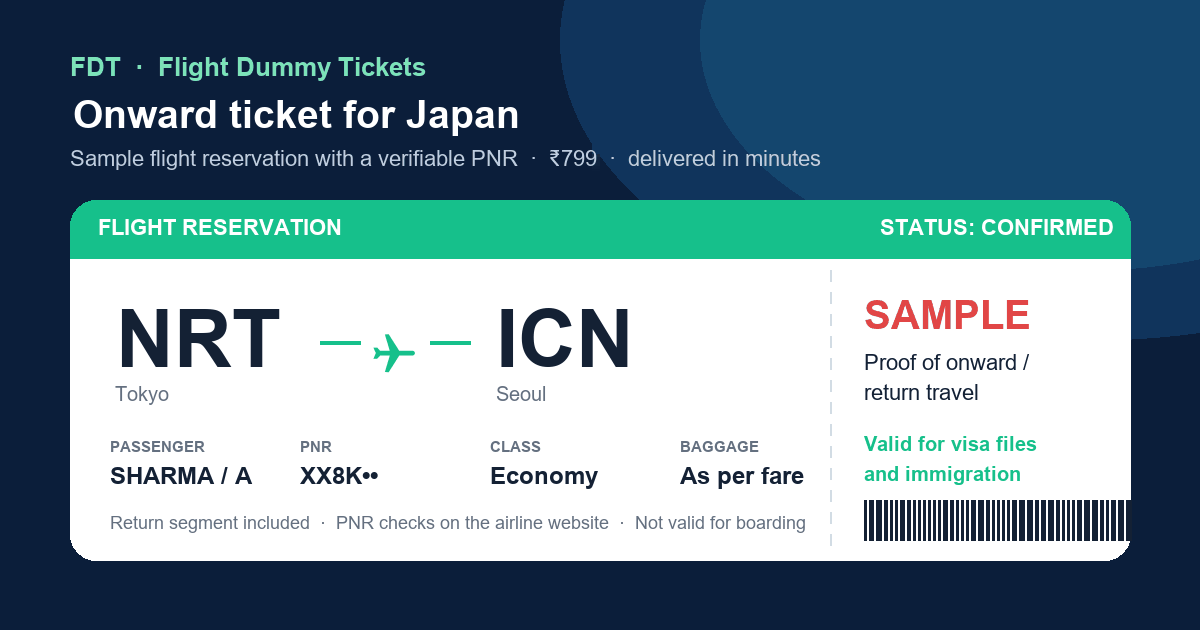
For Japan, an onward ticket means a flight reservation that shows you leaving Japan before your permitted stay ends, in your name, with a date, a destination outside Japan, and a booking reference an officer can check. Indian passport holders normally need a visa before travelling to Japan, and the Japanese embassy or VFS centre usually asks for a flight itinerary as part of that visa file. That itinerary is your onward proof at the visa stage. At the airport, the check happens twice: first at check-in in India, where the airline must be satisfied you can enter Japan and leave it again, and then at immigration at Narita or Haneda, where an officer may ask to see your return or onward flight. A dummy ticket is a temporary flight reservation for visa purposes. It is not a paid ticket, it is not for boarding, and it does not guarantee a visa. With FDT it costs ₹799 / $10 flat per passenger, the same for One-Way, Return and Multi-City, delivered in about 10 minutes as a PDF by email and WhatsApp with a verified PNR, valid for up to 2 weeks. Payment is through Razorpay, UPI, cards and net banking, with 5% off every booking and 10% off for 3 or more passengers. Support is at support@flightdummytickets.com and on WhatsApp at +1 786 957 8117. FDT has delivered 20,000+ tickets. Always check your own embassy or VFS checklist before you submit; if this guide and your checklist disagree, follow the checklist.
Key facts at a glance
| Question | Short answer |
|---|---|
| Do Indians need a visa for Japan? | Yes, in most cases. Apply before travel through the Japanese embassy or VFS. |
| What is an onward ticket for Japan? | A reservation showing you leaving Japan before your stay ends, in your name, with a verifiable PNR. |
| Does it have to be a paid ticket? | No. A flight reservation or itinerary is normally accepted for the visa. Do not buy a full ticket before approval. |
| Where is it checked? | At check-in in India, and at immigration at Narita or Haneda. |
| What must it show? | Your name as in your passport, departure date and airport, destination outside Japan, flight number and PNR. |
| FDT price | ₹799 / $10 flat per passenger, same for One-Way, Return and Multi-City. |
| FDT delivery | About 10 minutes, PDF by email and WhatsApp, verified PNR. |
| FDT validity | Up to 2 weeks. Check your own reservation expiry. |
| FDT payment | Razorpay (UPI, cards, net banking). 5% off every booking, 10% off for 3+ passengers. |
| FDT support | support@flightdummytickets.com, WhatsApp +1 786 957 8117. 20,000+ tickets delivered. |
| Does it guarantee a visa? | No. No ticket guarantees a visa. |
Contents
- Why Japan asks about your exit before it asks about your entry
- Narita versus Haneda: what actually happens at the immigration counter
- The airline check in India: the first gate you must pass
- What a Japan onward reservation must show, line by line
- Return to India or onward to a third country: which one Japan prefers
- The visa file: how the flight fits with hotels, bank statements and cover letter
- Dates that must agree: flights, hotels, insurance and your itinerary
- One-way arrivals, open-jaw trips and multi-city Japan itineraries
- Families, honeymoon couples and first-time travellers: extra care
- When your dates change: rebooking, expiry and fresh reservations
- The mistakes Indian applicants make most often with Japan
- A pre-flight checklist for Delhi, Mumbai and Bengaluru departures
- Frequently asked questions
1. Why Japan asks about your exit before it asks about your entry
Japan is orderly, and its immigration system is orderly too. The officer at Narita or Haneda is not trying to catch you out. They are working through a short list of questions, and one of them is always the same: when are you leaving, and how? That question matters more than it seems, because Japan gives most Indian visitors a short stay, commonly 15 or 30 days for a tourist visa, depending on what is granted, and it expects you to leave inside that period. A return flight is the simplest evidence that you have thought about the end of the trip, not just the beginning.
Think of it from the officer's side. They see a traveller from Mumbai who has a hotel in Tokyo for four nights, a JR Pass, and a plan to see Kyoto and Osaka. That is a good start. But if there is no flight out of Japan in the file, the officer has to ask where the trip ends. Does it end in Osaka? Does the traveller fly home from Osaka Kansai? Do they go on to Seoul and then home? Or do they have no plan at all? A reservation answers that in one line. Without it, the conversation becomes longer, and longer conversations at immigration are rarely good news.
The visa stage works the same way, only earlier. The Japanese embassy in Delhi, or the consulate in Mumbai, Chennai, Bengaluru or Kolkata, looks at your file before you fly. The flight itinerary is one of the documents that shows your trip has a shape: a start, a middle and an end. Officers are used to seeing reservations rather than paid tickets, because they know a sensible applicant does not spend ₹45,000 or ₹60,000 on a non-refundable flight before a visa is granted. A reservation is the expected document. What they do not expect is a screenshot of a flight search, a fare quote with no name on it, or a one-way booking with no explanation. Those are not reservations. They are intentions, and intentions do not prove anything.
There is also a practical reason the onward ticket matters in Japan more than in some other countries. Japan is an island nation. You cannot leave by bus or train to another country. Your exit is almost always a flight, or occasionally a ferry to South Korea or China, and the ferry is slow, infrequent and rarely the plan for a tourist. So the flight out is not one option among many. It is the exit. That is why officers look for it, and why airlines check it before you board in India. If you cannot show a way out of Japan, the airline knows you may be refused entry on arrival, and refused passengers are flown back at the airline's expense. The airline would rather check your documents in Delhi than pay to fly you back from Tokyo.
Asha from Pune learned this the useful way, before she travelled. She was planning a ten-day trip: Delhi to Tokyo on 12 March, Tokyo for four nights, Kyoto for three nights, Osaka for two nights, and Osaka to Delhi on 22 March. Her first draft of the file had a one-way reservation to Tokyo and a note in her cover letter saying she would book the return later, once her leave was confirmed. Her agent pointed out the problem in one sentence: the embassy would read that as a trip with no end. She changed the reservation to a return, Delhi to Tokyo on 12 March, Osaka Kansai to Delhi on 22 March, and the file suddenly made sense. Hotels, insurance and cover letter all ended on 22 March. The visa was granted without a query. The lesson is not that a one-way ticket is forbidden. It is that a tourist trip without a visible end looks unfinished, and unfinished files get questions.
2. Narita versus Haneda: what actually happens at the immigration counter
Narita and Haneda feel different, and travellers often ask which one is stricter. The honest answer is that the rules are the same at both airports, but the experience is different because the airports are built differently. Narita is further from central Tokyo, larger, and handles a huge number of international arrivals in waves. Haneda is closer to the city, more compact, and its international terminal is efficient but can feel crowded at peak hours. At both, you will go through the same sequence: you land, you walk to immigration, you present your passport and visa, you give fingerprints and a photograph, and you answer a few questions. The onward ticket question can come at any point in that sequence, and it can come in different forms.
At Narita, the immigration hall is wide and the queues move in lanes. An officer will look at your passport, your visa sticker, and your landing card or Visit Japan Web record. They may ask, in simple English, how long you are staying and when you are leaving. They may ask to see your return ticket. Have it ready, not buried in your email, not on a phone with 4% battery, but as a printed PDF or a PDF saved offline on your phone. Show the page with your name, the flight number, the date and the PNR. If the officer wants to check the PNR, they can. A verified PNR is what turns a piece of paper into a real booking, and our guide on how to verify dummy ticket PNR explains how to check it yourself before you travel, so you are never surprised at the counter.
At Haneda, the same questions are asked, but the setting is tighter. The international terminal is smaller, the walk from the gate is shorter, and the immigration counters are closer together. Travellers sometimes feel more watched at Haneda because there is less space to wait and less time to gather documents. That is exactly why you should have your return flight, your hotel confirmation for the first night, and your passport in one folder or one phone folder before you land. Do not wait until you are at the counter to search for a PDF. The officer will not wait while you scroll through six months of email.
One difference travellers notice is the landing card. Japan has moved towards Visit Japan Web, where you fill in your arrival details, customs declaration and immigration information online before you land, and show a QR code at the counter. If you use it, your departure date is part of what you enter, and it should match your flight reservation. If you write 22 March on the form and your flight is on 24 March, the officer will notice. If you write 22 March and your hotel ends on 21 March, the officer may ask about the missing night. Consistency is not a small detail in Japan. It is the whole system. Fill in the form from your reservation, not from memory.
Another practical point is the airport you leave from. Many Indian travellers fly into Tokyo and out of Osaka, or into Osaka and out of Tokyo. That is normal, and it is called an open-jaw trip. At immigration on arrival, the officer will see that your departure airport is different from your arrival airport. That is fine, as long as the reservation shows it clearly and your itinerary explains how you get from one city to the other, usually by Shinkansen, which is a normal part of a Japan trip. What is not fine is arriving at Narita with a return flight from Narita on a date that does not match your hotel bookings, or with no return flight at all and a vague plan to decide later. Japan rewards travellers who have a plan. Show the plan.
Families should note one more thing. If you are travelling with children, the officer may ask about the whole family, not just the person holding the documents. Each traveller should be named on the reservation, or the reservation should clearly cover the family booking. A reservation in the father's name only, with a wife and two children standing beside him, creates a question that is easy to avoid. Book the reservation for everyone travelling, with every name spelled exactly as in each passport. Our guide on dummy ticket for family group booking works through family bookings in detail.
3. The airline check in India: the first gate you must pass
Long before you reach Narita or Haneda, you will meet the first onward-ticket check, and it is the one most Indian travellers underestimate. It happens at the check-in counter in Delhi, Mumbai, Bengaluru or Chennai, and it is carried out by the airline, not by immigration. The airline's job is to make sure you will be allowed into Japan. If you are refused entry, the airline must fly you back, and it may be fined. So check-in staff are careful, and they are trained to ask for a return or onward ticket when the destination requires one.
The check is simple. The staff member looks at your passport and visa, then asks for your return flight. They may ask to see it on paper or on your phone. They may type the PNR into their system. They may ask when you are coming back. If you have a clear reservation, the conversation takes thirty seconds. If you do not, it can take thirty minutes, and it can end with you not being allowed to board. That is not a threat. It is the airline protecting itself, and it happens to travellers every week on busy routes.
Rohit from Hyderabad had a close call on this point. He was flying Delhi to Tokyo on a work trip that he had extended by a few days for sightseeing. His original booking was a return, but he had changed his return date by phone and the airline had sent him a new confirmation that he had not saved. At check-in, he could only show the old return date, which had already passed. The staff member was polite but firm: the document he was showing did not prove he was leaving Japan after this trip. Rohit found the new confirmation in his email after ten minutes of searching, and he was allowed to board, but he spent those ten minutes standing at a busy counter while the queue grew behind him. The lesson is to save the current reservation as a PDF, check that the date is the right one, and keep it where you can find it in seconds.
There are two other airline checks worth knowing. The first is the transit check. If you fly Delhi to Tokyo via Singapore, Bangkok, Hong Kong or Kuala Lumpur, the airline in India checks your documents for Japan, and the transit airport may also check that you have a ticket onwards from the transit point. Your reservation should show the whole journey, or at least the leg into Japan and the leg out of Japan, so that each check is answered by the same document. The second is the check for a different return airport. If you fly into Narita and out of Kansai, the check-in staff in India will see a return from a different airport. That is normal, but it is worth pointing it out yourself, "I am flying into Tokyo and out of Osaka", so the staff member does not think the return flight is missing. A short, clear sentence saves a long explanation.
Low-cost and full-service airlines check with the same care, but they check in different ways. A full-service airline may have more time at the counter and a supervisor nearby. A low-cost airline may have a shorter check-in window and less patience for a passenger who cannot produce a document quickly. Either way, the standard is the same. Have the PDF ready, have the PNR visible, and make sure the name on the reservation matches the name on the passport exactly. A middle name missing, a surname spelled differently, or a first name and surname swapped can turn a valid reservation into a question. Check the spelling before you leave home, not at the airport. The guide on dummy ticket PDF check before upload explains the line-by-line check to do before you travel.
Book your dummy ticket, ₹799 flat
One-Way, Return or Multi-City, with a verified PNR. Delivered in about 10 minutes by email and WhatsApp.
Book Dummy Ticket, ₹799 WhatsApp Us4. What a Japan onward reservation must show, line by line
A Japan onward reservation is not judged by how expensive it looks. It is judged by whether it contains the right information, in the right form, and whether that information can be checked. Go through this list before you submit a visa file or board a flight, and fix anything that is missing.
First, your full name, spelled exactly as in your passport. That means the same order, surname first or given name first, as the airline prints it, and the same spelling, including any double letters or extra vowels that Indian names often have. If your passport says "Ananya Sharma" and your reservation says "Ananya Sharmma", that is a mismatch. It may be a small one, but it is the kind of mismatch that makes an officer pause. If your passport has a middle name and your reservation does not, that is usually fine, but if your reservation has a different middle name, it is not. Check every letter.
Second, the departure date and the departure airport. The date must be inside your visa validity and inside your permitted stay, and it must be the date your itinerary says you leave. The airport must be a real airport in Japan, Narita (NRT), Haneda (HND), Kansai (KIX), Chubu Centrair (NGO), Fukuoka (FUK) or another international airport, and it must match the city where your trip ends. If your last hotel night is in Osaka and your flight leaves from Tokyo the next morning, you need to explain the journey between them, or change one of the two. A flight from an airport you cannot plausibly reach in time is a problem.
Third, the destination outside Japan. This is usually Delhi, Mumbai, Bengaluru or Chennai, but it can be a third country if your trip genuinely continues there. If you are flying Tokyo to Seoul, the destination is Seoul, and you should be able to show that you can enter South Korea, a visa, a K-ETA, or a visa-free entry that applies to you. An onward ticket to a country you cannot enter is not onward proof. It is a ticket to a refusal. If you are flying home to India, the destination is straightforward, and the officer knows you can enter your own country. That is one reason a return to India is the simplest onward proof for most Indian travellers.
Fourth, the flight number and the airline. The reservation should show the operating airline and the flight number, not just a route and a date. A document that says "Tokyo to Delhi, 22 March" without a flight number looks like a plan, not a booking. A document that says "Japan Airlines JL 123, Tokyo Haneda to Delhi, 22 March, PNR XXXXXX" looks like a booking, because it is one. If your flight is a codeshare, sold by one airline and operated by another, the PDF should make clear which airline to check the PNR with. If it does not, ask the provider before you submit.
Fifth, the PNR itself. This is the six-character booking reference, and it is the single most important line on the document. An officer or airline staff member can enter the PNR with your surname on the airline's website and see the booking. If the PNR does not work, the reservation does not work. Check it yourself on the day you receive the PDF, and check it again the day before your appointment or flight. The guide on what is a dummy ticket explains the difference between a reservation and a paid ticket, and why a verifiable PNR is what makes a reservation real.
Sixth, the status. The reservation should show as confirmed or held, not as waitlisted, cancelled or expired. A waitlisted booking is not a booking. A cancelled booking is worse than no booking, because it suggests you had a plan and lost it. An expired reservation is the most common problem with dummy tickets, because a reservation is valid for up to 2 weeks with FDT, and a visa appointment that is delayed by a month can easily outlast it. Check your own reservation expiry, and get a fresh reservation if the old one has expired before your appointment.
Seventh, the passenger count and the names of everyone travelling. If you are travelling as a couple or a family, every traveller should be named. If only one name is on the reservation, the other travellers have no onward proof. That is a common mistake for honeymoon couples, who book one reservation in one name and assume it covers both. It does not. Each person needs to be named, or each person needs their own reservation.
Eighth, the class and the fare type do not matter for the visa, but the document should look like a real airline document, not like a Word file with a flight typed into it. A proper PDF from a booking system, with the airline's header, the PNR, and the flight details in a table, is what officers expect. A home-made itinerary with no PNR is not what they expect, and it will be treated as such. If you are unsure whether your PDF looks right, compare it with the checklist in flight itinerary for visa application, which explains what a flight itinerary document should contain.
5. Return to India or onward to a third country: which one Japan prefers
For most Indian travellers, the answer is simple: a return to India is the cleanest onward proof for Japan. It is easy to understand, easy to check, and it matches the story of a tourist who lives in India and is visiting Japan for a holiday. The embassy knows you can enter India. The airline knows you can enter India. The immigration officer knows you can enter India. There is no second visa to check, no second country's rules to consider, and no question about whether you will be allowed into the next destination. That simplicity is valuable, and it is why most first-time applicants should choose a return to India, even if they are tempted by a more complicated route.
An onward ticket to a third country is different. It can be perfectly valid, but it has to be part of a real plan, and the plan has to be visible in the file. Suppose you are flying Delhi to Tokyo, then Tokyo to Seoul, then Seoul to Delhi. The Tokyo to Seoul flight is your onward travel from Japan. For that to work, you need to show that you can enter South Korea, a visa, a K-ETA, or a visa-free arrangement that applies to Indian passport holders in your situation, and you need to show the Seoul to Delhi flight as well, or at least explain where the trip ends. If you show only the Tokyo to Seoul flight, the officer sees you leaving Japan, but they do not see you going home. That is better than nothing, but it is not as strong as a complete chain.
There is a second kind of third-country onward that Indian travellers use often: flying home via another country. Delhi to Tokyo, then Tokyo to Singapore, then Singapore to Delhi, with a short stop in Singapore. In that case, the Tokyo to Singapore flight is the onward flight from Japan, and the Singapore to Delhi flight is the return home. Show both. The officer should be able to follow the chain without asking a question. If the Singapore stop is a few hours, it is a transit, and it needs no visa. If it is a few days, it is a visit, and you need to show that you can enter Singapore. The distinction matters, and the file should make it clear.
A third pattern is the multi-country Asia trip: India to Japan, Japan to Thailand, Thailand to Vietnam, Vietnam to India. These trips are popular, and they are fine, but they need a complete set of reservations. Each country's embassy or immigration will want to see the flight out of that country, and the Japanese embassy will want to see the flight out of Japan. That means you need a reservation for each leg, or a single multi-city reservation that shows all the legs. A single-city return to India does not prove you will leave Japan on the date you say you will, if your actual plan is to fly to Bangkok. Show the real plan. Officers are not impressed by a simple file that hides a complicated trip. They are impressed by a complicated file that is complete and consistent.
One warning is worth repeating. Do not book an onward ticket to a third country you have no intention of visiting, just because it is cheaper than a return to India. Officers see this often, and they know the signs: a flight to a country with no hotel booking, no visa, and no mention in the cover letter. A cheap onward ticket that does not fit the rest of the file is not a clever saving. It is a mismatch, and mismatches are what get files questioned. Book the flight that matches your real itinerary, even if it costs more. The visa is worth more than the saving.
The same logic applies to the return airport. If your trip ends in Osaka, fly home from Osaka Kansai. If it ends in Tokyo, fly home from Tokyo. Do not fly home from an airport that is far from your last hotel night just because the fare is lower, unless you can show how you get there in time. A flight from Fukuoka on the morning after your last night in Sapporo is not a plan. It is a geography problem. The officer will see it, and so will the airline. Choose the departure that fits the itinerary, and let the fare follow the plan, not the other way round.
6. The visa file: how the flight fits with hotels, bank statements and cover letter
A Japan visa file is a story told in documents, and the flight reservation is one chapter. On its own, it proves very little. With the other chapters, it proves a trip. The chapters are the cover letter, the itinerary, the hotel bookings, the bank statements, the employment or business proof, and the flight reservation. Each one should agree with the others on dates, places and names. When they agree, the file reads as a single, credible plan. When they disagree, the file reads as several plans that have been stapled together.
Start with the cover letter. It should be short, honest and specific. Say who you are, what you do, why you are going to Japan, when you are going, where you are staying, and when you are coming back. Mention the flight by date and route: "I will fly from Delhi to Tokyo on 12 March and return from Osaka to Delhi on 22 March." That sentence should match the reservation exactly. If the reservation says 22 March and the cover letter says 23 March, the officer has to decide which one is true. Do not make them decide. Write the cover letter from the reservation, not from memory, and check the dates twice.
The day-by-day itinerary is the next chapter. Japan expects a detailed itinerary, often on a specific form, showing what you will do each day: Tokyo on 12 March, arrival and hotel; Tokyo sightseeing on 13 March; travel to Kyoto on 16 March; Kyoto on 17 March; travel to Osaka on 20 March; Osaka on 21 March; departure on 22 March. Each day should have a place, an activity, and a hotel. The flight dates should be the first and last days of that itinerary. If the itinerary ends on 22 March and the flight leaves on 24 March, there are two days with no plan. If the itinerary ends on 24 March and the flight leaves on 22 March, the plan is impossible. Both are problems. Make the itinerary and the flight end on the same day.
Hotel bookings are the third chapter. You need a hotel for every night from arrival to the night before departure. If you arrive on 12 March and leave on 22 March, you need hotels for the nights of 12 to 21 March, ten nights. If you have hotels for nine nights, one night is missing. If you have hotels for eleven nights, one night is extra. Either way, the officer will ask. Book hotels that cover the whole trip, in the cities your itinerary mentions, and make sure the hotel names and dates are legible. A hotel booking in a city you never visit, or on dates that do not match the itinerary, is worse than no booking at all, because it suggests the itinerary is not real.
Bank statements are the fourth chapter, and they are about whether you can afford the trip, not about the flight. But they interact with the flight in one way: the cost of the trip should be plausible for your finances. If your bank balance is ₹80,000 and your trip costs ₹2,50,000, the officer will ask how you are paying for it. If your sponsor is paying, say so, and show the sponsor's documents. Do not book a flight that costs more than your trip budget and then claim the trip is cheap. The numbers should make sense together.
Employment proof is the fifth chapter. A letter from your employer saying you are on leave from 12 to 22 March, and that you will return to work on 24 March, supports the return flight on 22 March. A business owner should show business proof and a reason to return. A student should show a letter from their college. A retired person should show pension proof and family ties. In each case, the proof of ties to India is what makes the return flight believable. The flight says you plan to leave Japan. The employment letter says you have a reason to come back to India. Together, they answer the officer's hardest question.
Finally, the flight reservation itself should be submitted as a clear PDF, not as a screenshot, not as a forwarded email with the details buried in a thread, and not as a printout with half the page cut off. Print it, look at it, and ask yourself: can a stranger understand this in thirty seconds? If the answer is no, fix it before you submit. The guide on dummy ticket vs real ticket explains why a reservation is the right document, and proof of accommodation and onward travel explains how the hotel and flight documents work together.
7. Dates that must agree: flights, hotels, insurance and your itinerary
If there is one rule that explains most Japan visa delays, it is this: every date in your file must agree with every other date. The flight date, the hotel dates, the insurance dates, the itinerary dates, the leave dates and the cover letter dates are not separate. They are the same trip, described six times. If they disagree, the officer does not know which version to believe, and they will ask. Asking takes time, and time is what a visa appointment does not have.
Work through the dates in order. Your flight out of India is day one. Your hotel for night one starts that day. Your insurance starts that day, or the day before if you want a margin. Your itinerary starts that day. Your leave from work starts that day, or the day before if you travel overnight. Your return flight is the last day. Your last hotel night is the night before the return flight. Your insurance ends on the return date, or the day after if you want a margin. Your itinerary ends on the return date. Your leave ends on the return date, or the day after if you need a day to recover. Your cover letter says the same dates. That is the whole system. It is not complicated, but it requires checking.
The most common disagreement is the insurance. Many travellers buy insurance for the exact dates of the trip, which is fine, but some buy it for a shorter period to save money, or they buy it for the wrong dates because they typed the return date incorrectly. If your flight returns on 22 March and your insurance ends on 20 March, you are uninsured for two days, and the officer will notice. Buy insurance that covers the whole trip, with a day of margin if you can. It costs very little extra, and it removes a question.
The second most common disagreement is the hotel. Travellers book hotels for the cities they want to visit, but they forget a night in transit, or they book a hotel that starts a day after they arrive, or they book a hotel that ends a day before they leave. Each of those is a gap. A gap is a night with no place to sleep, and an officer will ask where you are sleeping that night. If the answer is "on a night bus" or "with a friend", say so in the itinerary and show the booking or the friend's details. Do not leave a gap unexplained.
The third disagreement is the flight itself. Travellers sometimes book a return flight for a date that is different from the date in their cover letter, because they changed the flight after writing the letter, or because they booked the flight first and wrote the letter from memory. The fix is simple: write the cover letter last, from the final reservation, and check the dates one more time before you submit. A cover letter is a short document. It takes two minutes to check. A visa query takes weeks.
Time zones cause a fourth disagreement, and it is specific to Japan. Japan is three and a half hours ahead of India. A flight that leaves Delhi at 11 pm on 12 March arrives in Tokyo in the morning on 13 March. Your hotel for the night of 12 March in Tokyo is therefore wrong, you arrive on 13 March, not 12 March. Your itinerary should start on 13 March in Japan, even though you left India on 12 March. Similarly, a flight that leaves Tokyo in the evening on 22 March arrives in Delhi late that night or early on 23 March. Your insurance should cover you until you are home, not just until you leave Tokyo. Check the arrival dates, not just the departure dates, and make sure the hotels and insurance follow the arrival dates in Japan.
A practical way to check is to make a one-page table for yourself, before you submit. Columns: date, city, hotel, flight, insurance. Rows: each day of the trip. Fill it in, and look for gaps, overlaps and mismatches. If a day has no hotel, fix it. If a day has two hotels, fix it. If the flight date is not the first or last row, fix it. That table is not for the embassy. It is for you. But if your file passes your own table, it will usually pass the embassy's check. Our guide on dummy ticket and hotel booking matching dates works through this matching in more detail.
8. One-way arrivals, open-jaw trips and multi-city Japan itineraries
Not every Japan trip is a simple return to the same airport. Many Indian travellers plan trips that are more interesting, and more complicated, and the onward ticket has to keep up with the complication. The three patterns to understand are one-way arrivals, open-jaw trips and multi-city itineraries.
A one-way arrival means you fly into Japan with no return flight on the same reservation. For a tourist, this is rarely a good idea, as explained earlier. But there are honest cases. A student going to Japan for a language course may not know when they will return. A worker with a job offer may be moving for a year or more. A person joining family may be emigrating. In those cases, a one-way ticket is honest, and it should be explained in the cover letter: "I am travelling on a student visa for a one-year course. I do not have a return date yet. I will book a return flight when my course dates are confirmed." That explanation, with the student visa and the course admission letter, is credible. What is not credible is a tourist who says the same thing. A tourist has a return date. Show it.
An open-jaw trip means you fly into one airport and out of another. Delhi to Tokyo, Osaka to Delhi is the classic example. It is normal, it is efficient, and it is what most experienced Japan travellers do, because it saves a long journey back to Tokyo. The onward proof for an open-jaw trip is the flight out of the second airport. Show it clearly, and explain the journey between the two cities in your itinerary. "12 March: arrive Tokyo. 16 March: Shinkansen to Kyoto. 20 March: travel to Osaka. 22 March: fly Osaka Kansai to Delhi." That is a complete story. The officer can follow it without a map. What the officer cannot follow is a file that says "arrive Tokyo, leave Tokyo" but shows hotels in Osaka on the last night. That file has a gap, and the gap is the journey from Osaka back to Tokyo that is never explained. Fill the gap, or change the departure airport to match the last city.
A multi-city itinerary is an open-jaw trip with more stops. Delhi to Tokyo, Tokyo to Kyoto by train, Kyoto to Osaka by train, Osaka to Delhi by air is a multi-city trip, even though only two flights are involved. A longer version might include a flight from Osaka to Sapporo, or from Tokyo to Fukuoka, and then a flight home from there. In that case, the reservation should show all the flights, or you should submit each flight reservation separately. The key is that the officer can see the whole journey, from arrival to departure, without having to guess the middle. If you have internal flights, show them. If you have train journeys, mention them in the itinerary. If you have a night bus, say so. The itinerary is where the middle of the trip lives. The flight reservation is where the beginning and the end live. Both need to be complete.
There is one more pattern that is becoming common: the Japan-plus-one trip. Delhi to Tokyo, Tokyo to Seoul, Seoul to Delhi, or Delhi to Osaka, Osaka to Taipei, Taipei to Delhi. These trips are attractive because they let you see two countries in one holiday. They are also more work, because you need a visa or entry permission for both countries, and you need onward proof for both. The Japanese embassy will want to see the flight out of Japan, to Seoul or Taipei. The Korean or Taiwanese authorities will want to see the flight out of their country, to Delhi. Show the whole chain, and make sure each link is a real, checkable reservation. A chain with a missing link is not a chain. It is a question.
If you are planning a complicated trip, book the reservation as a multi-city booking with FDT, so that all the legs are on one document. A multi-city reservation costs the same ₹799 / $10 flat per passenger as a one-way or return, and it shows the whole journey in one place. That is easier for the officer to read, easier for the airline to check, and easier for you to keep track of. Our guide on how to book dummy ticket online explains the booking steps, and dummy ticket price in India explains the flat price.
9. Families, honeymoon couples and first-time travellers: extra care
Families need one reservation that names everyone, with each name spelled as in each passport. Children need their own names on the booking, even if they are infants. Honeymoon couples should not submit a reservation in one name only; both partners need to be named, and the hotel bookings should be in both names where possible. First-time travellers should add extra clarity: a day-by-day itinerary, hotel confirmations for every night, and a cover letter that explains the trip in plain language. A first trip to Japan is exciting, but it is also the trip most likely to be questioned, because there is no travel history to support it. Make the file do the work that history cannot.
10. When your dates change: rebooking, expiry and fresh reservations
Dates change. Leave is postponed, a VFS appointment is delayed, a flight is rescheduled. When that happens, update the reservation and update the rest of the file to match. Do not submit an old reservation with new hotels, or a new reservation with an old cover letter. A reservation from FDT is valid for up to 2 weeks, so check your own reservation expiry before your appointment. If it has expired, get a fresh one for the new dates. That is normal, and a fresh reservation with a new PNR is a straightforward fix, as long as you notice the expiry before you submit. The guide on dummy ticket validity explains how validity works.
11. The mistakes Indian applicants make most often with Japan
The most common mistakes are a one-way ticket for a tourist trip, a return date that does not match the hotels, a PNR that does not verify, a name spelled differently from the passport, and a reservation that has expired before the appointment. Each one is easy to avoid with a ten-minute check. Print the PDF, check the name, check the dates, check the PNR on the airline website, and check that the hotels and insurance agree. Ten minutes at home saves weeks of waiting for a query. Also avoid screenshots, fare quotes, and home-made itineraries with no PNR. Officers see them every day, and they put them aside.
12. A pre-flight checklist for Delhi, Mumbai and Bengaluru departures
Before you leave home, check these items. Passport valid for six months beyond your trip, with a visa sticker. Printed return or onward PDF, with a verified PNR, in a folder you can reach in seconds. Hotel confirmation for the first night. Visit Japan Web QR code, with departure date matching your flight. Travel insurance covering the whole trip. A copy of your itinerary. Cash or a card that works in Japan. And a phone with the PDF saved offline, in case the airport Wi-Fi is slow. If every item is checked, the checks at check-in and at Narita or Haneda will be short and uneventful, which is exactly what you want.
Dummy ticket options compared
Use this when you are deciding between a free generator PDF, a fully paid ticket, and a verifiable reservation.
| Option | Airline-checkable PNR | Typical cost | Best for |
|---|---|---|---|
| Free PDF generator | No | ₹0 | Never for embassy/VFS upload |
| Fully paid ticket | Yes | Full airfare | When dates are locked and refundable |
| FDT verifiable dummy ticket | Yes | ₹799 / passenger | Visa file before dates are final |
Official sources to check before you apply
Always match your documents to the embassy or VFS checklist for your nationality. These are the primary references we used while writing this page:
13. Frequently asked questions
1. Do I need a return ticket for Japan if I am an Indian passport holder? Yes, in practice. Indians normally need a visa, and the visa file asks for a flight itinerary. At immigration, an officer may ask to see your return or onward flight. A return reservation to India is the simplest proof, and it should be in your name with a verifiable PNR.
2. Can I use a dummy ticket for a Japan visa? Yes. A dummy ticket is a temporary flight reservation for visa purposes, not a paid ticket and not for boarding. Embassies generally accept a reservation with a verified PNR. It does not guarantee a visa, and you should always check your own embassy or VFS checklist first.
3. What if I fly into Narita and out of Osaka? That is normal and is called an open-jaw trip. Show the flight out of Osaka Kansai clearly, and explain the journey from Tokyo to Osaka in your itinerary, usually by Shinkansen. The departure airport should match the city where your trip ends.
4. Will the airline in India check my onward ticket? Yes. Check-in staff check that you can enter Japan and leave it again, because the airline must fly you back if you are refused entry. Have the PDF ready with the PNR visible, and make sure the name matches your passport exactly.
5. What happens if my PNR does not verify? Do not submit it. Check the spelling of your surname, check you are on the right airline website, and wait an hour if the booking is very fresh. If it still does not verify, contact the provider for a fresh reservation. A PNR that does not work is a failed document.
6. How long is an FDT reservation valid? Up to 2 weeks. Check your own reservation expiry, and get a fresh reservation if your appointment or flight is delayed beyond it. A fresh reservation for the same dates, with a new PNR, is a normal fix.
7. Can I fly on to Seoul or Bangkok instead of returning to India? Yes, if that is your real plan. Show the flight out of Japan to that country, show that you can enter it, and show the flight home from there. An onward ticket to a country you cannot enter is not valid onward proof.
8. Do children need to be named on the onward ticket? Yes. Every traveller, including children and infants, should be named on the reservation, with the name spelled exactly as in each passport. A reservation in one parent's name only does not cover the rest of the family.
9. Is a flight search screenshot enough for Japan? No. A screenshot or fare quote shows that a flight exists, not that you have reserved a seat. You need a reservation with your name, flight number, dates and a verifiable PNR. That is what the embassy and the airline check.
10. Should my insurance dates match my flight dates? Yes. Insurance should cover the whole trip, from departure to return, with a day of margin if possible. If your flight returns on 22 March and your insurance ends on 20 March, you are uninsured for two days, and the officer will notice.
11. What is Visit Japan Web, and does it affect my onward ticket? Visit Japan Web lets you fill in arrival, immigration and customs details online before you land and show a QR code at the counter. Your departure date on the form should match your flight reservation exactly. Fill it in from the reservation, not from memory.
12. How much does an FDT reservation cost for Japan? ₹799 / $10 flat per passenger, the same for One-Way, Return and Multi-City. Delivery is about 10 minutes as a PDF by email and WhatsApp with a verified PNR. Payment is through Razorpay, with 5% off every booking and 10% off for 3 or more passengers.
Official sources to check: japan.travel, mofa.go.jp, immigration.go.jp
Ready to book?
Get your dummy ticket for ₹799 per passenger, with a verified PNR, in about 10 minutes.
Book Dummy Ticket, ₹799